TheJakartaPost
Please Update your browser
Your browser is out of date, and may not be compatible with our website. A list of the most popular web browsers can be found below.
Just click on the icons to get to the download page.


Popular Reads
Top Results
No results found. Please check your search term and try again
Can't find what you're looking for?
View all search results
Popular Reads
Top Results
No results found. Please check your search term and try again
Can't find what you're looking for?
View all search resultsCritically Bali: Contextualizing Balinese art
As an ongoing exhibition seems to imply, approaching an artwork or an exhibition doesn't necessarily require referring to their titles to fully appreciate the significance of either.
Change text size
Gift Premium Articles
to Anyone
Share the best of The Jakarta Post with friends, family, or colleagues. As a subscriber, you can gift 3 to 5 articles each month that anyone can read—no subscription needed!
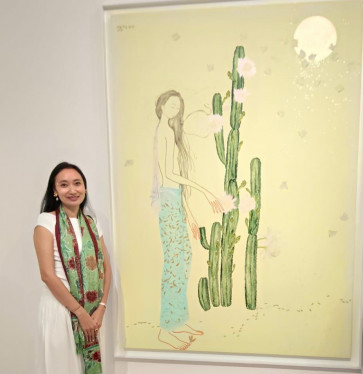
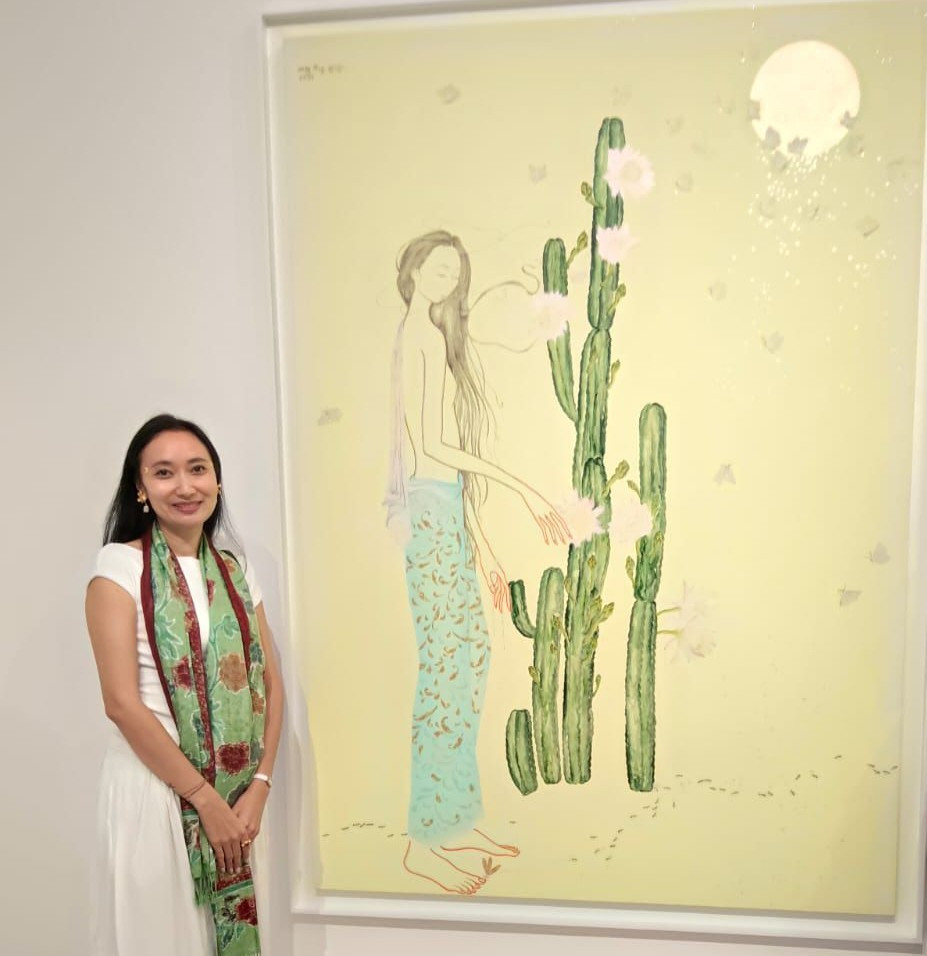 Balinese artist Satya Cipta stands in front of her work, ‘The Moon Falls Quietly in My Hands’, which is being exhibited in the Critically Bali group exhibition from March 7 to 29 at Gajah Gallery in Tanah Abang, Central Jakarta, in this undated photo. (Courtesy of/Franki Raden)
I
t has been a while since we realized that Balinese art normally stays within the context of Balinese society. Exhibitions and talk about Balinese art rarely occur in the context of our national art scene outside Bali. One reason may be that whenever renowned Balinese contemporary masters such as painters I Nyoman Masriadi and Satya Cipta or sculptor Nyoman Nuarta exhibit their works in a national or international context, they are introduced or discussed more as individual Indonesians than as Balinese artists.
Therefore, the ongoing Critically Bali art exhibition in Jakarta is interesting, as it makes us aware that the Balinese art scene can be considered to have its own historical trajectory, characteristics, aesthetics and paradigm within the context of the Indonesian art scene.
Of course, this rather pretentious title invites certain expectations from viewers. Looking at the artworks exhibited now at the Gajah Gallery, the phrase "critically Bali" does not quite align with the content of the show. Most of the artworks exhibited emphasize aesthetic issues rather than social or cultural critique, as shown by the works of I Gusti Nyoman Lempad, I Nyoman Tjokot, Dewa Putu Mokoh, Ashley Bickerton, Made Wianta, I Gusti Ayu Kadek Murniasih, Putu Sutawijaya, I Nyoman Sukari, Jemana Murti and the aforementioned Satya.
However, when approaching an artwork or an art exhibition, we don’t necessarily need to refer to the title of either an artwork or an exhibition to fully appreciate their significance. As the saying goes, “the author (artist and curator) is dead”.
As mentioned, the showing of these progressive, Balinese contemporary artworks within the Indonesian art scene is crucial.
Gajah Gallery’s exhibition, which opened on March 7 and ends on March 29, presents the historical development of Balinese modern art from the works of Lempad (b.1862), Tjokot (b.1886) and Mokoh (b.1943/36), known as the early masters of Balinese 20th-century art, to the works of prominent young artists such as Satya (b.1988) and Jemana (b.1997) through the works of older generation such as Wianta (b.1949), I Made Djirna (b.1957), Mangu Putra (b.1963), Muniarsih (b.1966), Sukari (b.1968), Sutawijaya (b.1970), Masriadi (b.1973) and Tantin Udiantara (b.1976).

In addition to these artists, Gajah Gallery also offers the works of the well-known Balinese expatriate Ashley Bickerton, who followed in the footsteps of Walter Spies and Antonio Blanco in the 1930s and 1950s. Instead of his famous paintings, the gallery is exhibiting two rarely shown sculptures by the American artist, Octopus Shark White and Double Helix Hammerhead.