TheJakartaPost
Please Update your browser
Your browser is out of date, and may not be compatible with our website. A list of the most popular web browsers can be found below.
Just click on the icons to get to the download page.


Popular Reads
Top Results
No results found. Please check your search term and try again
Can't find what you're looking for?
View all search results
Popular Reads
Top Results
No results found. Please check your search term and try again
Can't find what you're looking for?
View all search resultsSulawesi’s ancient art and the end of Europe’s prehistoric monopoly
New dating of cave art in southern Sulawesi places Indonesia at the very center of one of the most profound developments in human history: the emergence of symbolic and narrative thought.
Change text size
Gift Premium Articles
to Anyone
Share the best of The Jakarta Post with friends, family, or colleagues. As a subscriber, you can gift 3 to 5 articles each month that anyone can read—no subscription needed!
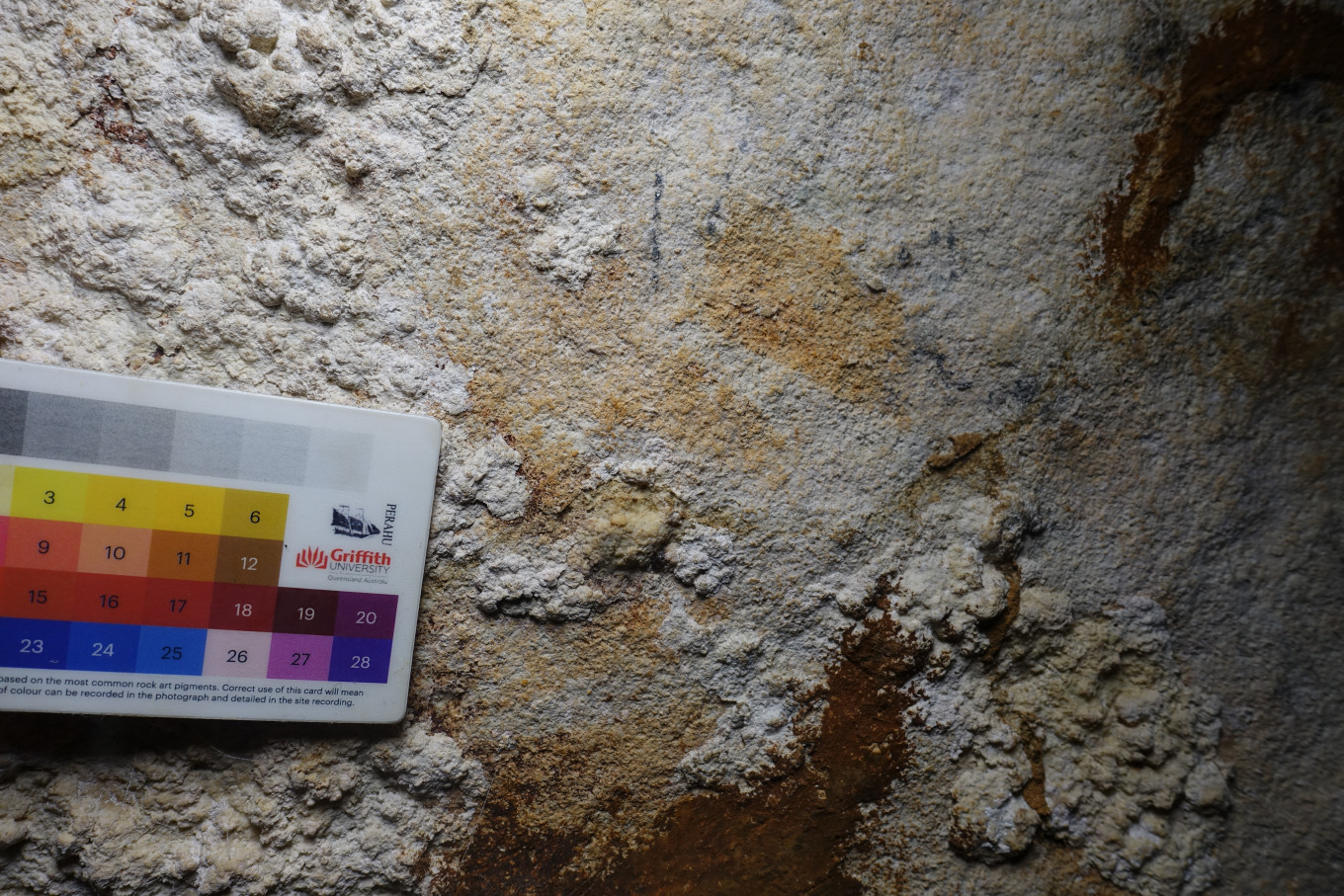 The faded hand stencil that is dated at least 67,800 years old is pointed at by a color palette chart held by an archaeologist during an expedition in May 2019 to the Liang Metanduno cave on Muna Island, Southeast Sulawesi. (Courtesy of Maxime Aubert/Courtesy of Maxime Aubert)
F
or generations, the story of human creativity has been told as a European tale. Textbooks and museum narratives have long pointed to the painted caves of France and Spain — Lascaux, Chauvet — as the birthplace of art, symbolism and the fully modern human mind.
The rest of the world, including Southeast Asia, appeared only as a late adopter, a peripheral stage onto which culture arrived after its supposed invention elsewhere. Recent discoveries in Sulawesi should put that narrative to rest.
New dating of cave art in southern Sulawesi — hand stencils now estimated to be at least 65,000–70,000 years old, alongside figurative hunting scenes over 50,000 years old — places Indonesia at the very center of one of the most profound developments in human history: the emergence of symbolic and narrative thought.
These are not crude markings or isolated experiments. They are deliberate, repeated and in some cases narrative representations of the world — images that suggest storytelling, shared meaning and social imagination. The implications are not incremental. They are foundational.
First, these findings dismantle the long-standing assumption that the “creative explosion” of humanity occurred in Ice Age Europe around 40,000 years ago. Instead, they point to a much earlier and more geographically dispersed emergence of symbolic behavior. Southeast Asia was not following Europe’s lead; it was participating in — if not helping define — the earliest chapters of human cultural expression.
Second, Sulawesi forces us to rethink Indonesia’s place in global history. Too often, Indonesian history is framed as beginning with early states, trade networks or the arrival of Islam. Prehistory is treated as a prelude, a deep past disconnected from the archipelago’s later significance. Yet these cave paintings suggest that the region was not merely inhabited early — it was a site of innovation. Wallacea, long understood as a corridor between Asia and Australia, now appears as a center of cultural production in its own right.

This matters not only for national pride, though it certainly invites it, but for how history is taught and understood. Indonesia is not simply a crossroads of civilizations; it is part of the foundation of civilization itself.