TheJakartaPost
Please Update your browser
Your browser is out of date, and may not be compatible with our website. A list of the most popular web browsers can be found below.
Just click on the icons to get to the download page.


Popular Reads
Top Results
No results found. Please check your search term and try again
Can't find what you're looking for?
View all search results
Popular Reads
Top Results
No results found. Please check your search term and try again
Can't find what you're looking for?
View all search resultsWhy vocational education struggles for respect in Indonesia
In Indonesia, the "respectable" child is too often imagined as the one who moves toward the desk, the title, the clean office, or the bureaucratically legible role.
Change text size
Gift Premium Articles
to Anyone
Share the best of The Jakarta Post with friends, family, or colleagues. As a subscriber, you can gift 3 to 5 articles each month that anyone can read—no subscription needed!
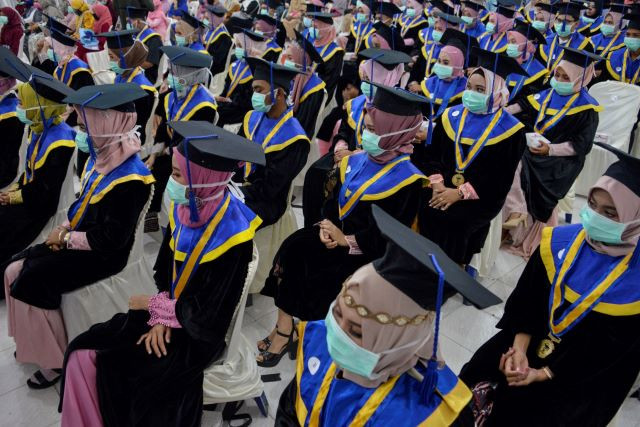 Happy ending: Students wearing face masks as a preventive measure against COVID-19 attend a pharmacy vocational school graduation ceremony on Sept. 24, 2020, in Banda Aceh, Aceh. (AFP/Chaideer Mahyuddin)
I
f Indonesia wants to become an innovation-driven country, it must stop treating the mind and hand as if one were noble and the other secondary. Yet, that remains the social code in many places. Vocational schools, polytechnics and other applied pathways are too often treated as lower in status than university routes, even though the country’s productive future depends on practical capability, technical mastery and disciplined, hands-on work.
As a teacher in a faculty of agriculture, I see this bias appear in a concrete form. Many students study food systems, land management and production, yet too few seem to imagine a future close to farming itself or the hard realities of applied agribusiness. Instead, aspirations often drift toward office-based, visibly cleaner and more socially admired work. This concern is not merely anecdotal; Indonesia’s farming demographic is aging rapidly, and research suggests that agriculture is still seen by many students as less promising, less prestigious and dictated by social status.
This is where the deeper cultural drivers begin to matter. One of them is gengsi (pride). Another is the preference for stable jobs. A third is the hunger for a title. In such a setting, the attraction of government offices, state-owned enterprises and other institutionally secure careers become more than an economic choice; they become a moral signal.
It says respectability. It says safety. It says the family will not be embarrassed. Once those signals become strong enough, many young people choose not the path that builds the greatest capability, but the path that carries the quickest legitimacy.
Yet, this hierarchy is neither natural nor intellectually serious. The example of the Massachusetts Institute of Technology (MIT) makes that clear. One of the world’s most respected institutions was built around mens et manus—mind and hand. That phrase is not ornamental Latin; it expresses a philosophy in which rigorous thought and practical execution belong together. It asserts that hands-on, technical, applied, "learning-by-doing" work is not beneath intellectual life.
On the contrary, it can sit at the very center of institutional prestige. Indonesia does not need to copy MIT mechanically, but it should stop acting as if a path becomes less honorable simply because it remains close to real work.

In Indonesia, however, the social code often runs the other way. The "respectable" child is too often imagined as the one who moves toward the desk, the title, the clean office, or the bureaucratically legible role. By contrast, the child who remains close to tools, machinery, fabrication, or technical execution is seen as aiming lower.