TheJakartaPost
Please Update your browser
Your browser is out of date, and may not be compatible with our website. A list of the most popular web browsers can be found below.
Just click on the icons to get to the download page.


Popular Reads
Top Results
No results found. Please check your search term and try again
Can't find what you're looking for?
View all search results
Popular Reads
Top Results
No results found. Please check your search term and try again
Can't find what you're looking for?
View all search resultsAI war has arrived, but the revolution isn’t done
The US-Israeli war against Iran is the first conflict in which the entire operational architecture ran at machine speed, with human commanders at the authorization margins rather than in the processing chain.
Change text size
Gift Premium Articles
to Anyone
Share the best of The Jakarta Post with friends, family, or colleagues. As a subscriber, you can gift 3 to 5 articles each month that anyone can read—no subscription needed!
 Set as preferred source
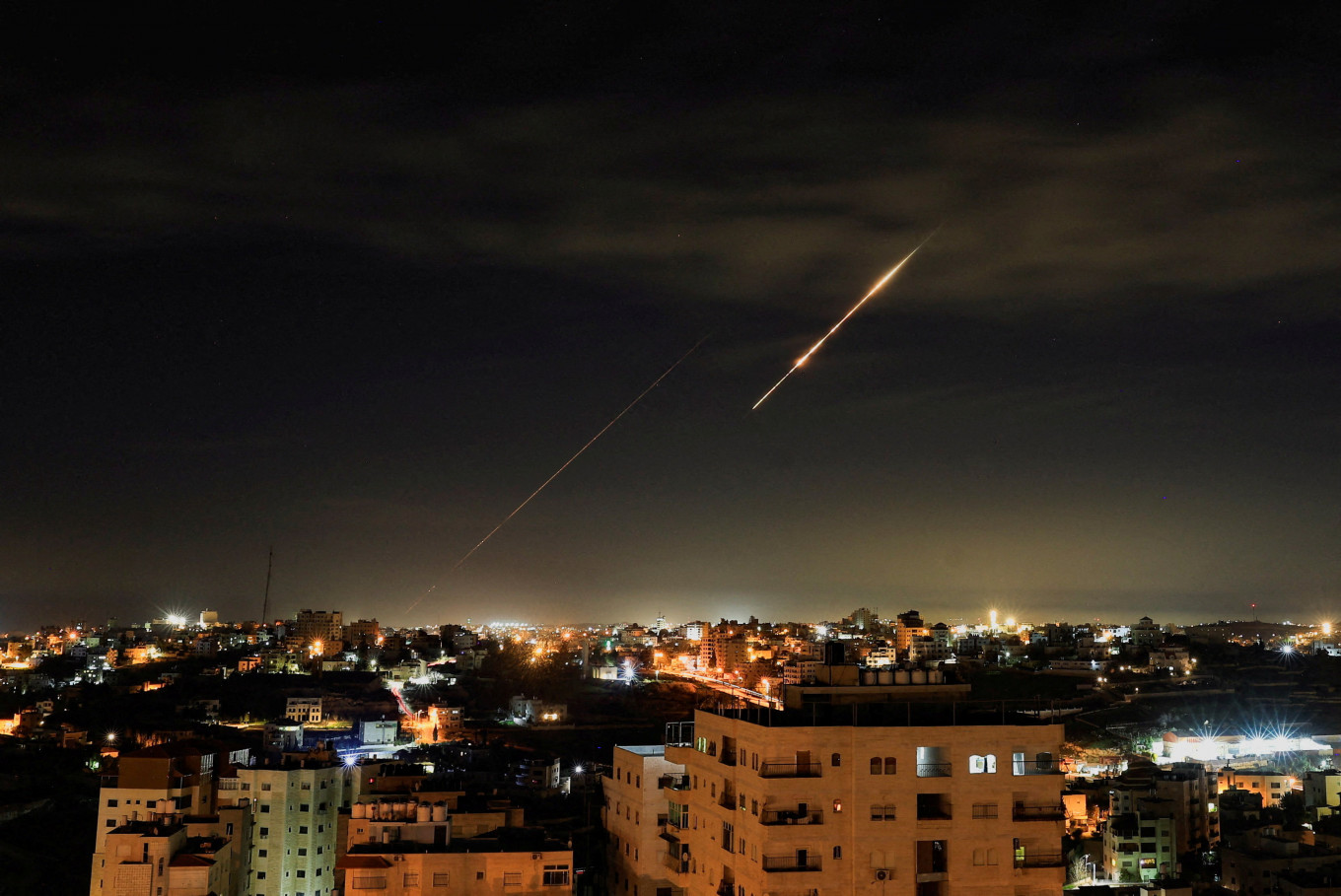 Iranian missiles fly toward Israel on March 13 amid the United States-Israeli war on Iran, as seen from Hebron, in the Israeli-occupied West Bank. (Reuters/Mussa Qawasma)
T
wo questions have shaped strategic debate since Feb. 28. Was Operation Epic Fury the first artificial intelligence war in history - a genuine break from every previous conflict - or merely the largest application of technologies militaries have been using for decades?
And if it was the first AI war, does it mark a revolution in military affairs (RMA), or simply a faster version of the precision warfare the world first saw in the Gulf War of 1991? Twenty-nine days of combat have produced precise answers to both. Yes, and yes - but the revolution is not yet complete.
The question whether this was the first AI war requires a precise answer, not a rhetorical one.
AI has been present in warfare for decades. GPS-guided bombs achieved precision warfare in 1991. The Predator drone used pattern recognition in 2001. Logistics algorithms have assisted inventory management since the 2010s. In every one of those cases, AI was a tool at a specific node of the military process. A human still received the intelligence, made the targeting decision, authorized the strike and assessed the damage. The human planning cycle remained the binding constraint on operational tempo.
Epic Fury dissolved that constraint entirely. Every node of the kill chain - finding targets, fixing their location, tracking their movement, assigning weapons, executing the strike and assessing damage - was run by interconnected AI systems operating simultaneously, without human processing between steps.
Project Maven analyzed satellite imagery across thirty-one provinces in under a minute per pass. JADC2 fused data from satellites, reconnaissance aircraft and drone infrared tracks and presented a targeting picture to the weapon-assignment algorithm in seconds - not the thirty minutes a human staff would require. AIDED matched weapons to targets in ninety seconds, accounting for hardness, weather, inventory and collateral damage probability simultaneously. LUCAS made its terminal targeting decision autonomously, identifying and striking its aim point through a neural network running on commercial hardware, with no human authorization in the final phase.

The result was a kill chain that closed itself. Maven's battle damage assessment fed automatically back into AIDED's reattack queue. Sites assessed as insufficiently damaged were automatically requeued for the next wave without human reentry. The loop ran continuously.