TheJakartaPost
Please Update your browser
Your browser is out of date, and may not be compatible with our website. A list of the most popular web browsers can be found below.
Just click on the icons to get to the download page.


Popular Reads
Top Results
No results found. Please check your search term and try again
Can't find what you're looking for?
View all search results
Popular Reads
Top Results
No results found. Please check your search term and try again
Can't find what you're looking for?
View all search resultsAnalysis: KDMP strains Village Funds, risks repeating KUD’s failures
Change text size
Gift Premium Articles
to Anyone
Share the best of The Jakarta Post with friends, family, or colleagues. As a subscriber, you can gift 3 to 5 articles each month that anyone can read—no subscription needed!
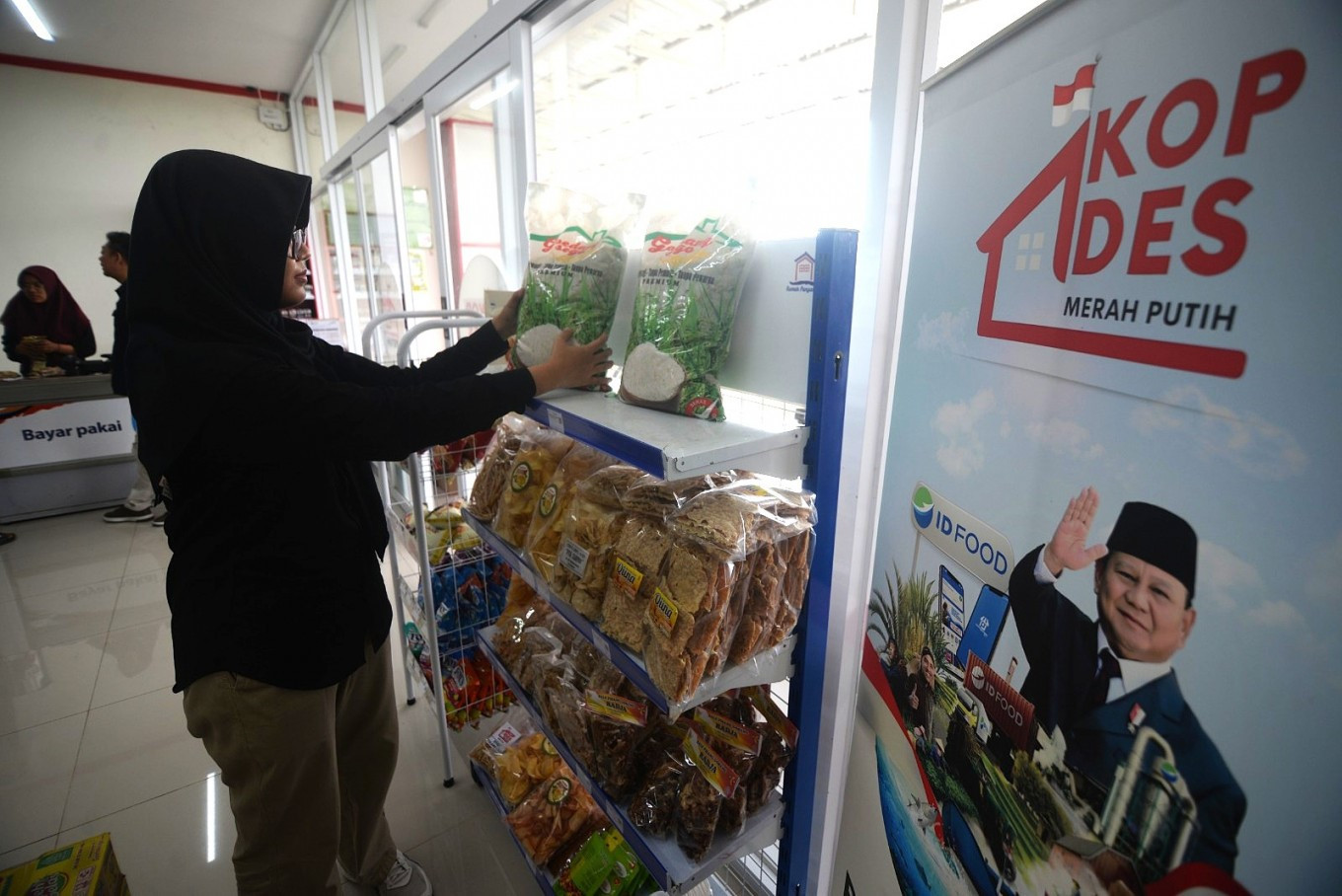 An employee arranges rice products for sale on Jan. 22, 2026, at an outlet under the Red and White Cooperatives program in Metuk Village, Boyolali Regency, Central Java. (Antara/Aloysius Jarot Nugroho)
T
he plan to finance President Prabowo Subianto’s flagship Red and White Village Cooperatives (KDMP) program remains controversial, as the burden is set to fall on state-owned banks and the Village Fund. The Finance Ministry has stipulated that state-owned banks, supported by government liquidity, will finance the establishment of KDMP units, while the Village Fund will be used for repayment. Without strong governance, the program risks repeating the failures of the New Order regime’s Village Unit Cooperatives (KUD).
The legal foundation for extensive state financial support to KDMP was laid out in Presidential Instruction (Inpres) No. 17/2025. The regulation authorizes the Finance Ministry to utilize the General Allocation Fund (DAU), Revenue-Sharing Fund (DBH) and the Village Fund to repay loans for constructing and equipping KDMP units. The ministry is also instructed to place funds in state-owned banks (Himbara) to finance PT Agrinas Pangan Nusantara, which is responsible for construction, with loans of up to Rp 3 billion (US$177,310) per unit and six-year maturity.
Financing for KDMP has effectively become highly dependent on the Village Fund, as stipulated in Finance Ministry Regulation (PMK) No. 7/2026. According to Article 7, of the total Village Fund allocation of Rp 60.57 trillion in the state budget, Rp 59.57 trillion is distributed based on existing formulas, while Rp 1 trillion is reserved for incentives for priority villages and KDMP support. Notably, Article 15 mandates that 58.03 percent of the formula-based allocation, equivalent to Rp 34.57 trillion, be directed toward supporting KDMP units. This leaves only around Rp 25 trillion to be directly distributed to and managed by more than 75,000 villages, or roughly Rp 300 million per village.
The Finance Ministry has clarified that loan repayments to Himbara banks for Red and White Subdistrict Cooperatives (KKMP) will be funded through DAU and DBH transfers to local administrations. It also emphasized that KDMP buildings and equipment will be legally owned by villages. To compensate for the reallocation of Village Fund resources, Inpres No. 17/2025 mandates that 20 percent of each cooperative’s profits (SHU) be distributed to the village for development purposes.
Meanwhile, Agrinas Pangan revealed that, of the Rp 200 trillion financing it secured from Himbara banks, around Rp 90 trillion has been spent. The funds have been used to construct 30,712 KMP cooperative stalls, although only 1,357 were operational as of Feb. 24. The company has also imported 105,000 pickup and six-wheel trucks from India.
The Finance Ministry has assured that the mass import of trucks, valued at Rp 24.66 trillion, will not add to the 2026 state budget deficit. Instead, it will manage repayment of Agrinas Pangan’s debt to Himbara banks through annual installments of Rp 40 trillion over six years, in line with the original financing scheme. A significant portion of this repayment is expected to rely on the Village Fund, alongside continued budgetary support for the KMP program.

Criticism over the truck imports has prompted Agrinas Pangan to state that it would comply with any directive from the government or the House of Representatives to cancel the orders. However, the company has already paid Rp 7.39 trillion in down payments for 1,000 trucks that have arrived in Indonesia.