The Jakarta Post
Please Update your browser
Your browser is out of date, and may not be compatible with our website. A list of the most popular web browsers can be found below.
Just click on the icons to get to the download page.


Popular Reads
Top Results
No results found. Please check your search term and try again
Can't find what you're looking for?
View all search results
Popular Reads
Top Results
No results found. Please check your search term and try again
Can't find what you're looking for?
View all search resultsThe strategic repositioning of the TNI: From ‘Reformasi’ to 2045
As we navigate a volatile global order, the military’s role is evolving from post-authoritarian survival to strategic maturation. To secure its democratic future by 2045, the country must bridge the gap between necessary military adaptation and the urgent need for a comprehensive national security framework.
Change text size
Gift Premium Articles
to Anyone
Share the best of The Jakarta Post with friends, family, or colleagues. As a subscriber, you can gift 3 to 5 articles each month that anyone can read—no subscription needed!
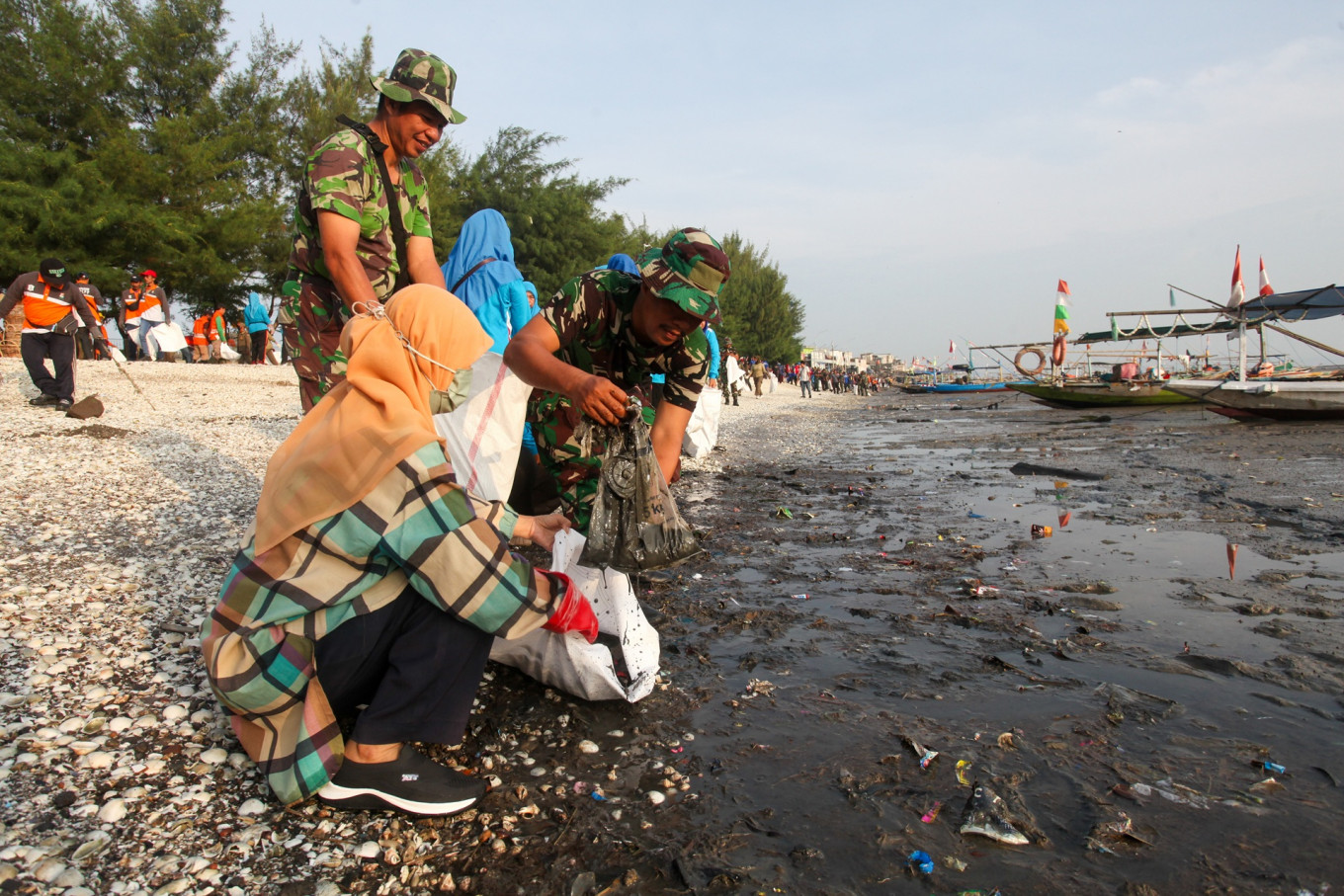 Indonesian Military (TNI) personnel and local residents collect trash on Feb. 15, 2026, during a community cleanup on Kenjeran Beach in Surabaya, East Java. The initiative had been launched by President Prabowo Subianto for regular cleanups by regional administrations and local communities. (Antara/Didik Suhartono)
I
ndonesia’s democratic consolidation has entered a decisive phase. More than two decades after the Reform Era movement reshaped the nation’s political landscape, the central issue is no longer whether the Indonesian Military (TNI) should withdraw from politics, that principle is now widely accepted. Instead, the question is how the military should be repositioned within a democratic state facing increasingly complex, multidimensional and evolving security challenges.
This question is neither trivial nor purely administrative; it sits at the nexus of democracy, statecraft and national survival. The answer will determine not only the trajectory of civil-military relations in Indonesia but also the country’s capacity to emerge as a credible, democratic regional power and simultaneously a high-income nation by 2045.
At its core, the repositioning of the TNI must not be interpreted as a deviation from the Reform Era agenda initiated in 1998. On the contrary, it represents its logical continuation and strategic maturation.
The normative foundation of TNI reform remains deeply influenced by the ideas of the late Agus Widjojo, former president Susilo Bambang Yudhoyono, and former defense minister Juwono Sudarsono, who passed away on Saturday. Their intellectual contributions during the transition period helped define a new path for civil-military relations. By dismantling the dwifungsi (dual function) doctrine, establishing clear civilian supremacy and transforming the TNI into a professional defense institution, they provided an indispensable blueprint for reform. These principles remain the bedrock of the modern state.
Yet, Indonesia today operates in a fundamentally different strategic environment from that of 1998. Twenty-eight years later, in 2026, Indonesia is no longer a fragile post-authoritarian state preoccupied with internal consolidation. It is an emerging middle power navigating geopolitical competition, technological disruption and an increasingly fragmented global order. The demands placed upon the state, and by extension its military, have expanded accordingly.
A significant structural challenge lies in Indonesia’s conceptual framework of security. The country continues to rely heavily on a state defense paradigm rooted in its post-colonial experience and revolutionary struggle. While effective in its time, this paradigm is no longer sufficient for contemporary threats.

Indonesia must move decisively toward a comprehensive national security framework. This shift is more than semantic; it represents a fundamental transformation in how the state protects its people and interests. As articulated by theorist Barry Buzan, modern security extends far beyond the military domain, encompassing political stability, economic resilience, societal cohesion and environmental sustainability.