The Jakarta Post
Please Update your browser
Your browser is out of date, and may not be compatible with our website. A list of the most popular web browsers can be found below.
Just click on the icons to get to the download page.


Popular Reads
Top Results
No results found. Please check your search term and try again
Can't find what you're looking for?
View all search results
Popular Reads
Top Results
No results found. Please check your search term and try again
Can't find what you're looking for?
View all search resultsFamiliar interventions, graver consequences in a region in churn
As the Middle East undergoes a violent restructuring, the failures of Western-led regime changes offer a grim warning. For India, navigating this "region in churn" requires a masterclass in strategic autonomy and the pursuit of a new regional compact.
Change text size
Gift Premium Articles
to Anyone
Share the best of The Jakarta Post with friends, family, or colleagues. As a subscriber, you can gift 3 to 5 articles each month that anyone can read—no subscription needed!
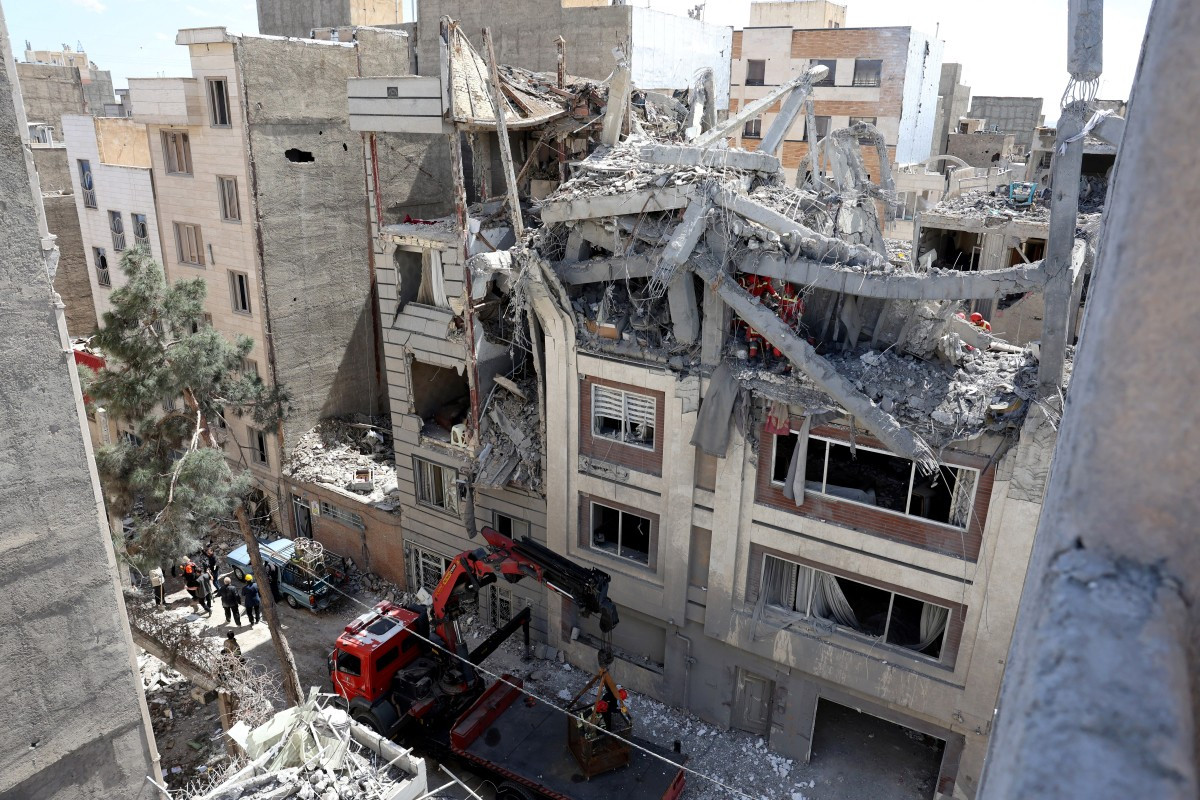 Firefighters look for victims and inspect damage on March 27 at a residential building in southern Tehran, Iran, nearly a month into the Middle East war. Israel's military said it carried out strikes on targets in Tehran early on March 27. Iran has been under heavy bombardment since Feb. 28, when the United States and Israel launched their campaign. (AFP/-)
I
n November 2012, then-National Security Advisor (NSA) Shivshankar Menon and I met United States President Barack Obama’s NSA, Tom Donilon, in Phnom Penh on the margins of the East Asia Summit. With the Arab Spring raging and Syria descending into internal conflict, Menon asked Donilon how Sunni fighters from Afghanistan and Pakistan were reaching Syria when land access across Iran and Iraq was denied. He warned that a destabilized Syria would become a far worse terrorist sanctuary than Afghanistan.
Donilon replied that the US would first remove Syrian President Bashar al-Assad, then deal with terrorism. Although Assad lasted until December 2024, a devastated Syria indeed became a sanctuary for virulent terrorist groups such as Islamic State and the Al-Nusra Front. This remains a stark example of the US sequential approach, which frequently disregards secondary consequences.
The US use of Islamist insurgency, facilitated by Pakistan, against the Soviet Union in 1980s Afghanistan transformed Pakistan into a hub of terrorism. This shifted the security environment in South Asia, leading to a lethal rise in terrorism in Jammu and Kashmir after the Soviets withdrew. Similarly, the US invasion of Afghanistan after 9/11 temporarily uprooted al-Qaeda and the Taliban, but the US then outsourced the Afghan project to Pakistan and turned its attention to Iraq, with disastrous results.
After invading Iraq on March 20, 2003, the US declared victory on May 1; however, it remained trapped by a massive insurgency for years. It eventually left Iraq in shambles and under increased Iranian influence. Furthermore, the elimination of Muammar Gaddafi in the wake of the Arab Spring fractured Libya and turned Africa’s Sahel region into an ungovernable theater of terrorism, coups and external competition.
The doctrine of regime change was formalized by the neoconservative Project for a New American Century in the late 1990s. Over time, even the pretense of consultation with the United Nations and allies has disappeared. This pattern is now on display in the war initiated by the US and Israel on Feb. 28.
In April 2025, I listened to a high-level bipartisan panel in Washington, DC, describe in chilling detail plans for a joint Israel-US attack on Iran—a script followed in the June 2025 attack and the most recent offensive. This intelligence failure is due less to incompetence than to human bias and predetermined decisions, amplified by a complicit media and willing partners. As the US discovered in Vietnam, the outcome of a contest between power and will, or technology and strategy, remains uncertain.

The US and Israel appear surprised and unsettled by the Iranian response. As the war approaches its one-month mark, it is undergoing vertical escalation and horizontal spread. An unsettled region that does more than just fuel the global economy now faces total collapse.