The Jakarta Post
Please Update your browser
Your browser is out of date, and may not be compatible with our website. A list of the most popular web browsers can be found below.
Just click on the icons to get to the download page.


Popular Reads
Top Results
No results found. Please check your search term and try again
Can't find what you're looking for?
View all search results
Popular Reads
Top Results
No results found. Please check your search term and try again
Can't find what you're looking for?
View all search resultsIndonesia’s fiscal policy stumbles amid the energy crisis
As global energy tensions mount, Indonesia’s fiscal future hangs in the balance between rigid populist spending and the urgent need for structural reform.
Change text size
Gift Premium Articles
to Anyone
Share the best of The Jakarta Post with friends, family, or colleagues. As a subscriber, you can gift 3 to 5 articles each month that anyone can read—no subscription needed!
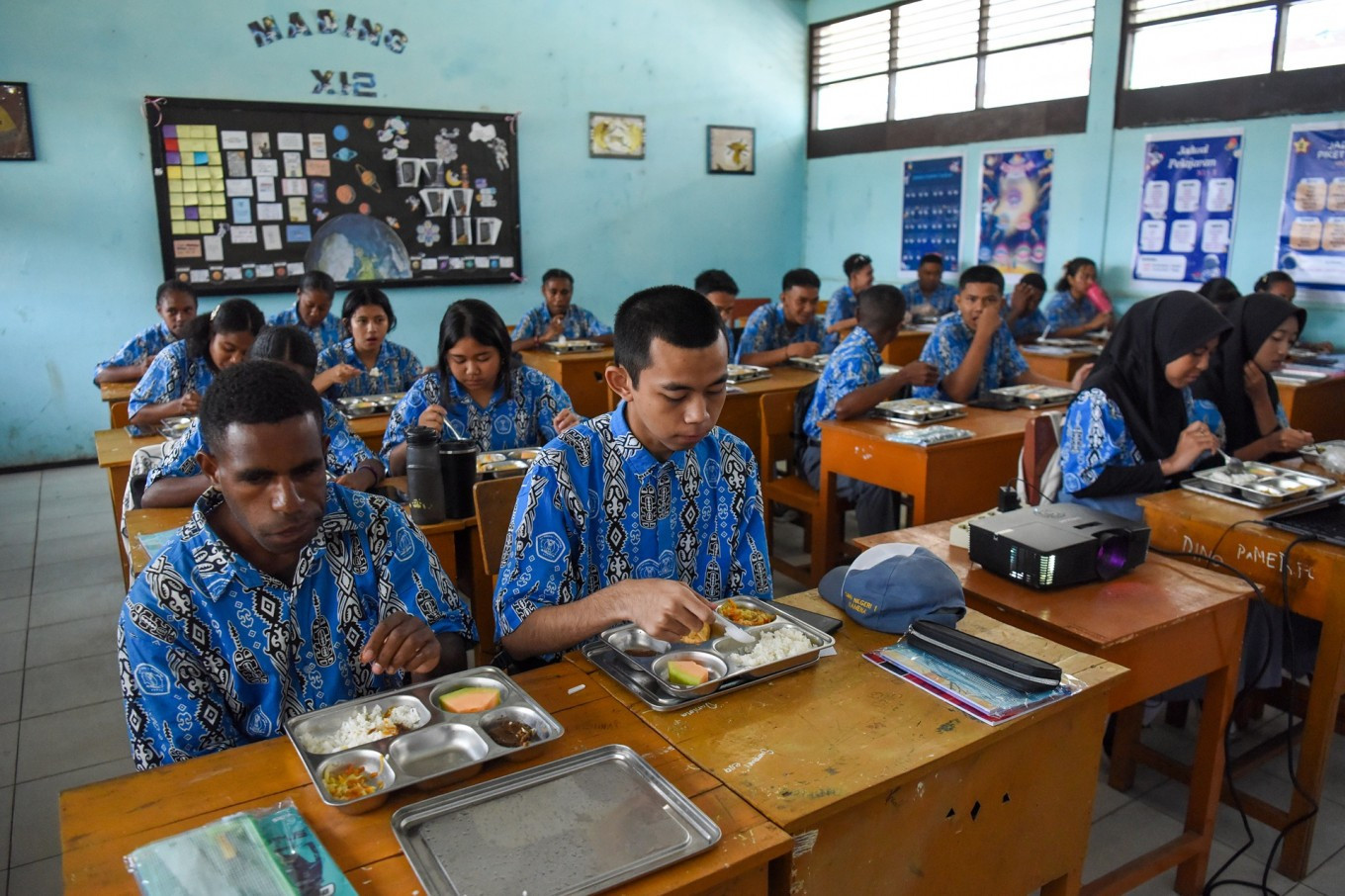 Students eat meals provided under the free nutritious meal program on Jan. 14 at SMAN 1 Wamena senior high school in Jayawijaya regency, when Vice President Gibran Rakabuming Raka inspected program rollout in Wamena district, Highland Papua. (Antara/Indrianto Eko Suwarso)
A
mid the escalation of the global energy crisis triggered by tensions in the Middle East, Indonesia is intensifying efficiency measures. These initiatives range from controlling fuel consumption through a work-from-home (WFH) scheme to cutting ministry and agency spending.
The potential savings of 10 percent from capital expenditure are projected to reach Rp 10.3 trillion (US$610 million). These savings reflect the government’s awareness of increasingly limited fiscal space amid global pressures; however, the fiscal pressures faced are far greater than the potential gains from administrative efficiency.
A simple calculation shows that every US$1 per barrel increase in oil prices above the baseline assumption of $70 per barrel will add Rp 10.3 trillion to energy subsidy spending. In an extreme scenario, oil prices could rise to the range of $100–120 per barrel. In this case, Celios projects the fiscal burden could reach Rp 515 trillion. Given Indonesia’s position as a net oil importer, this surge will directly pressure energy subsidies, compensation spendingand national logistics costs.
However, Indonesia’s fiscal policy direction shows a marked ambivalence. Fiscal discipline is often compromised in the face of costly populist programs. The government continues to push for the sustainability of the free nutritious meal program and the Red and White Rural Cooperatives as social buffers. Positioning free meals and rural cooperatives as social safety nets creates a contradiction with crisis logic in budget prioritization.
The universal nature of free meals and the uniformly designed village cooperatives have blurred priorities in vulnerability-based interventions. Expensive and permanent universal programs create budget rigidity and reduce fiscal flexibility.
The government’s stumbling response to the crisis is evident in its inability to distinguish between protective and promotive interventions. Direct cash assistance and targeted subsidies are protective instruments designed to cushion shocks in the short term. In contrast, free and rural cooperatives are projected to serve long-term promotive functions. Equating the two simplistically obscures the hierarchy within the mandate of social protection.

An important discourse in fiscal incidence and the effectiveness of social spending developed by Nora Lustig explains that when a country’s fiscal capacity is limited, expanding program coverage often comes at the expense of benefit depth. As a result, programs can become regressive and ineffective in protecting vulnerable groups from economic shocks. This approach also contradicts the principle of countercyclical fiscal policy as conceptualized by Olivier Blanchard, which requires fiscal responses during crises to be temporary, measured, and highly impactful.