The Jakarta Post
Please Update your browser
Your browser is out of date, and may not be compatible with our website. A list of the most popular web browsers can be found below.
Just click on the icons to get to the download page.


Popular Reads
Top Results
No results found. Please check your search term and try again
Can't find what you're looking for?
View all search results
Popular Reads
Top Results
No results found. Please check your search term and try again
Can't find what you're looking for?
View all search resultsAnalysis: Oil shock accelerates EV push as RI rethinks national car ambitions
Change text size
Gift Premium Articles
to Anyone
Share the best of The Jakarta Post with friends, family, or colleagues. As a subscriber, you can gift 3 to 5 articles each month that anyone can read—no subscription needed!
 Set as preferred source
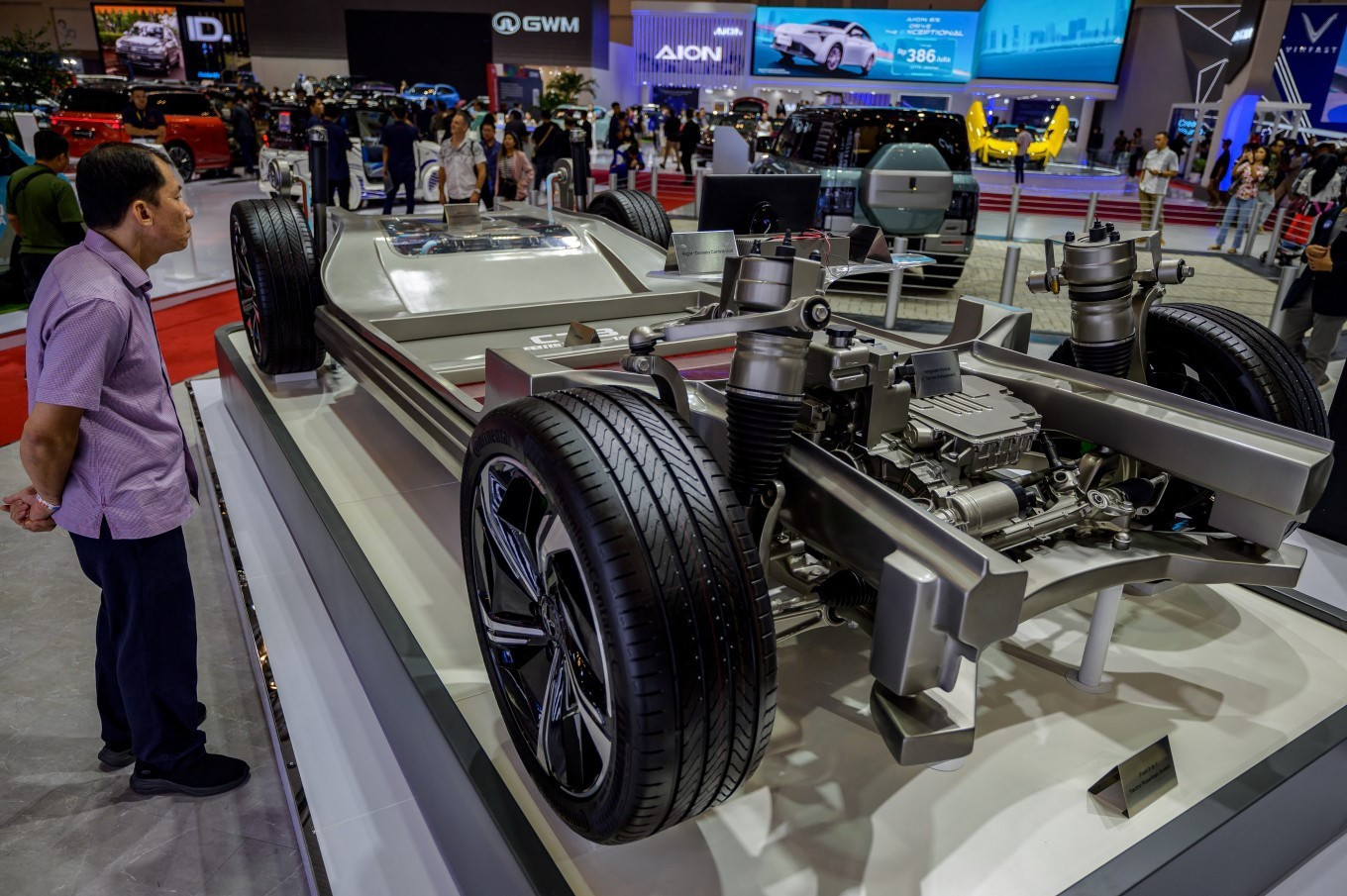 A man stands next to the chassis of an electric vehicle on July 18 at the Gaikindo Indonesia International Auto Show (GIIAS) 2024, which ran until July 28 at the Indonesia Convention Exhibition in Tangerang, Banten. (AFP/Bay Ismoyo)
S
urging global oil prices and tightening domestic fuel supplies have thrust Indonesia’s long-running electrification agenda back into the spotlight. Policymakers are increasingly portraying the shift, especially in the motorcycle sector, as the most practical and immediate way to curb fuel consumption. As part of this, the government is raising targets for its electric motorcycle conversion program, aiming to gradually electrify more than 120 million gasoline-powered motorcycles nationwide.
Energy and Mineral Resources Minister Bahlil Lahadalia explains that the government plans to significantly accelerate the fuel-to-electric motorcycle conversion program, also known as the retrofit program, to approximately 6 million units per year, a sharp increase from the current annual target of about 200,000 units. The expansion, he noted, is supported by advances in conversion technology that make large-scale implementation more feasible.
To support the accelerated rollout, the government has established a dedicated energy transition task force to coordinate implementation across ministries and agencies. The task force is expected to speed up the conversion of Indonesia’s conventional motorcycle fleet, which is estimated at around 120 million units.
The urgency behind this policy shift is underscored by the severity of the current fuel situation. Global oil prices have surged above US$100 per barrel, driven by the United States-Israeli war with Iran. This has prompted the government to consider demand-side measures to contain consumption and ease supply pressures.
Electrifying motorcycles, which remain the dominant mode of transport in Indonesia, is one of the key measures under consideration. At the same time, the government is also exploring more aggressive steps, including the possible reintroduction of nationwide work from home (WFH) arrangements to temporarily reduce fuel demand.
The oil shock has also revived scrutiny of earlier initiatives such as the Agrinas program, which aimed to import trucks and other vehicles to support the rollout of Red and White Cooperatives (KMP) across regions. Conceived prior to the recent spike in oil prices, the KMP program was designed to strengthen logistics and distribution networks at the grassroots level, with plans involving large-scale procurement of vehicles to support cooperative activities nationwide. In the current context of elevated fuel costs, however, the program’s reliance on conventional vehicles raises new questions about its economic and energy efficiency.

The situation also casts uncertainty over other automotive ambitions, including the long-discussed national car (Mobnas) initiative. While the project has been framed as part of Indonesia’s industrial and technological advancement, its direction remains unclear, particularly as the government has yet to specify whether the vehicle will be developed as an electric model in line with its broader energy transition goals or continue to rely on conventional internal combustion engine technology.