The Jakarta Post
Please Update your browser
Your browser is out of date, and may not be compatible with our website. A list of the most popular web browsers can be found below.
Just click on the icons to get to the download page.


Popular Reads
Top Results
No results found. Please check your search term and try again
Can't find what you're looking for?
View all search results
Popular Reads
Top Results
No results found. Please check your search term and try again
Can't find what you're looking for?
View all search resultsWhy Jakarta ranks 71st?: A case for a non-aligned cities index
Jakarta is more than a 71st-place ranking; it is a rising laboratory for a new kind of global city built on social resilience and kampung innovation. By championing a "Non-Aligned Cities Index," Jakarta can stop chasing Western ideals and start leading an urban future defined by the Global South.
Change text size
Gift Premium Articles
to Anyone
Share the best of The Jakarta Post with friends, family, or colleagues. As a subscriber, you can gift 3 to 5 articles each month that anyone can read—no subscription needed!
 Set as preferred source
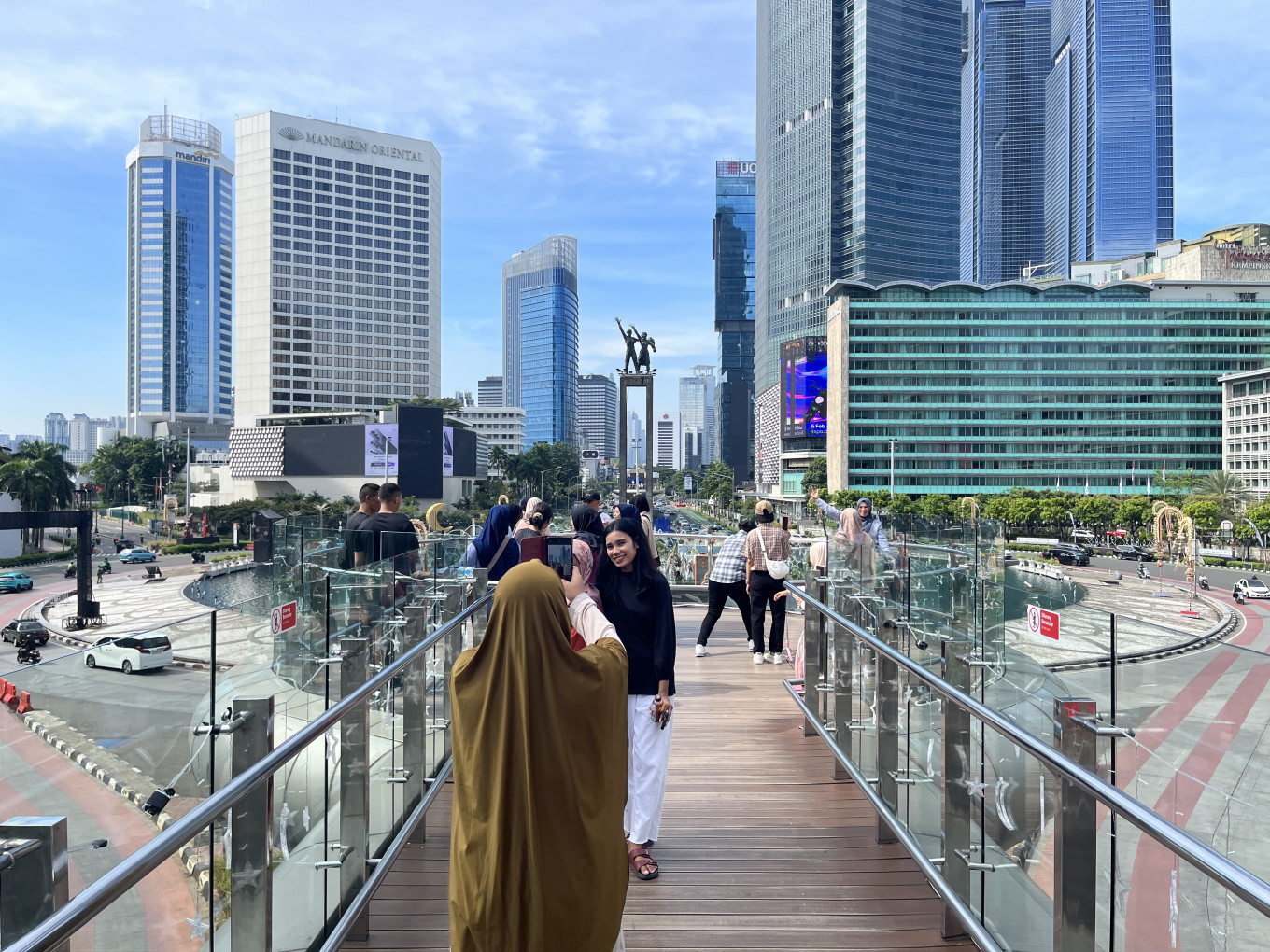 Visitors prepare to take selfies at the TransJakarta bus stop pavilion at the Hotel Indonesia traffic circle amid light traffic during the Eid al-Fitr homecoming and holiday period in Jakarta on Monday, March 23, 2026. (JP/Iqro Rinaldi)
“Why does Jakarta rank 71st?” That question circulates in policy circles and the media whenever new global city rankings appear. But it assumes there is only one ladder worth climbing and one way to measure success. Jakarta’s real challenge is not to climb an existing hierarchy, but to help define a new one.
In 1955, representatives of 29 newly independent nations gathered in Bandung, West Java, to issue a declaration that the world’s dominant powers had not anticipated. They did not come to compete for a place in an existing order. They came to propose a different one, built on the actual conditions, challenges and aspirations of the majority of the world’s people.
They called it non-alignment. It was never about absence, but about presence on different terms.
Seventy years later, the world’s cities face a similar choice. The dominant urban order has its own rankings and its own hierarchy of “global cities” descending from New York, London and Tokyo.
To rise, cities must demonstrate global connectedness on the index’s terms: business activity oriented toward international flows, human capital measured by mobility and cultural experiences legible to the globally mobile. Cities must become more plugged into the networks that already exist.
Jakarta currently ranks 71st. The city government’s ambition to move into the top tiers has generated serious analytical work. In 2025, Jakarta’s governor was invited to the United Nations High-Level Political Forum to present the city’s global-city vision and Sustainable Development Goal (SDG) commitments, a clear sign that Jakarta is already on the map.

However, indices like the Kearney Global Cities Index are designed to measure a particular kind of city, one whose success is defined by its integration into existing global networks of capital and talent. It rewards international connection more than local belonging. While UN-Habitat’s City Prosperity Index has broadened this field by treating urban prosperity as multidimensional, neither framework captures cities whose most important capabilities operate through different logics for a population only partly touched by global flows.