TheJakartaPost
Please Update your browser
Your browser is out of date, and may not be compatible with our website. A list of the most popular web browsers can be found below.
Just click on the icons to get to the download page.


Popular Reads
Top Results
No results found. Please check your search term and try again
Can't find what you're looking for?
View all search results
Popular Reads
Top Results
No results found. Please check your search term and try again
Can't find what you're looking for?
View all search resultsTime for Indonesia to enact the climate change law
Now that the Climate Change Bill has been included in this year's Prolegnas, it is up to our representatives to ensure that short-term economic interests cannot override ecological primacy, the very imbalance that has led to the climate crisis today.
Change text size
Gift Premium Articles
to Anyone
Share the best of The Jakarta Post with friends, family, or colleagues. As a subscriber, you can gift 3 to 5 articles each month that anyone can read—no subscription needed!
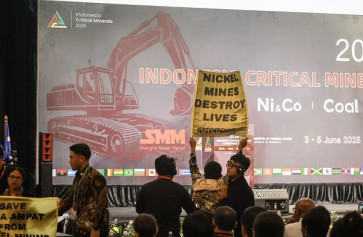
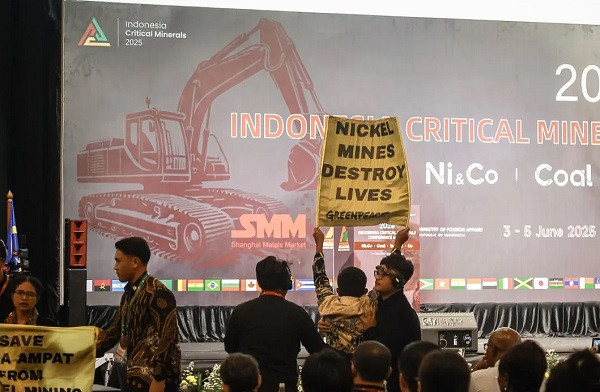 Activists from Greenpeace Indonesia unfurl banners to protest nickel mining in Southwest Papua’s Raja Ampat regency on June 3, during the Indonesia Critical Minerals Conference & Expo 2025 at the Pullman Jakarta Central Park in West Jakarta. (Antara/Dhemas Reviyanto)
T
he World Meteorological Organization reported last year that global greenhouse gas concentrations reached record levels in 2024 and continued to rise into 2025, confirming that the climate crisis is accelerating rather than slowing down. The Sixth Assessment Report (AR6, 2023) of the Intergovernmental Panel on Climate Change (IPCC) further warned that many climate impacts were no longer future projections but were already unfolding today, with some becoming irreversible on the human timescale.
The first “global stocktake” under the Paris Agreement, conducted during COP28 in Dubai in 2023, showed that even if the Nationally Determined Contributions (NDCs) of 194 countries were fully implemented, the world would still fail to remain within the 1.5-degree-Celsius pathway.
This signals that the current pace of climate action remains insufficient, while the window to avoid the most catastrophic impacts is rapidly closing.
As a result, extreme weather events are becoming more frequent and intense worldwide, and Indonesia is increasingly exposed to these risks. The World Bank ranks Indonesia 97th out of 181 countries in terms of vulnerability to climate impacts, reflecting high population density in hazard-prone areas and a strong dependence on natural resources for livelihoods and development.
At the same time, Indonesia remains among the world’s top 10 greenhouse gas emitters, based on national emissions estimated by combining fuel consumption data, sector-specific emission factors and electricity system data (International Energy Agency, 2025).
Addressing these challenges requires an overarching, coherent and comprehensive climate law (London School of Economics/LSE, 2024).

Indonesia now stands at a critical legislative moment: The Climate Change Bill proposed by the Regional Representative Council (DPD) has been included in the 2026 National Legislative Program (Prolegnas). The academic position paper for the Climate Change Bill identifies three key foundations: the protection of human rights, Indonesia’s biogeophysical vulnerability to climate change and the country’s obligation to fulfill its international climate commitments.