TheJakartaPost
Please Update your browser
Your browser is out of date, and may not be compatible with our website. A list of the most popular web browsers can be found below.
Just click on the icons to get to the download page.


Popular Reads
Top Results
No results found. Please check your search term and try again
Can't find what you're looking for?
View all search results
Popular Reads
Top Results
No results found. Please check your search term and try again
Can't find what you're looking for?
View all search resultsJuwono Sudarsono and the unfinished task of civilian rule
Elections are not enough to uphold democracy and civilian supremacy; civilian authority must be sustained by competence, integrity and delivery.
Change text size
Gift Premium Articles
to Anyone
Share the best of The Jakarta Post with friends, family, or colleagues. As a subscriber, you can gift 3 to 5 articles each month that anyone can read—no subscription needed!
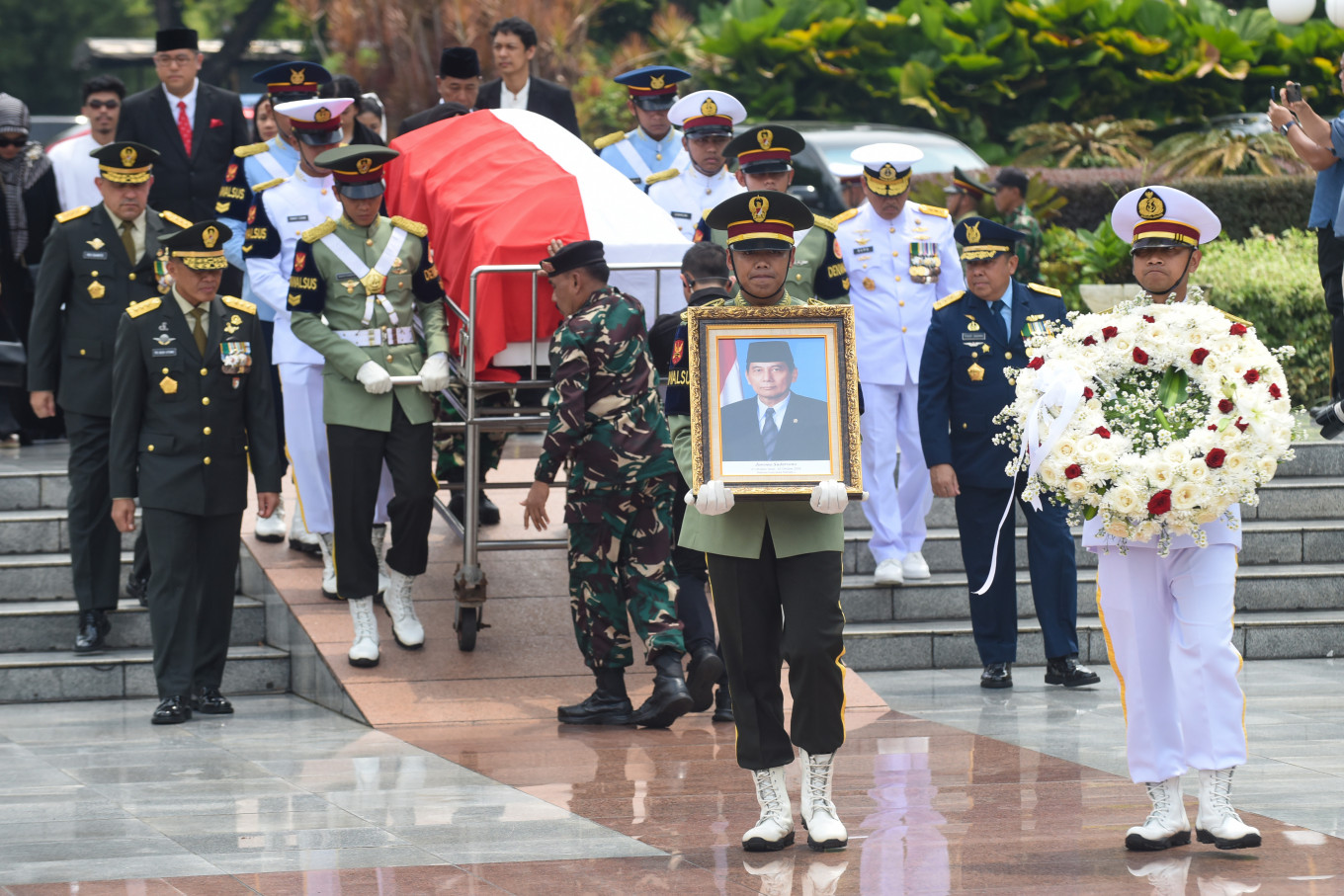 Indonesian Military (TNI) personnel carry the body of former defense minister Juwono Sudarsono on March 29, 2026, for burial at Kalibata Heroes Cemetery in South Jakarta. Juwono, who served in the United Indonesia Cabinet in Susilo Bambang Yudhoyono's presidency, died at the age of 84 after undergoing treatment at Pondok Indah Hospital, West Jakarta. (Antara/Indrianto Eko Suwarso)
On the afternoon of March 28, I stood beside my father, Juwono Sudarsono, as he took his final breath.
At that moment, I was not thinking about his public offices or his place in Indonesia’s political history. I was thinking about the man who raised me, shaped my mind and taught me how to understand power, justice and public duty. Yet in the days since his passing, I have also been reminded of how often he was misunderstood.
One of the most persistent misconceptions about Juwono is that he was “pro-military.” This perception grew because he often criticized weak civilian leadership after the Reform Era. He was direct, skeptical of political parties, and unimpressed by civilian elites who sought office but failed to govern. To some, that sounded like a defense of military influence. It was not.
Long before he entered the orbit of Indonesia’s security establishment, he built his life as a civilian academic. He spent decades at the University of Indonesia’s Faculty of Social and Political Sciences, first as a lecturer and later in leadership roles, including assistant dean and dean. For years, his principal vocation was not military affairs, but teaching, scholarship and the formation of future Indonesian civil leaders and social-science intellectuals.
His most intensive interaction with the Indonesian Military (TNI) came much later, especially in the mid-1990s, when his expertise in strategic and international affairs increasingly intersected with state policy. To reduce his worldview to "pro-military" is, therefore, historically inaccurate. My father did not want the military to dominate politics. He wanted civilian leaders to become so competent, so legitimate and so trusted that military dominance would become unnecessary, and politically unthinkable.
Indonesia has succeeded in one major task since 1998, it has institutionalized electoral democracy. But it has been less successful in another: Producing civilian leadership that consistently earns deep public trust through integrity and performance. That gap is measurable. Public trust surveys continue to show that the TNI remains among the country’s most trusted institutions; a 2024 survey found that more than 90 percent of respondents expressed trust in the TNI, while political parties and legislatures rank far lower.

That should prompt a more honest question. The issue is not whether Indonesia has formal civilian supremacy, it does. The challenge is whether civilian leadership has justified it. My father believed elections are not enough; civilian authority must be sustained by competence, integrity and delivery.