The Jakarta Post
Please Update your browser
Your browser is out of date, and may not be compatible with our website. A list of the most popular web browsers can be found below.
Just click on the icons to get to the download page.


Popular Reads
Top Results
No results found. Please check your search term and try again
Can't find what you're looking for?
View all search results
Popular Reads
Top Results
No results found. Please check your search term and try again
Can't find what you're looking for?
View all search resultsAnalysis: The shadow of the TNI power struggle behind the acid attack
Change text size
Gift Premium Articles
to Anyone
Share the best of The Jakarta Post with friends, family, or colleagues. As a subscriber, you can gift 3 to 5 articles each month that anyone can read—no subscription needed!
 Set as preferred source
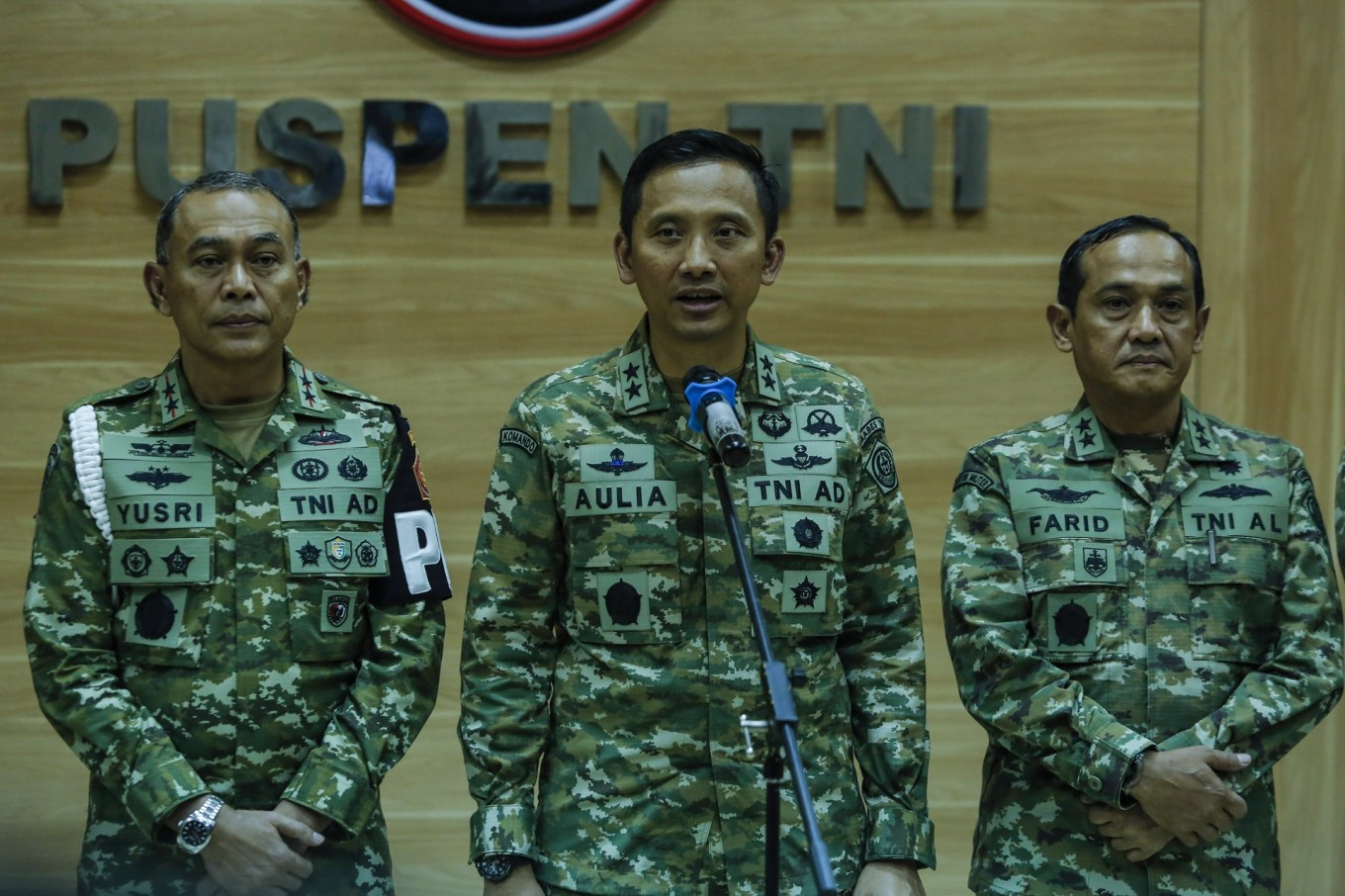 Indonesian Military (TNI) spokesperson Maj. Gen. Aulia Dwi Nasrullah (center), accompanied by TNI Police Headquarters (Puspom) commander Maj. Gen. Yusri Nuryanto (left) and TNI legal division chief Rear Adm. Farid Ma'ruf (right), speaks to journalists on March 25, 2026, during a press briefing at the TNI's headquarters in Cilangkap, East Jakarta. During the press briefing, Aulia announced the resignation of TNI Strategic Intelligence Agency (BAIS) chief Lt. Gen. Yudi Abrimantyo amid the investigation into BAIS linked personnel for the acid attack against Andrie Yunus in Jakarta on March 12. (Antara/Asprilla Dwi Adha)
T
hree weeks after the acid attack on Commission for the Disappeared and Victims of Violence (Kontras) activist Andrie Yunus, investigators have yet to clearly identify who bears ultimate responsibility. What has drawn particular attention is the resignation of the chief of the Strategic Intelligence Agency (BAIS), framed by the Indonesian Military (TNI) as a form of institutional accountability. Yet, this raises the critical question of whether the move reflects genuine responsibility-taking by the state or signals deeper power struggles within the military.
On the evening of March 12, Andrie Yunus, an activist with Kontras, was attacked with acid while riding home in Central Jakarta. Earlier that day, he recorded a podcast discussing the military’s role in politics. The timing has sharpened concerns about possible links between his advocacy work and the assault.
As of April 1, Andrie remained in the high-care unit at Cipto Mangunkusumo General Hospital (RSCM). He is undergoing intensive treatment, particularly for his eyes, as residual acid exposure has complicated medical assessments and may result in permanent damage. Kontras has described his condition as critical.
President Prabowo Subianto has condemned the attack and pledged that investigators will pursue not only the perpetrators on the ground but also the “highest actors” behind it. He emphasized the need to uncover “who ordered and paid for” the crime and has floated the possibility of establishing an independent fact-finding team.
However, this firm stance unfolds within a layered historical context. As widely documented, Prabowo himself faced allegations of human rights abuses during his military career. While he was never tried in court, he was dismissed from the TNI in 1998 for insubordination. This juxtaposition, between past controversies and present commitments to justice, adds a layer of political complexity to the case.
On March 25, TNI spokesperson Maj. Gen. Aulia Dwi Nasrullah announced that the chief of BAIS, Lt. Gen. Yudi Abrimantyo, no longer held that position. This followed the arrest of four officers, two from the Navy and two from the Air Force, who were assigned to BAIS and are allegedly involved in the attack.

Yet, the spokesperson did not clarify whether Yudi’s removal was linked to command responsibility, internal disciplinary measures or broader institutional considerations. The ambiguity surrounding his exit has fueled speculation about the true motives behind the move.