The Jakarta Post
Please Update your browser
Your browser is out of date, and may not be compatible with our website. A list of the most popular web browsers can be found below.
Just click on the icons to get to the download page.


Popular Reads
Top Results
No results found. Please check your search term and try again
Can't find what you're looking for?
View all search results
Popular Reads
Top Results
No results found. Please check your search term and try again
Can't find what you're looking for?
View all search resultsReform, regret and the politics of reversal in Indonesia
In recent years, Indonesia has witnessed a series of policy reversals that, taken together, raise important questions about the consistency of its reform agenda.
Change text size
Gift Premium Articles
to Anyone
Share the best of The Jakarta Post with friends, family, or colleagues. As a subscriber, you can gift 3 to 5 articles each month that anyone can read—no subscription needed!
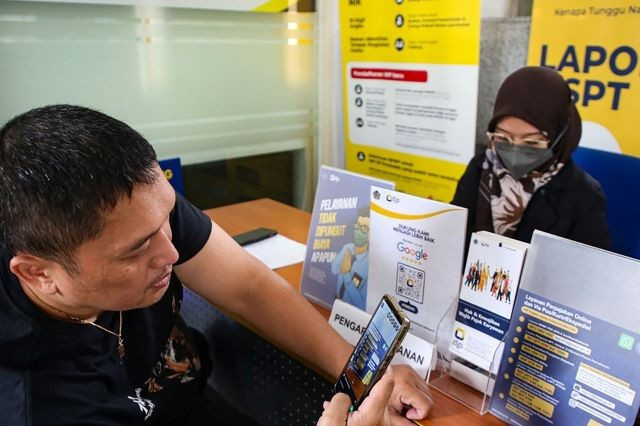 A taxpayer takes a picture of the guidelines for requesting online taxation services on Nov. 20, 2023, at a counter at the Kebayoran Baru 1 branch of the tax office in South Jakarta. (Kompas/Priyombodo)
I
ndonesia’s development story is often told as a sequence of reforms: liberalization in the 1980s, stabilization after the late 1990s crisis, decentralization in the early 2000s and, more recently, digitalization and administrative modernization. Each phase reflects an effort to correct past distortions and build stronger institutions.
But there is another, less-discussed pattern that runs alongside this narrative: reform, followed by hesitation and eventually partial reversal.
The story of Coretax illustrates both the promise and the limits of reform in Indonesia. Conceptually initiated more than two decades ago and implemented only in 2025 after a long and difficult process, Coretax represents perhaps the most ambitious digitalization reform in Indonesia’s fiscal administration. Like most institutional reforms, it is a starting point: a platform upon which further integration, enforcement and governance improvements must be built.
Its significance lies not only in its technical features but in what it represents: a long-term commitment to improving state capacity through data integration, transparency and administrative coherence. But precisely because such reforms take decades to design and implement, they are inherently fragile. They depend on sustained political commitment across administrations and on the alignment of incentives within the bureaucracy.
This is where Indonesia’s reform trajectory becomes more complex.
While some institutions move forward, slowly, unevenly, but persistently, others move backward. In recent years, Indonesia has witnessed a series of policy reversals that, taken together, raise important questions about the consistency of its reform agenda.

Take energy subsidies. The effort to rationalize fuel subsidies did not begin recently. It has been a long process, spanning multiple administrations. Since the late New Order period and continuing through the Reform era, successive governments have attempted, often under difficult political conditions, to move toward more targeted subsidy schemes. During the Susilo Bambang Yudhoyono administration, important steps were taken, including reducing kerosene subsidies and transitioning households toward liquefied petroleum gas (LPG). At the same time, the policy direction became clearer: subsidies should be targeted, not generalized.