TheJakartaPost
Please Update your browser
Your browser is out of date, and may not be compatible with our website. A list of the most popular web browsers can be found below.
Just click on the icons to get to the download page.


Popular Reads
Top Results
No results found. Please check your search term and try again
Can't find what you're looking for?
View all search results
Popular Reads
Top Results
No results found. Please check your search term and try again
Can't find what you're looking for?
View all search resultsTokyo, Seoul rethink ties as global order shifts
The world order that the United States has taken charge of, and that Japan has taken advantage of, is fading away under the Trump 2.0 administration and the growing hegemonic threat from China.
Change text size
Gift Premium Articles
to Anyone
Share the best of The Jakarta Post with friends, family, or colleagues. As a subscriber, you can gift 3 to 5 articles each month that anyone can read—no subscription needed!
 Set as preferred source
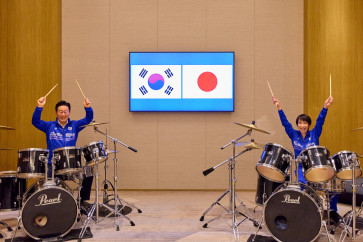
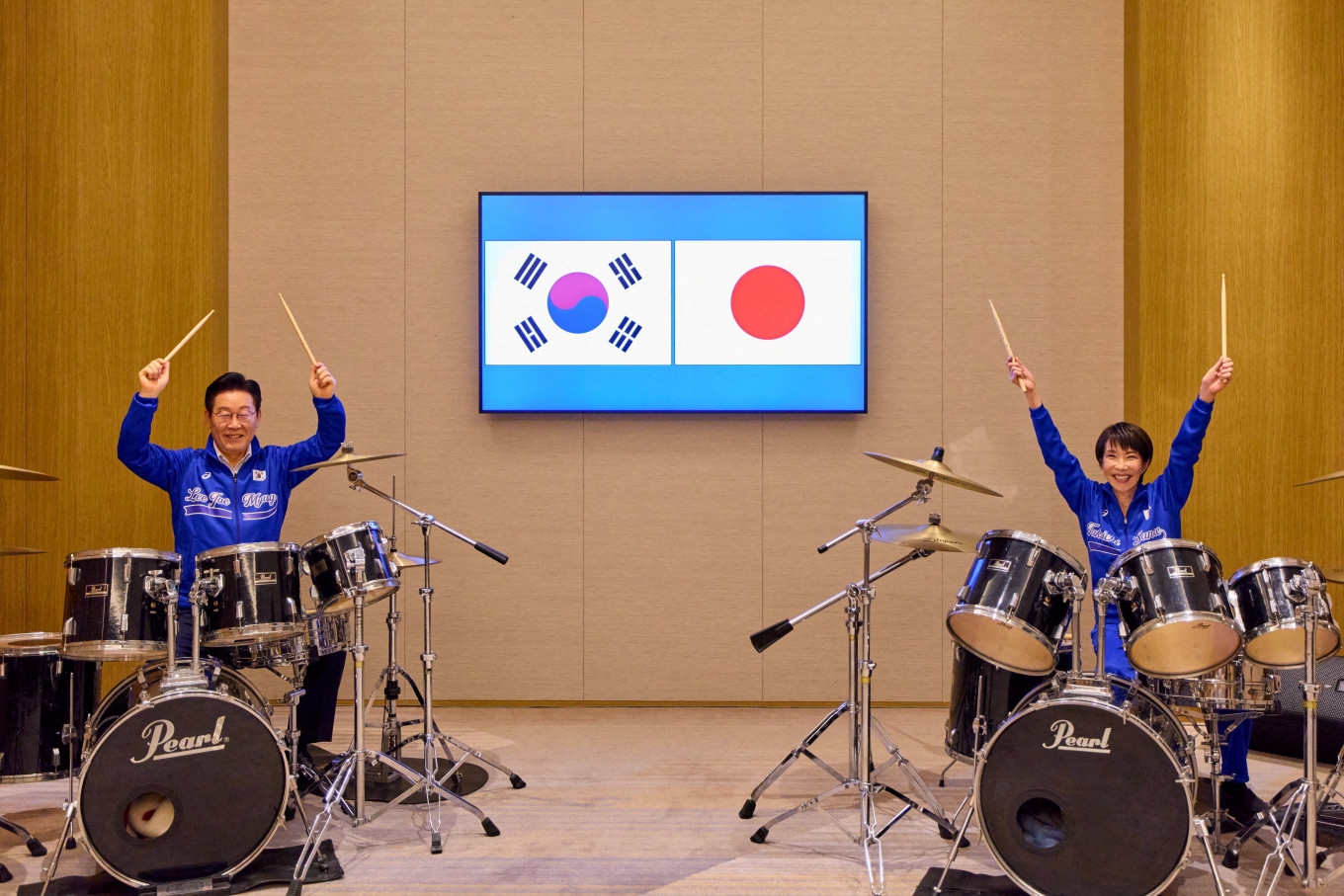 Japanese Prime Minister Sanae Takaichi (right) and South Korean President Lee Jae Myung pose on Jan. 12, 2026, for photographs before performing on drums after their meeting in Nara, Japan. (Reuters/Yonhap/Reuters/Yonhap)
T
he world order that the United States has taken charge of, and that Japan has taken advantage of, is fading away under President Donald Trump second administration and the growing hegemonic threat from China. This means that Japan faces the need to reshape its foreign and security policy, which strongly relies on the US as its only ally. There is a certain other country facing the same national security and foreign policy challenges. This is South Korea. Against this backdrop, the relationship between Japan and South Korea, which has been hindered by historical conflict, is at a critical strategic turning point.
“In the current strategic environment, in which the importance of Japan-ROK relations is growing, we will work to further strengthen our relationship through candid exchanges of views based on the relationship of trust between President Lee [Jae Myung] and me,” Japanese Prime Minister Sanae Takaichi explained her administration’s South Korea policy in this way in her first policy speech at the ordinary Diet session on Feb. 20.
Before she took office, it was believed that she would surely make the relationship worse if she were to become prime minister with concerns that the Japan-South Korea relationship would be critically worsened by her hawkish and ideological foreign policy stance.
But she has taken a more practical foreign policy stance as prime minister, especially toward South Korea. Soon after taking office in October 2025, she visited South Korea to participate in the Asia-Pacific Economic Cooperation (APEC) summit there, and while in the country she also met with Lee. At their first meeting she stressed that she would strengthen ties in a future-oriented manner and boost cooperation in their mutual strategic interest.
Her stance was well received in South Korea. Lee praised her, saying, “All my worries are gone.” In a mirror image, Lee himself was a politician whom many in Japan had worried would worsen the Japan-South Korea relationship through his anti-Japan sentiment if he were to become president, but in reality he changed his foreign policy stance in a practical way once he took office.
These two leaders’ changes of mind occurred not only because of their political maneuvering but also because of strategic decisions by both countries.

It had been believed by conservatives in Japan that South Korea put more importance on its relationship with China than on its relationship with Japan. According to the results of a public opinion survey conducted by the Japan Press Research Institute (JPRI) in 2016, only 32.3 percent of South Koreans had favorable views of Japan, while the number of those with favorable views of China was far higher at 55.6 percent.