The Jakarta Post
Please Update your browser
Your browser is out of date, and may not be compatible with our website. A list of the most popular web browsers can be found below.
Just click on the icons to get to the download page.


Popular Reads
Top Results
No results found. Please check your search term and try again
Can't find what you're looking for?
View all search results
Popular Reads
Top Results
No results found. Please check your search term and try again
Can't find what you're looking for?
View all search resultsThe coming inflation-deflation whipsaw
Markets must grapple with both the immediate threat of higher inflation from geopolitical tensions and conflagrations, as well as the longer-term risk of AI-driven deflation.
Change text size
Gift Premium Articles
to Anyone
Share the best of The Jakarta Post with friends, family, or colleagues. As a subscriber, you can gift 3 to 5 articles each month that anyone can read—no subscription needed!
 Set as preferred source
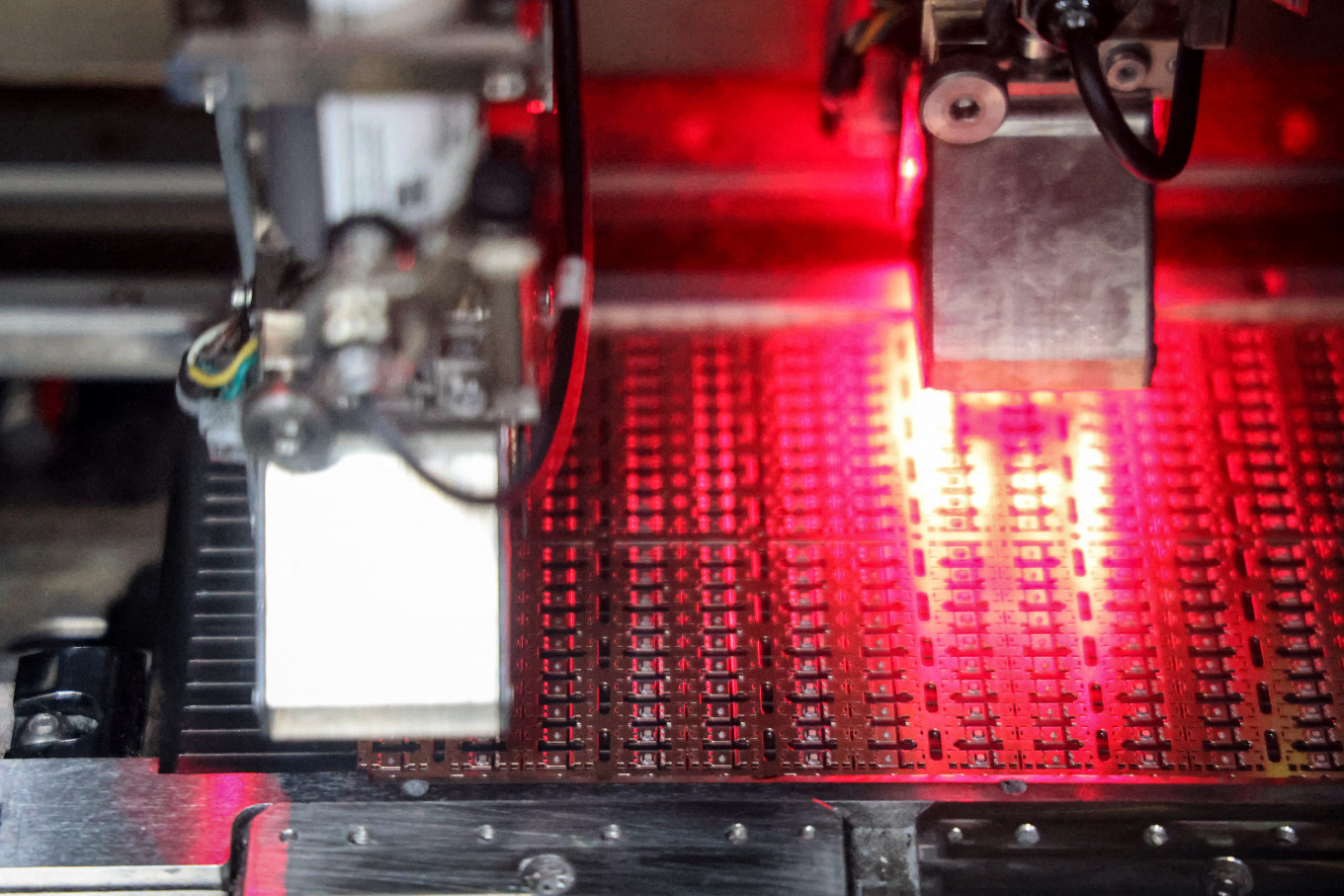 A semiconductor machine performs the semiconductor chip creation process on Dec. 25, 2024, at a factory in Binzhou, in eastern China's Shandong province. (AFP/-)
W
e are living through a rare moment in which two powerful forces are pulling prices in opposite directions. Markets must grapple with both the immediate threat of higher inflation from geopolitical tensions and conflagrations, as well as the longer-term risk of artificial intelligence-driven deflation.
At the start of this year, many forecasters expected oil prices to hover around US$50 per barrel, owing to what looked like relatively large inventories and flat global demand. Yet now, Brent futures have breached $100, with some predicting prices as high as $150.
The United States-Israeli war against Iran has disrupted transit through the Strait of Hormuz, which generally accounts for around 20 percent of the world’s 100 million barrels in daily demand. That makes this the largest oil-supply shock in the history of the global oil market. By comparison, the 1973 Arab oil embargo, the 1990 Gulf War and the 2022 Russian invasion of Ukraine cut global supply by 7 percent, 6.5 percent and 3 percent, respectively.
Not only have oil and natural gas prices risen well over 30 percent since the war began, but the shock has extended across the commodity complex, hitting everything from fertilizer, 30 percent of which passes through the Strait, and the polyethylene at 50 percent, used in plastics to helium, about 33 percent, a critical input for semiconductors, and thus for the AI revolution.
Global shipping and insurance costs have also spiked, making the Iran war the biggest threat to maritime trade and supply chains since COVID-19. And because physical infrastructure is being destroyed, the effects could prove more persistent. Qatar estimates that rebuilding certain liquefied natural gas facilities could take as long as five years.
The longer-term ramifications of such losses are already showing up in revisions to the inflation and interest-rate outlook. The Organisation for Economic Co-operation and Development (OECD) is now forecasting 4.2 percent inflation in the US — more than 200 basis points above the US Federal Reserve’s 2 percent target. Higher inflation has obvious negative implications for businesses, whose margins will be compressed, and for consumers, whose real, inflation-adjusted, wages will be eroded.

Meanwhile, the market has gone from pricing in one or two Federal Reserve rate cuts this year to anticipating a possible hike. Of course, the Federal Reserve may treat the current energy-price shock as “transitory” and avoid tightening its policy; but it will also recognize that the broader disruption to commodity supplies could be prolonged.