The Jakarta Post
Please Update your browser
Your browser is out of date, and may not be compatible with our website. A list of the most popular web browsers can be found below.
Just click on the icons to get to the download page.


Popular Reads
Top Results
No results found. Please check your search term and try again
Can't find what you're looking for?
View all search results
Popular Reads
Top Results
No results found. Please check your search term and try again
Can't find what you're looking for?
View all search resultsWhy user states must share the burden of Indonesia’s sea-lanes
As the case of the Strait of Hormuz in the Iran war illustrates amid escalating global tensions, Indonesia can no longer afford to be the sole guardian of the world’s most dangerous maritime choke points: It’s time for user states to pay their fair share.
Change text size
Gift Premium Articles
to Anyone
Share the best of The Jakarta Post with friends, family, or colleagues. As a subscriber, you can gift 3 to 5 articles each month that anyone can read—no subscription needed!
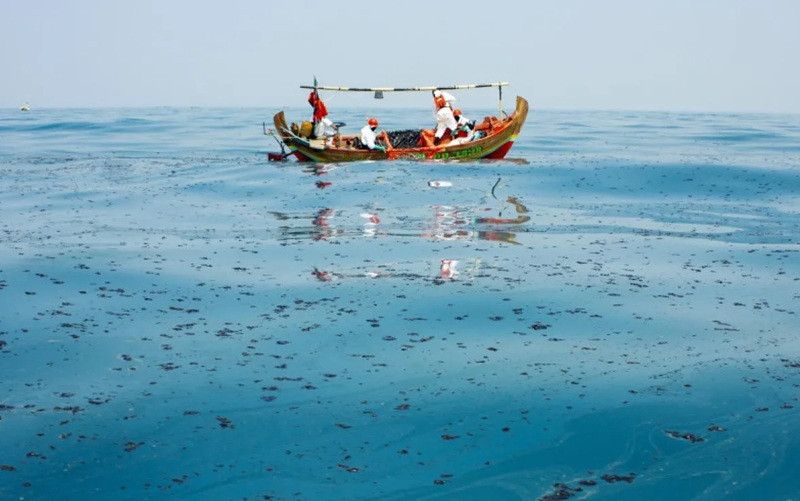 Local environmental officers clean up an oil spill on Aug. 12, 2019, in the Java Sea off Karawang regency, West Java. (Antara/Ibnu Chazar)
R
ecent armed conflicts, notably the war between Russia and Ukraine and the conflict involving the United States, Israel and Iran, have underscored the strategic significance of maritime straits in global security.
The Bosphorus and Dardanelles, governed by Turkey under the 1936 Montreux Convention, illustrate how legal control over straits can influence naval operations and seaborne trade during periods of hostility. Similarly, the Strait of Hormuz remains a critical strategic leverage point, particularly for Iran, given its profound impact on the global energy supply and maritime security.
The strategic value of straits is rooted primarily in their role in seaborne trade. Maritime transport remains the most efficient and cost-effective means of moving large volumes of goods over long distances, and historical trade patterns have been shaped by access to these key maritime passages.
As an archipelagic state, Indonesia occupies a central position within global and regional shipping networks. Its waters contain several internationally significant choke points, including the straits of Malacca, Singapore, Sunda, Lombok, Makassar and Ombai-Wetar. These waterways function as essential sea-lanes of communication (SLOCs) for international trade, naval movement and regional stability.
Indonesia has taken extensive measures to ensure the safety, security and environmental sustainability of these sea-lanes. These efforts include updating navigational charts, installing navigational aids, disseminating maritime safety information and conducting frequent patrols. Such actions demonstrate Indonesia’s commitment to fulfilling its international obligations and accommodating the interests of the global maritime community.
In recent years, a significant increase in the volume of energy (oil, gas and coal) and goods transported through these straits has placed greater pressure on coastal states to invest in sophisticated and expensive navigational infrastructure. The dangers of such passage are exacerbated by high maritime traffic and the transport of hazardous cargoes.

This raises a critical question: Should archipelagic states like Indonesia bear this financial burden alone, or should user states share the responsibility?