TheJakartaPost
Please Update your browser
Your browser is out of date, and may not be compatible with our website. A list of the most popular web browsers can be found below.
Just click on the icons to get to the download page.


Popular Reads
Top Results
No results found. Please check your search term and try again
Can't find what you're looking for?
View all search results
Popular Reads
Top Results
No results found. Please check your search term and try again
Can't find what you're looking for?
View all search resultsStability, criticism and the eroding meaning of Indonesia’s democracy
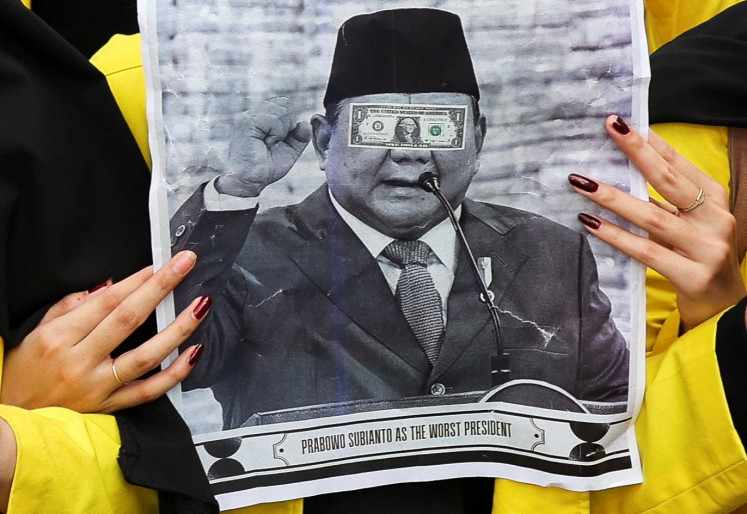
While Indonesia’s tradition of consensus is celebrated as a cultural jewel, it is increasingly being weaponized to hollow out democratic dissent. The legacy of colonial mentality and elite cooptation has transformed "deliberation" into a tool for maintaining a fragile, uncontested status quo.
Change text size
Gift Premium Articles
to Anyone
Share the best of The Jakarta Post with friends, family, or colleagues. As a subscriber, you can gift 3 to 5 articles each month that anyone can read—no subscription needed!
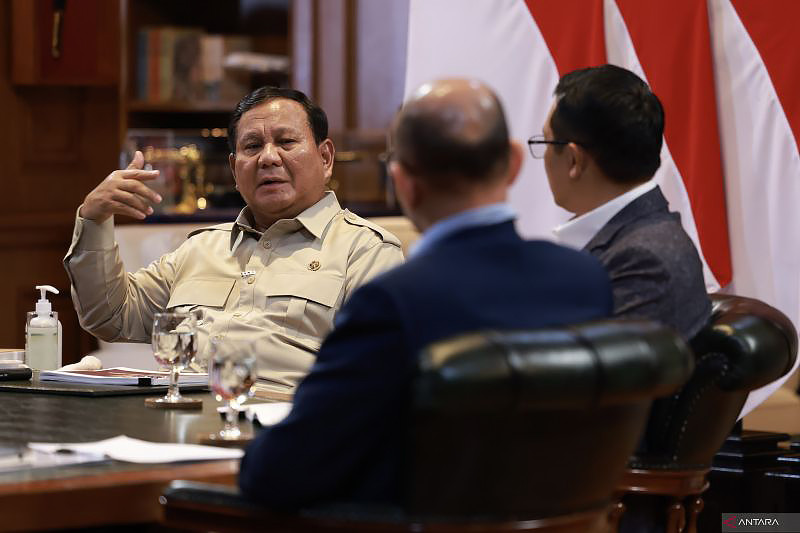 President Prabowo Subianto (left) speaks with several senior journalists, economists and analysts on March 17, 2026, at his private residence in Hambalang, Bogor regency, West Java. (Antara/Handout/Government Communication Office)
I
n Indonesian political life, musyawarah untuk mufakat (deliberation for consensus) has long been upheld as a noble cultural value. It is often associated with mutual cooperation and collective wisdom. Yet in practice, it rarely serves as a genuine process of seeking truth together. More often, it functions as a mechanism to secure agreement and avoid disruption.
This shift is not trivial. When agreement becomes the primary goal, the nature of the process changes. Differences are no longer something to be tested, but something to be managed. In many cases, conflict is not resolved but softened, as it is seen as inconvenient or potentially destabilizing.
This tendency is rooted in history. Colonialism not only left behind structural inequality; it also shaped how authority is perceived. Power was distant, hierarchical and seldom questioned. Feudal traditions reinforced this pattern, where criticism of superiors could easily be interpreted as disloyalty. Benedict Anderson once observed that in Javanese political culture, harmony is often elevated above confrontation, casting open conflict as a disturbance to order rather than a necessary part of political life.
Such legacies did not simply vanish after independence. As award-winning novelist Pramoedya Ananta Toer reflected, colonialism left behind a mentality that endured beyond the transfer of power. Citizens were not fully repositioned as active subjects, but often remained treated as objects of governance. In such a context, criticism becomes suspect, tolerated to an extent, but rarely embraced as essential.
This colonial mindset also shaped attitudes toward power itself. Under colonial rule, the state functioned more as an extractive apparatus than a provider of public service; office was understood as access rather than responsibility. The late historian Onghokham showed how colonial authorities relied on local elites, creating a system where loyalty mattered more than accountability. This logic continues to echo today, where power is often treated as something to be utilized rather than restrained.
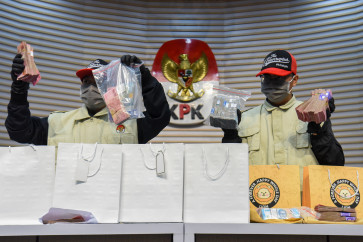
From this extractive foundation, corruption finds deeper roots. It is not merely a legal violation, but a reflection of how the state is perceived. Pramoedya criticized how post-independence elites replaced colonial rulers without transforming the underlying mentality. Patronage, rooted in feudal structures, reinforces this pattern, where loyalty is exchanged for access to resources. In practice, corruption is often normalized as part of how power operates, rather than seen as a deviation.

In contemporary Indonesia, this pattern has evolved into more complex forms. As Vedi Hadiz has argued, oligarchic forces remain dominant in shaping political outcomes. Corruption does not always appear in overt forms, but is embedded in policy arrangements, project distribution and closed-door political compromises that escape public scrutiny.