TheJakartaPost
Please Update your browser
Your browser is out of date, and may not be compatible with our website. A list of the most popular web browsers can be found below.
Just click on the icons to get to the download page.


Popular Reads
Top Results
No results found. Please check your search term and try again
Can't find what you're looking for?
View all search results
Popular Reads
Top Results
No results found. Please check your search term and try again
Can't find what you're looking for?
View all search resultsDismantling the bunker, demilitarizing Indonesian justice
The persistent absence of an updated Military Court Law, one aligned with constitutional democracy to eliminate the isolated nature of military jurisdiction, is a glaring manifestation of a lack of political will. It reveals a weak commitment among policymakers to finalize the military reform agenda.
Change text size
Gift Premium Articles
to Anyone
Share the best of The Jakarta Post with friends, family, or colleagues. As a subscriber, you can gift 3 to 5 articles each month that anyone can read—no subscription needed!
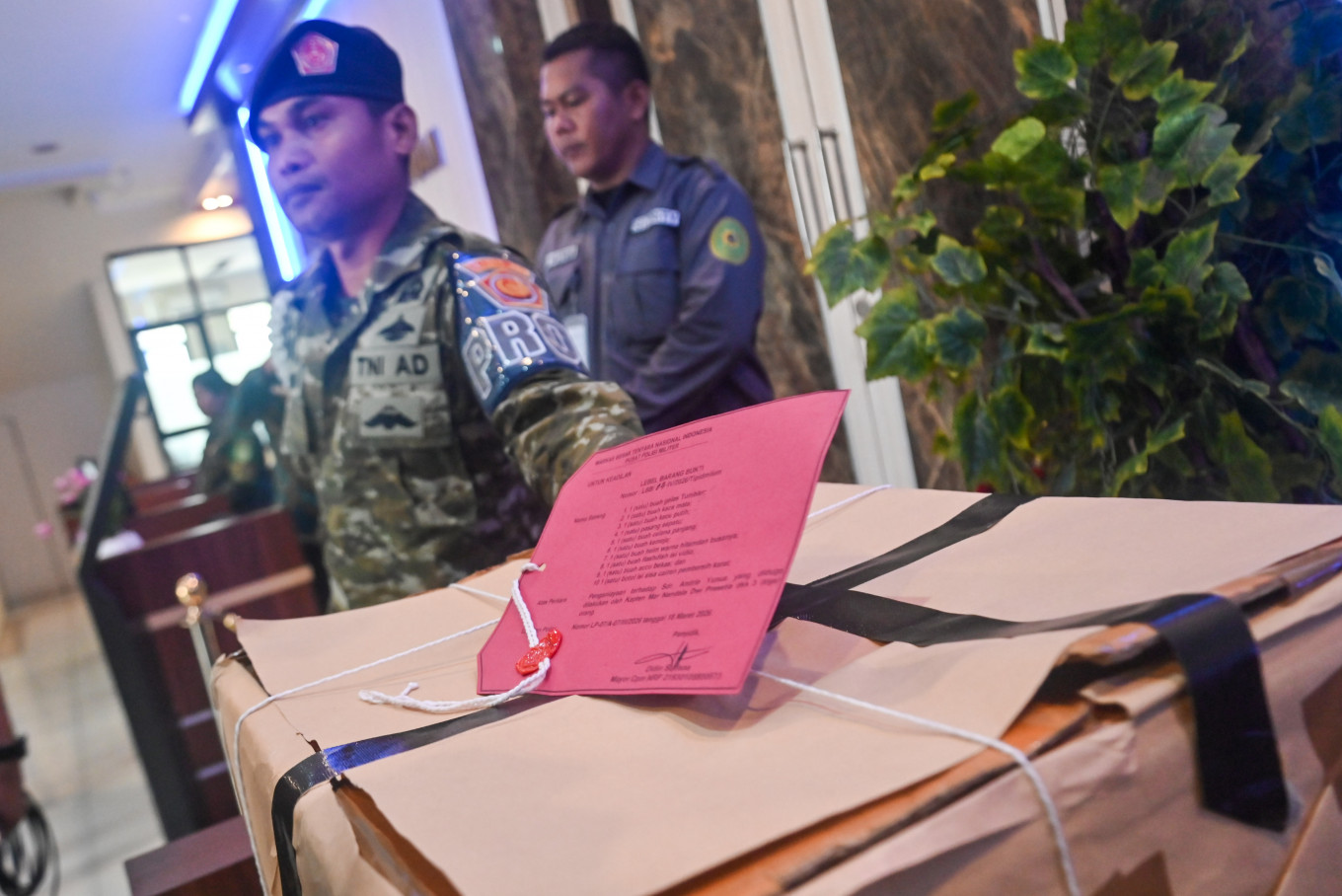 Military tribunal?: An Indonesian Military (TNI) soldier stands guard on Thursday, April 16, 2026, next to case files related to the alleged acid attack on Commission for Missing Persons and Victims of Violence (Kontras) deputy coordinator Andrie Yunus at the Military Court in Jakarta. (Antara/Fakhri Hermansyah)
D
imas Bagus Arya’s article, titled "New legal paradigm demands an end to impunity" (The Jakarta Post, April 11, 2026), highlights that transferring the acid attack case against human rights activist Andrie Yunus to a military court is widely viewed as a mechanism to protect perpetrators through impunity.
Consequently, the author demands that the case be tried in a civilian court. This demand is heavily substantiated by data from rights groups Kontras and the Indonesia Judicial Research Society (IJRS), which prove that military court sentences for general crimes, such as murder, assault and sexual violence, are significantly more lenient than those in civilian courts. These findings ultimately reveal a structural problem: one that systematically reproduces not only impunity, but also enables the law itself to be instrumentally deployed as a shield for perpetrators.
By linking the incidence of physical repression with the legal analysis behind it, what fundamental findings can we use as a foundation for civil society movements to end the cycle of violence and impunity against civilians during peacetime?
As an initial assessment, Article 65, paragraph (2), of Law No. 34/2004 on the Indonesian Military (TNI), as amended by Law No. 3/2025, sets a strict jurisdictional boundary. Fundamentally, it limits military courts exclusively to prosecuting purely military crimes, such as desertion and insubordination. For general crimes committed in peacetime, TNI soldiers are mandated to submit fully to the jurisdiction of civilian courts.
This aligns with the historical trajectory and the global paradigm of security sector reform. Modern legal frameworks consistently steer away from using military courts for general crimes, firmly requiring that soldiers who commit civilian offenses face civilian jurisdiction.
However, the persistent absence of an updated Military Court Law, one aligned with constitutional democracy to eliminate the isolated nature of military jurisdiction, is a glaring manifestation of a lack of political will. It reveals a weak commitment among policymakers to finalize the military reform agenda.

Furthermore, the exception clause in Article 65, paragraph (3), of the TNI Law, which posits a scenario where civilian courts are "not functioning", has created normative ambiguity and room for multiple interpretations. This is a fundamental issue that urgently requires revision to close legal loopholes and ensure certainty.