TheJakartaPost
Please Update your browser
Your browser is out of date, and may not be compatible with our website. A list of the most popular web browsers can be found below.
Just click on the icons to get to the download page.


Popular Reads
Top Results
No results found. Please check your search term and try again
Can't find what you're looking for?
View all search results
Popular Reads
Top Results
No results found. Please check your search term and try again
Can't find what you're looking for?
View all search resultsHow US, Indonesia build strategic defense partnership anew
Washington is quietly rewriting the rules of Indo-Pacific strategy by swapping formal alliances for deep technological integration. The new defense pact with Indonesia proves that in the age of AI and autonomous warfare, operational "plug-and-play" matters far more than a signed treaty.
Change text size
Gift Premium Articles
to Anyone
Share the best of The Jakarta Post with friends, family, or colleagues. As a subscriber, you can gift 3 to 5 articles each month that anyone can read—no subscription needed!
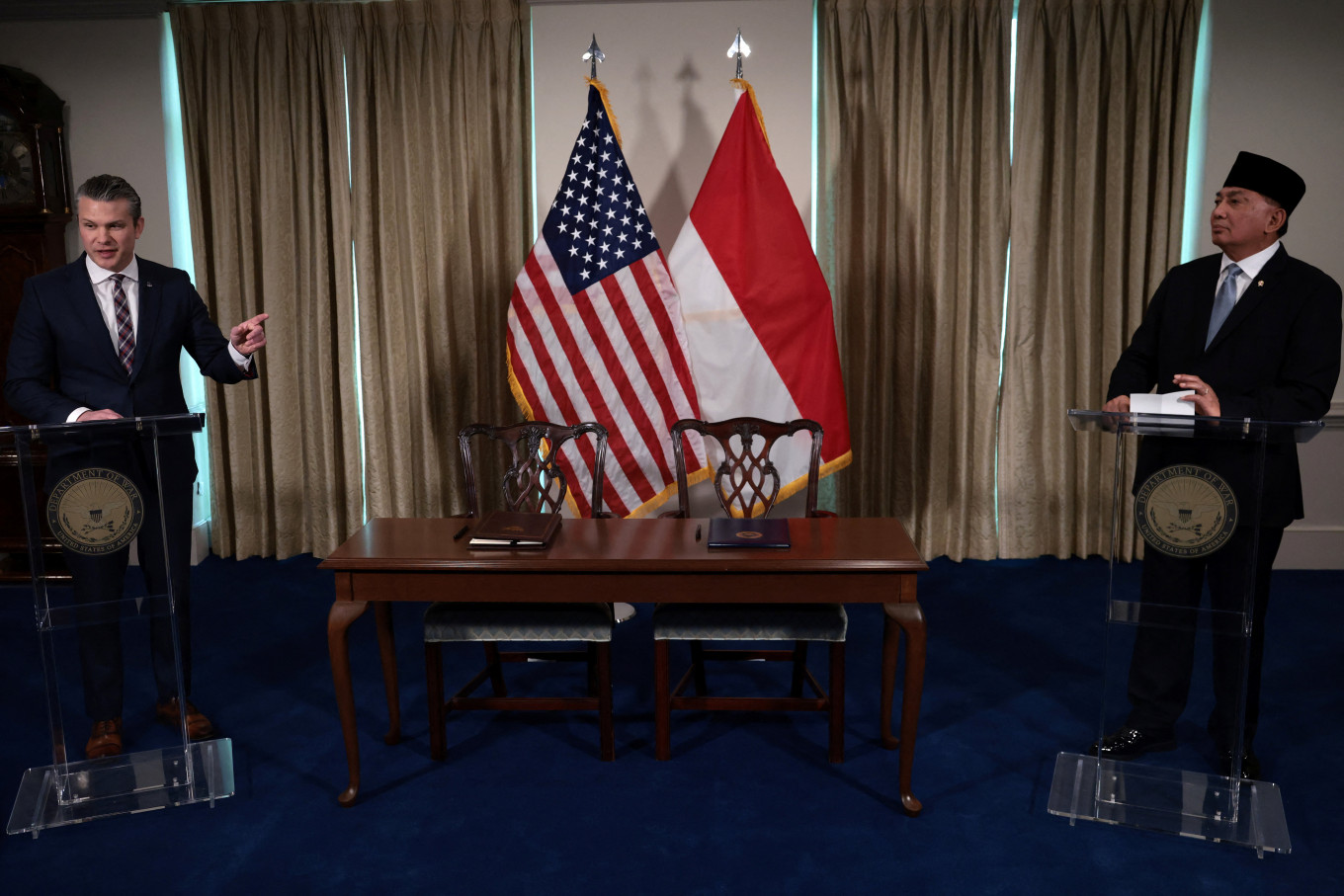 United States Defense Secretary Pete Hegseth (left) delivers remarks on April 13, 2026, during a visit by Defense Minister Sjafrie Sjamsoeddin at the Pentagon, in Virginia, the US. (Reuters/Evelyn Hockstein)
T
he United States builds order through architecture. Since the founding of the North Atlantic Treaty Organization (NATO) in 1949, Washington has constructed the most elaborate defense cooperation system in the history of international relations, a tiered, legally differentiated structure binding dozens of nations to US strategic purposes through instruments calibrated to what each partner can politically absorb.
At its apex sit 32 NATO allies carrying Article 5 mutual defense obligations. Below them, bilateral treaty allies in the Indo-Pacific, Japan, South Korea, Australia and the Philippines, carry defense commitments forged in the Cold War's opening decades. Further still, 19 nations hold Major Non-NATO Ally (MNNA) status, a statutory designation created by Congress in 1987, granting preferential arms access and joint research eligibility without formal alliance obligations.
When India, too large and too genuinely nonaligned to accept a congressional designation, demanded a different instrument, Washington created the Major Defense Partner framework in 2016: an executive-level arrangement outside statutory law, delivering near-equivalent technology transfer without requiring New Delhi to publicly declare alignment.
The Major Defense Cooperation Partnership (MDCP) signed with Indonesia on Monday is the architecture's latest expression, a tier that, until Washington needed it, did not exist.
Understanding why it had to be invented requires understanding the problem Indonesia has always posed. It is too consequential to leave unanchored: 280 million people, the world's largest Muslim-majority democracy, and an archipelago of 17,000 islands commanding the Malacca, Lombok and Sunda straits. Yet its constitutional doctrine of bebas-aktif (free and active nonalignment) has made every conventional instrument of US partnership-building politically unavailable.
MNNA designation requires congressional notification and a public alignment signal that no Indonesian government could survive domestically; a mutual defense treaty was never conceivable. For decades, the relationship drifted, long-characterized by "unrealized potential".

What the MDCP announces is the formal end of that era: a framework designed, in the Pentagon's own words, to "enhance operational collaboration, partner on defense modernization, and increase training and interoperability."