TheJakartaPost
Please Update your browser
Your browser is out of date, and may not be compatible with our website. A list of the most popular web browsers can be found below.
Just click on the icons to get to the download page.


Popular Reads
Top Results
No results found. Please check your search term and try again
Can't find what you're looking for?
View all search results
Popular Reads
Top Results
No results found. Please check your search term and try again
Can't find what you're looking for?
View all search resultsCan domestic workers protection law end ‘modern slavery’?
As Indonesia ratifies a historic domestic worker protection law after two decades of silence, the nation must now decide if these statutory rights will remain a paper promise or finally dismantle the structures of modern slavery.
Change text size
Gift Premium Articles
to Anyone
Share the best of The Jakarta Post with friends, family, or colleagues. As a subscriber, you can gift 3 to 5 articles each month that anyone can read—no subscription needed!
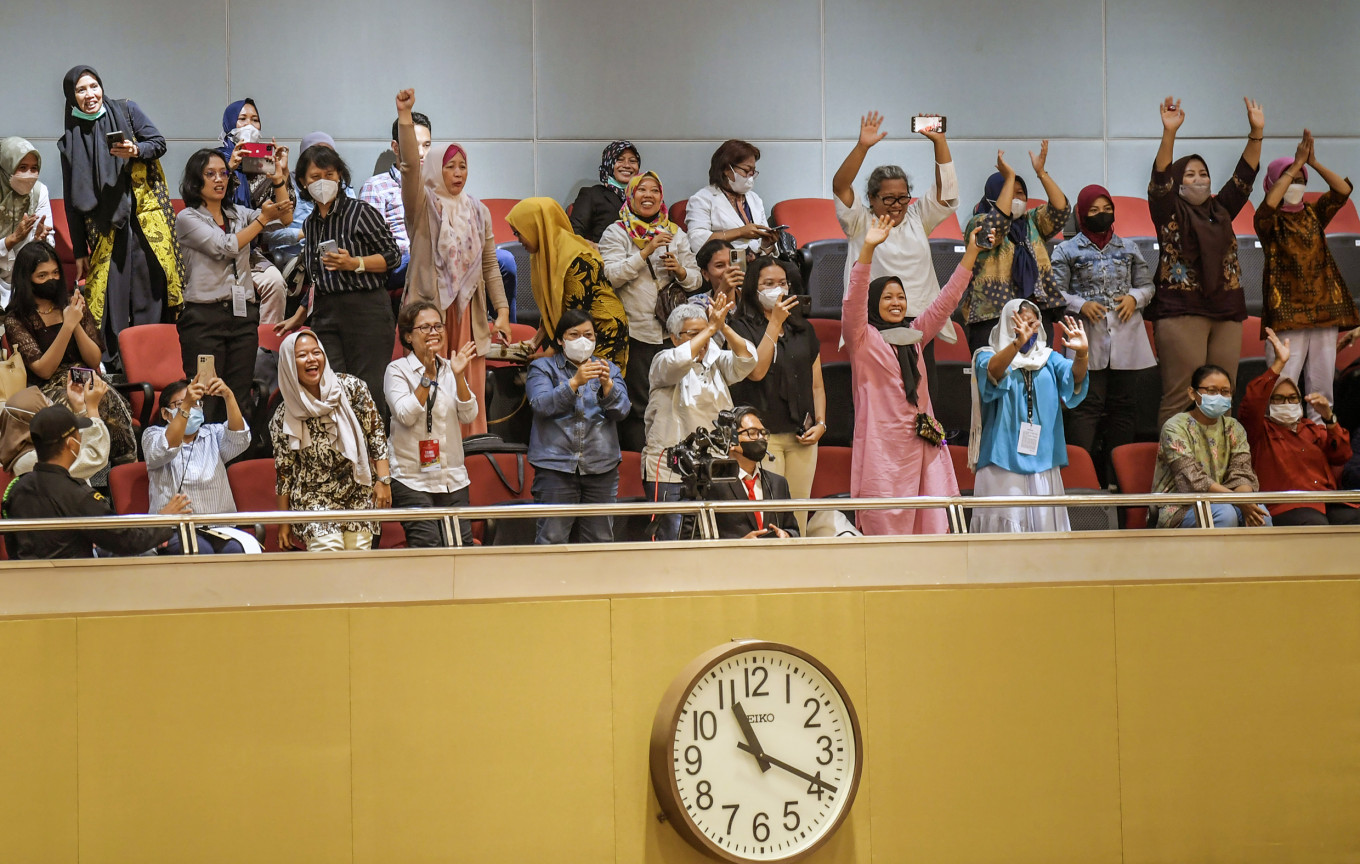 Spectators wave their hands as lawmakers endorse the Domestic Workers Protection Bill as an initiative draft law during a plenary session on March 21, 2023, at the House of Representatives in Senayan, Central Jakarta. (Antara/Galih Pradipta)
T
he House of Representatives has finally ratified the long-awaited Domestic Workers Protection Law (UU PPRT), marking a watershed moment in Indonesian labor history. This victory follows a grueling 22-year advocacy process—a generational struggle championed by civil society groups, labor unions and human rights activists.
For decades, domestic work in Indonesia existed in a precarious legal "gray zone". leaving millions of workers, the vast majority of whom are women, vulnerable to the whims of individual employers and systemic exploitation.
Comprised of 12 chapters and 37 articles, the new law establishes 14 core rights designed to professionalize a historically informal sector. At its heart, it mandates access to essential social security, specifically covering health insurance through state-run BPJS Kesehatan and employment-related protection via BPJS Ketenagakerjaan.
To curb the cycle of poverty, the law prohibits arbitrary wage deductions and sets a strict minimum age requirement of 18 years. Notably, the law adopts a retroactive principle ensuring that anyone under the age of 18 who was already active in the workforce before the law’s inception remains entitled to full legal recognition. This ensures that those currently in vulnerable positions are not abandoned during the transition to higher national standards.
Despite the celebratory atmosphere, the law's practical efficacy remains under intense scrutiny due to its heavy reliance on blanket norms. These are broad legal statements that delegate specific, substantive protections—such as the exact mechanics of pension schemes and insurance tiers—to secondary government rules such as government regulation (PP).
As noted by Deputy House Speaker Sufmi Dasco Achmad, many of these essential guarantees are not yet operational. In the Indonesian legislative context, the "wait for the PP" often results in administrative paralysis, leaving the law's most transformative elements in a state of limbo. Without these technical regulations, the 14 rights established by the law risk remaining symbolic rather than enforceable.

Furthermore, the lack of granular provisions regarding maximum daily working hours and occupational safety is particularly concerning for live-in workers, whose "on-call" status often leads to chronic exhaustion.