TheJakartaPost
Please Update your browser
Your browser is out of date, and may not be compatible with our website. A list of the most popular web browsers can be found below.
Just click on the icons to get to the download page.


Popular Reads
Top Results
No results found. Please check your search term and try again
Can't find what you're looking for?
View all search results
Popular Reads
Top Results
No results found. Please check your search term and try again
Can't find what you're looking for?
View all search resultsSexist humor is no joke
When future judges and lawyers treat "silence means consent" as a punchline, the scales of justice are broken before they even enter the courtroom. This controversy at the University of Indonesia isn't just a private chat gone wrong, it is a chilling look at the foundation of the pyramid that keeps rape culture alive.
Change text size
Gift Premium Articles
to Anyone
Share the best of The Jakarta Post with friends, family, or colleagues. As a subscriber, you can gift 3 to 5 articles each month that anyone can read—no subscription needed!
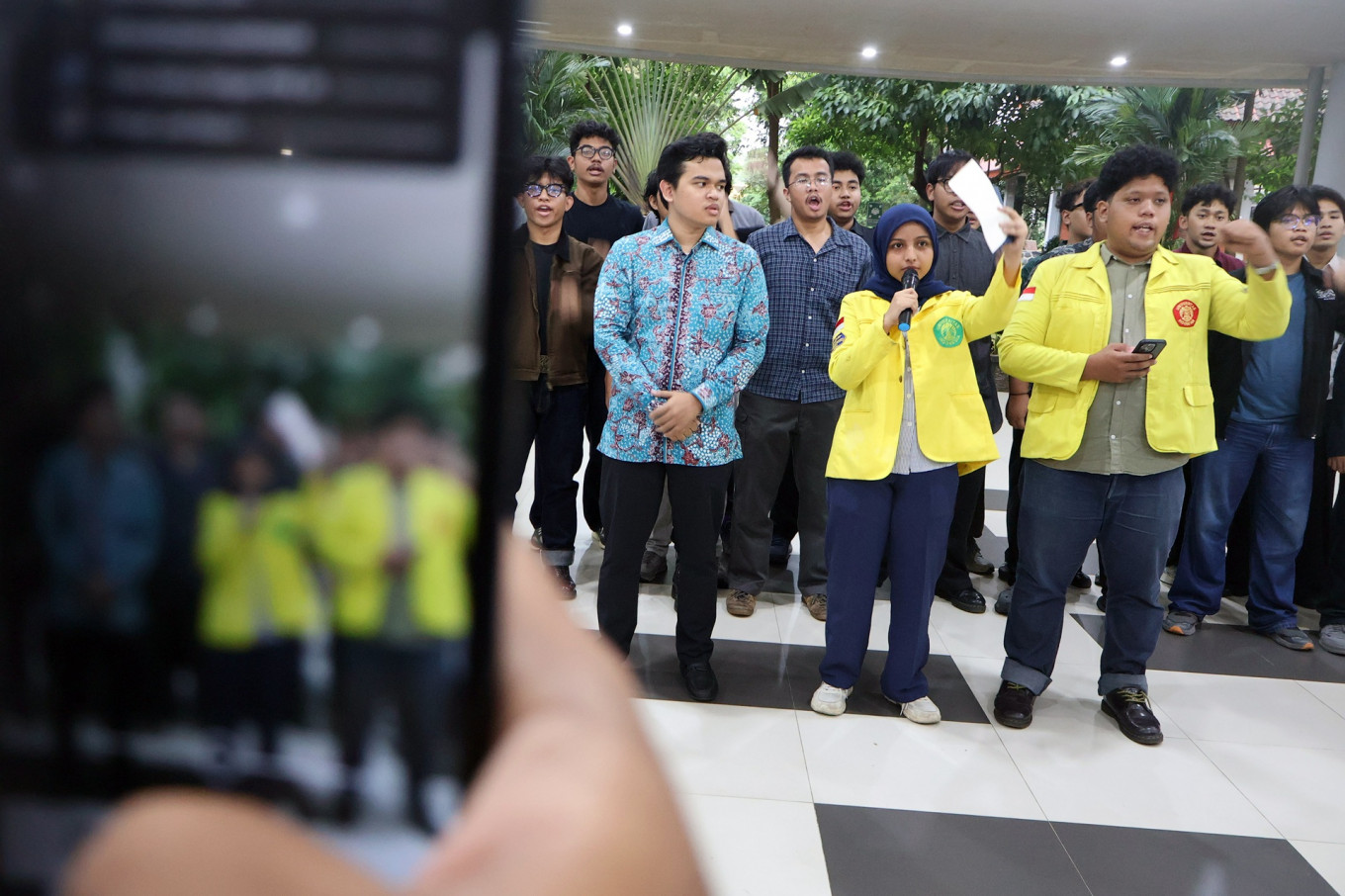 Students from the University of Indonesia (UI) Student Executive Board Alliance express their stance on April 14, 2026, regarding sexual harassment at the university's Law Faculty in Depok, West Java. The alliance urged the faculty's dean and the university rector to transparently process the case. (Antara/Yulius Satria Wijaya)
T
he recent controversy surrounding an explicit group chat involving more than a dozen students from the University of Indonesia’s (UI) Faculty of Law may not be entirely surprising, but it is no less disappointing.
While experts continue to debate whether the rape jokes and vulgar, sexually explicit remarks made about female peers and lecturers meet the threshold for criminally prosecutable sexual harassment, that legal question risks obscuring a more troubling truth.
It is profoundly disturbing that students at one of the country’s most prestigious law schools, future lawyers, judges and prosecutors, casually assert the dangerous fallacy that “silence means consent”. Just as concerning is the ease with which these individuals reduced their female peers and lecturers, many of whom are more highly educated than themselves, to mere sexual objects.
Most troubling of all, however, is what this controversy reveals about entrenched social attitudes. In the days after the case went viral, social media was saturated with responses, many from men, trivializing the incident.
Some dismissed it outright, noting there was no physical assault or direct confrontation. Others framed the remarks as harmless jokes typical of male friend groups or shifted blame onto those who exposed the conversation. Such reactions reflect the broader cultural mindset that allows sexual violence to take root, persist and escalate.
The “rape culture pyramid”, a framework developed by sociologists and educators, illustrates that extreme forms of sexual violence do not emerge in isolation. Instead, they are built upon a foundation of smaller, normalized behaviors. At the base of this pyramid are rape jokes, sexist humor and the objectification of women. While the first two are often dismissed as harmless, they contribute to an environment in which entitlement over another person’s body can quietly take hold.

Such language reflects a worldview in which women are not treated as fully autonomous individuals, but as objects available for sexual commentary. Framing this expression as “just harmless fun” minimizes its impact and normalizes attitudes that align with sexually predatory behavior.