TheJakartaPost
Please Update your browser
Your browser is out of date, and may not be compatible with our website. A list of the most popular web browsers can be found below.
Just click on the icons to get to the download page.


Popular Reads
Top Results
No results found. Please check your search term and try again
Can't find what you're looking for?
View all search results
Popular Reads
Top Results
No results found. Please check your search term and try again
Can't find what you're looking for?
View all search resultsA train collision waiting to happen: The human cost of system failure
While official reports often blame human error, the tragic collision in East Bekasi reveals a deeper, systemic rot within Indonesia’s railway infrastructure. True safety requires moving beyond segregated carriages and toward a modernized, automated network that protects all passengers by design.
Change text size
Gift Premium Articles
to Anyone
Share the best of The Jakarta Post with friends, family, or colleagues. As a subscriber, you can gift 3 to 5 articles each month that anyone can read—no subscription needed!
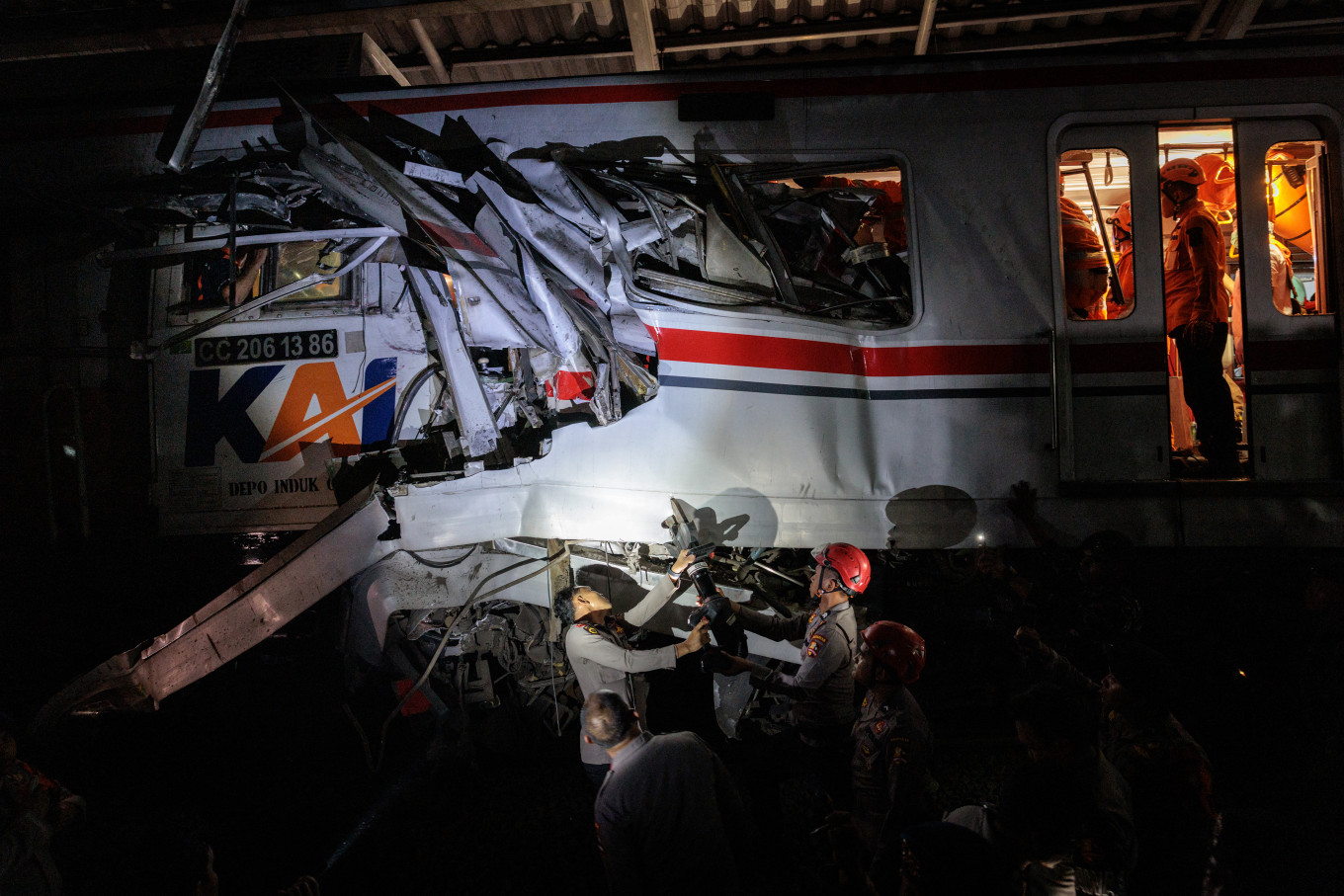 Rescuers work to save five survivors trapped inside a carriage after a passenger train locomotive pierced through the rear car of a commuter train on April 28, at Bekasi Timur station in Bekasi, West Java. (AFP/Yasuyoshi Chiba)
T
he recent collision involving a women-only carriage on the KAI Commuter Line in East Bekasi on April 27 has claimed at least 15 lives, shaking public confidence in one of Greater Jakarta’s most essential transport systems.
The tragedy is deeply unsettling, but not entirely surprising. Beneath the incident lies a long-standing pattern of risk embedded in Indonesia’s railway system, particularly at level crossings, where accidents have continued to rise despite clear regulatory frameworks.
Indonesian law is explicit: Law No. 23/2007 on Railways and Law No. 22/2009 on Road Traffic require road users to stop when train signals sound and barriers close. Yet, enforcement and infrastructure have lagged dangerously behind.
According to state railway company PT KAI (2025), Indonesia still operates 3,896 level crossings, 1,093 of which are illegal. Nearly half of these remain unguarded.
Over the past five years, accidents at these crossings have steadily increased—from 269 cases in 2020 to 337 in 2024—resulting in 1,226 victims and 450 fatalities. With more than 80 percent of accidents occurring at unguarded crossings (MTI, 2025), these are not isolated incidents; they are systemic failures.
A more precise way to understand this failure is through the hazard–barrier–target model, which views safety as a system's ability to prevent hazards from reaching people through multiple layers of protection. In a well-functioning network, hazards such as train movements are controlled through physical barriers, signaling systems, and grade separation. When these layers fail or remain incomplete, the hazard is no longer contained and directly strikes the "target"—the passengers.

At its core, the East Bekasi incident was not a single crash but a catastrophic chain reaction. It began when a taxi was struck by a commuter train at a level crossing. While operations on the adjacent track were halted to secure the area, a second, far more severe collision occurred: an intercity train (KA Argo Bromo) failed to stop in time and struck the stationary commuter train.