The Jakarta Post
Please Update your browser
Your browser is out of date, and may not be compatible with our website. A list of the most popular web browsers can be found below.
Just click on the icons to get to the download page.


Popular Reads
Top Results
No results found. Please check your search term and try again
Can't find what you're looking for?
View all search results
Popular Reads
Top Results
No results found. Please check your search term and try again
Can't find what you're looking for?
View all search resultsGlobal energy shock: A turning point for Indonesia’s nuclear energy policy?
As the Strait of Hormuz teeters on the edge of instability, Indonesia faces a high-stakes choice: remain shackled to volatile fossil fuel routes or embrace a nuclear future. This strategic pivot offers total energy sovereignty, but it requires the government to master a dangerous geopolitical balancing act and conquer decades of public fear over safety.
Change text size
Gift Premium Articles
to Anyone
Share the best of The Jakarta Post with friends, family, or colleagues. As a subscriber, you can gift 3 to 5 articles each month that anyone can read—no subscription needed!
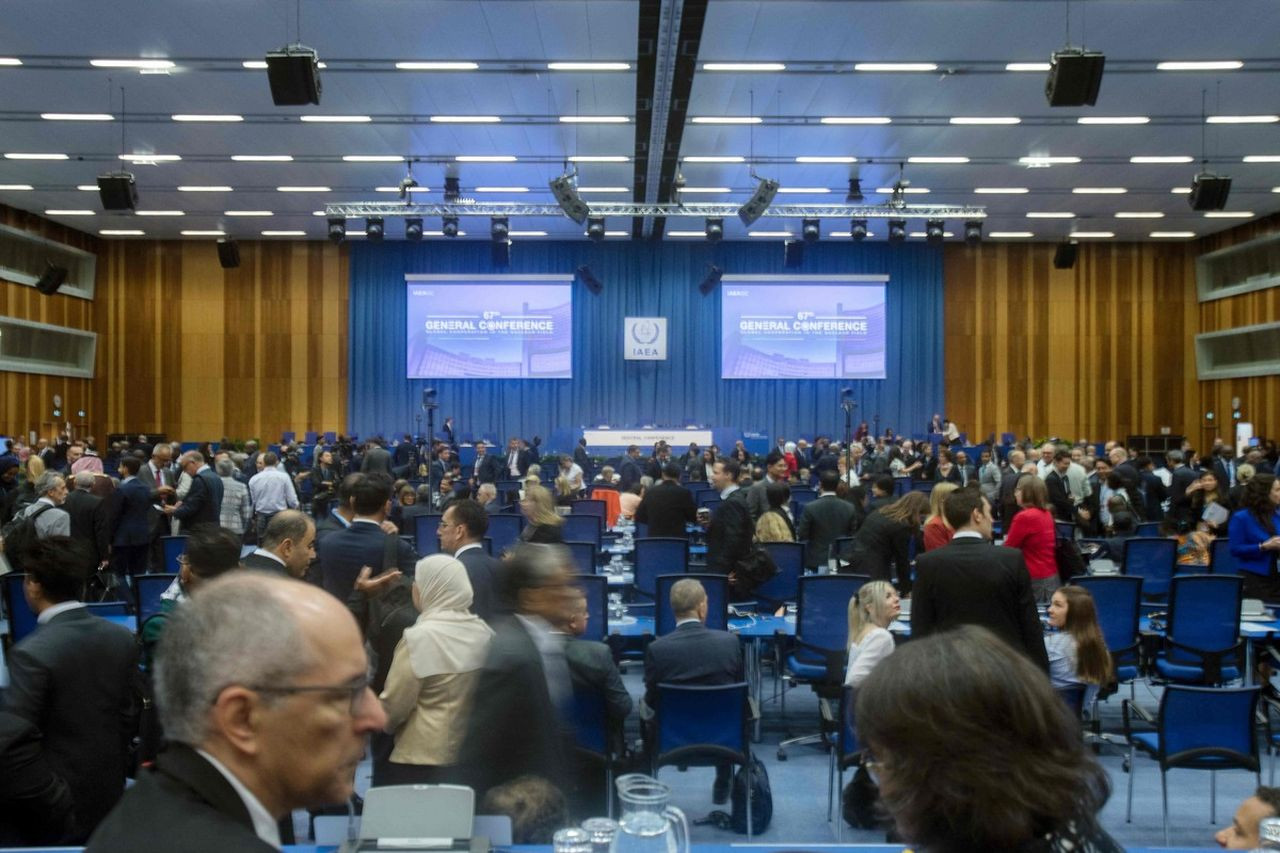 Delegates arrive for the opening ceremony of the 67th International Atomic Energy Agency (IAEA) General Conference on Sept. 25, 2023, at the global nuclear cooperation body’s Vienna headquarters. (AFP/Alex Halada)
T
he ongoing war in the Middle East has left uncertainty lingering over the state of the Strait of Hormuz, one of the world’s most critical energy choke points. For many Southeast Asian countries heavily dependent on imported crude oil and liquefied natural gas (LNG), this uncertainty is forcing a rethink of their energy strategy; one that goes beyond managing current disruptions to powering future demand.
Compared to biofuels, wind and solar, nuclear energy remains an underexplored option. This is partly due to public concern rooted in lingering perceptions shaped by past incidents, such as Fukushima Daiichi or Chernobyl. Meanwhile, demand trends underscore the urgent need for scalable clean energy solutions.
The International Energy Agency (IEA) projects Southeast Asia’s electricity demand to grow at least 5.3 percent annually over 2026-2030. Indonesia’s push for 8 percent economic growth will likely reinforce this trend. Under the latest National Electricity General Plan (RUKN), Indonesia’s energy demand is projected to more than triple by 2060, jumping from 539 terawatt-hours (TWh) in 2025 to 1,813 TWh.
Indonesia's inclusion of 500 megawatts of nuclear energy in the 2025-2034 Long-Term Electricity Supply Business Plan (RUPTL) signals an important leap toward energy sufficiency and decarbonization. While the 2032 commissioning target pushes the country into a regulatory and business sprint, it also creates a powerful mandate to accelerate nuclear technology deployment.
President Prabowo Subianto has recognized the urgency of meeting Indonesia’s growing energy demand with clean and stable power. In his state budget address, he set an ambitious goal of achieving 100 percent renewable energy within the decade, underscoring the country’s geothermal, wind and solar potential. Indonesia is also advancing its nuclear energy development through engagement across geopolitical lines, having signed memorandums of understanding with Canada, South Korea and the United States, as well as with China and Russia.
Indonesia is not the only country eyeing nuclear technology. Decarbonization and surging demand from AI and data centers have put nuclear back in the spotlight. Around 70 reactors are under construction globally, with 110 more planned and more than 300 proposed, adding to a worldwide fleet of 440 reactors already in operation.

At this stage, the success of Indonesia's nuclear energy agenda hinges on two key factors: a robust partnership strategy to address technological, operational and financing challenges, and effective public communication to close the perception gap.