The Jakarta Post
Please Update your browser
Your browser is out of date, and may not be compatible with our website. A list of the most popular web browsers can be found below.
Just click on the icons to get to the download page.


Popular Reads
Top Results
No results found. Please check your search term and try again
Can't find what you're looking for?
View all search results
Popular Reads
Top Results
No results found. Please check your search term and try again
Can't find what you're looking for?
View all search resultsMay Day 2026: From street rallies to real change
The path to true labor justice lies not in annual rhetoric but in structural reforms that integrate severance pay into social security and prioritize worker representation in the legislative process.
Change text size
Gift Premium Articles
to Anyone
Share the best of The Jakarta Post with friends, family, or colleagues. As a subscriber, you can gift 3 to 5 articles each month that anyone can read—no subscription needed!
 Set as preferred source
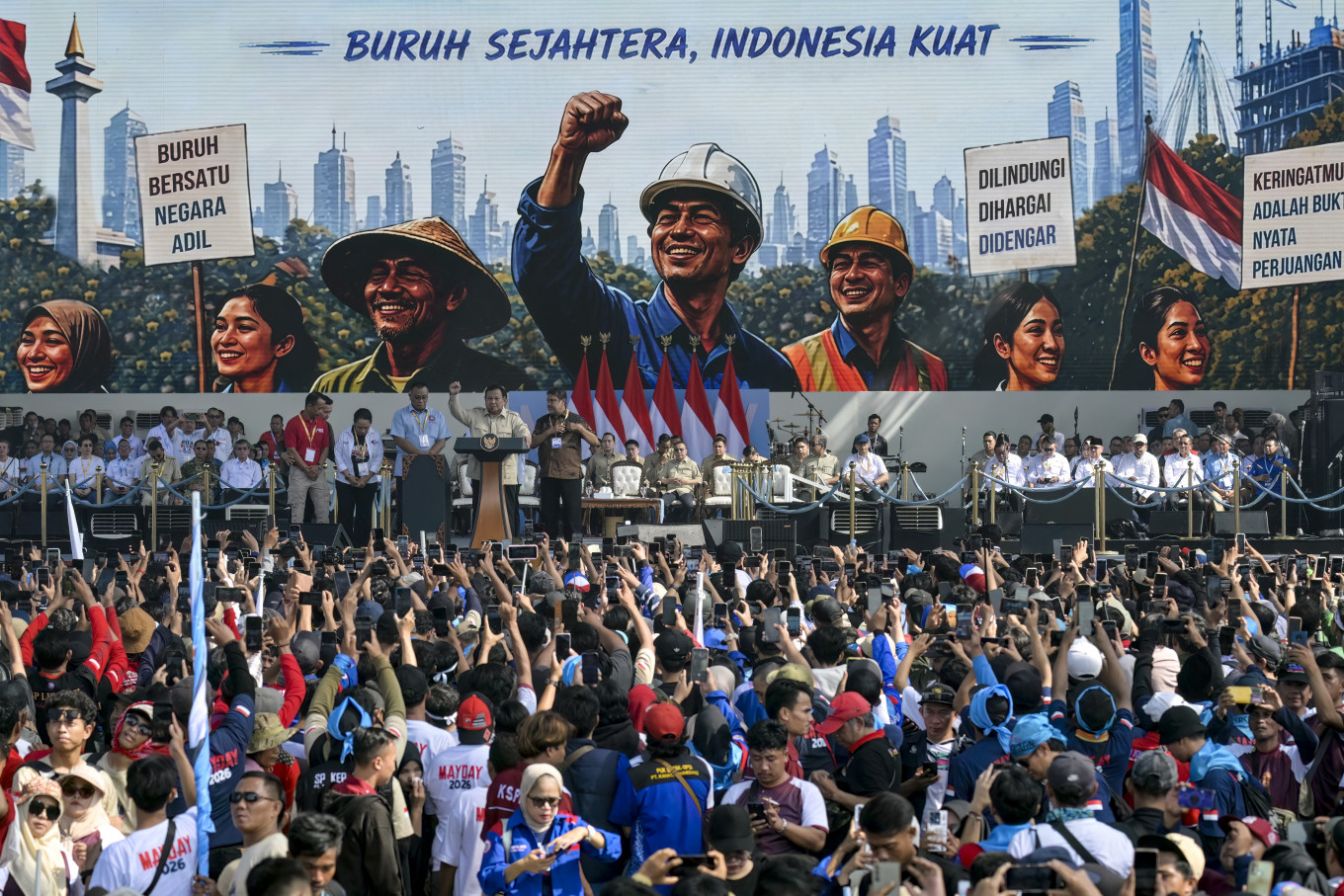 Labor and politics: President Prabowo Subianto (at podium) gestures on Friday, May 1, 2026, while delivering a speech in front of thousands of workers during Labor Day celebrations at the National Monument (Monas) park in Jakarta. (AFP/Bay Ismoyo)
E
ach year on May 1, Indonesian workers take to the streets in observance of International Labor Day, fueled by hope and determination. In 2026, it is imperative to acknowledge an uncomfortable reality: Despite the palpable enthusiasm of the national workforce, meaningful progress toward labor justice remains stalled, and many workers continue to confront legal and practical obstacles that have yet to be addressed in any substantive way.
On May Day this year, rather than relying on rhetoric alone, we require a renewed commitment to political action: one that translates into tangible legislative reforms and material improvements for Indonesia's workforce.
The issues raised annually, ranging from minimum wage stagnation to inadequate severance pay and social security, remain static, highlighting the current inability of trade unions to transform workers’ demands into reality. This institutional struggle is reflected in the decline of trade union density, falling from 14 percent in 2017 to approximately 11.76 percent in 2022.
This trend, mirrored in many economies around the world, explains why trade unions are increasingly marginalized in public policy formulation. Furthermore, the proliferate creation of informal jobs is fundamentally altering union membership and structure and hindering the advancement of organized labor.
The present crisis stems from a somber truth: The Constitutional Court ruled that the Job Creation Law (Law No. 11/2020) was conditionally unconstitutional, not because its objectives were inherently flawed but due to the deliberate exclusion of worker representation during the deliberative process. That wound remains raw.
While the Constitutional Court Decision No. 168/2023 subsequently amended Manpower Law No. 6/2023 to rectify previous shortcomings, it has failed to provide the material security necessary for the average household. Between August 2024 and August 2025, only 200,000 of the nearly 2 million newly created jobs were in the formal sector. The remainder were in the informal sector, characterized by a total lack of job security.

Legal certainty cannot be realized without harmonious labor relations and serious consideration of trade union recommendations.