TheJakartaPost
Please Update your browser
Your browser is out of date, and may not be compatible with our website. A list of the most popular web browsers can be found below.
Just click on the icons to get to the download page.


Popular Reads
Top Results
No results found. Please check your search term and try again
Can't find what you're looking for?
View all search results
Popular Reads
Top Results
No results found. Please check your search term and try again
Can't find what you're looking for?
View all search resultsMiddle powers: A new vision for India and Indonesia
Despite their geographical proximity and deep-rooted cultural affinities, India and Indonesia often overlook their potential as a united diplomatic front. By reclaiming the historic spirit of the Bandung Conference, these two "middle powers" could lead the way toward a more stable, multipolar world order.
Change text size
Gift Premium Articles
to Anyone
Share the best of The Jakarta Post with friends, family, or colleagues. As a subscriber, you can gift 3 to 5 articles each month that anyone can read—no subscription needed!
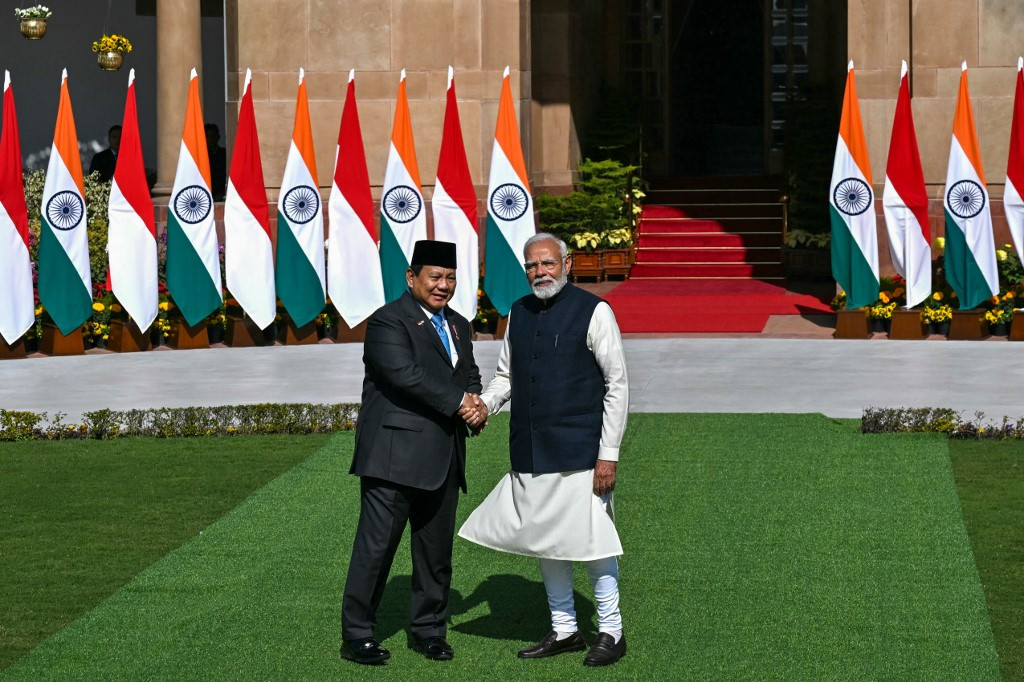 Indian Prime Minister Narendra Modi (right) welcomes President Prabowo Subianto on Jan. 25, 2025, at Hyderabad House in New Delhi. (AFP/Money Sharma)
E
ver since I spent a year as India’s ambassador to Indonesia in 2001-2002, I have had the impression that this archipelagic country to our east occupies less space in Indian minds than it should.
Few Indians are aware that Indonesia is a close and contiguous neighbor. The last island in the Nicobar chain is barely 80 kilometers from the first island north of Sumatra. Our two countries share a defined maritime boundary.
Historically, Indonesia straddled maritime routes leading from ports on the Indian peninsula to China’s eastern seaboard. Beyond being a transit point, flourishing trade existed between India and the Indonesian islands. While Indian cotton was a major trade item, the exquisite patolas (silk cloth) from Gujarat were especially prized among the elite and preserved over generations.
I recall the sultan of Yogyakarta held family heirlooms such as jackets and flared pants made of patola that were centuries old. These were worn exclusively by the princesses of the royal court for sacred dances, performed once a year, to ensure a bountiful harvest. On Sumatra, a mosque I visited even kept the holy Quran wrapped in a piece of patola.
In return, Indian traders bought large quantities of Indonesian spices. Ports on the Malabar coast, such as Kochi (Cochin) and Kollam (Quilon), became entrepôts for the spice trade, particularly pepper. Along with trade, cultural exchanges followed, as did religious ideas and rituals.
However, it is the innate genius and aesthetic sense of the Indonesian people that transformed these cultural infusions, not intrusions, into something uniquely their own. One may see the colors and hear the sounds of India across the islands, but this is not India. There is affinity but not identity.

A culture which has celebrated its own expansive plurality through the ages welcomed its multiple transformations in distant lands. In the 11th century, a dean of famed Vikramshila University, Atisa Dipamkara, braved the elements and sailed to Palembang in southeastern Sumatra to learn at the feet of Dharmakirti, an Indonesian Buddhist master revered across the Buddhist world. How these transformations took place and enriched the interacting cultures over time would be a fascinating historical inquiry.