TheJakartaPost
Please Update your browser
Your browser is out of date, and may not be compatible with our website. A list of the most popular web browsers can be found below.
Just click on the icons to get to the download page.


Popular Reads
Top Results
No results found. Please check your search term and try again
Can't find what you're looking for?
View all search results
Popular Reads
Top Results
No results found. Please check your search term and try again
Can't find what you're looking for?
View all search resultsThe Malacca Strait runs the world
Not Hormuz, but Malacca is the true fulcrum of global maritime power — and the evidence is already gathering on the ocean floor.
Change text size
Gift Premium Articles
to Anyone
Share the best of The Jakarta Post with friends, family, or colleagues. As a subscriber, you can gift 3 to 5 articles each month that anyone can read—no subscription needed!
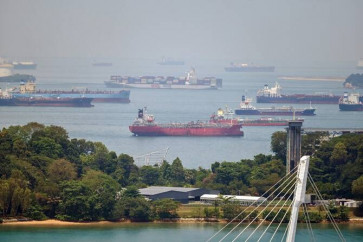
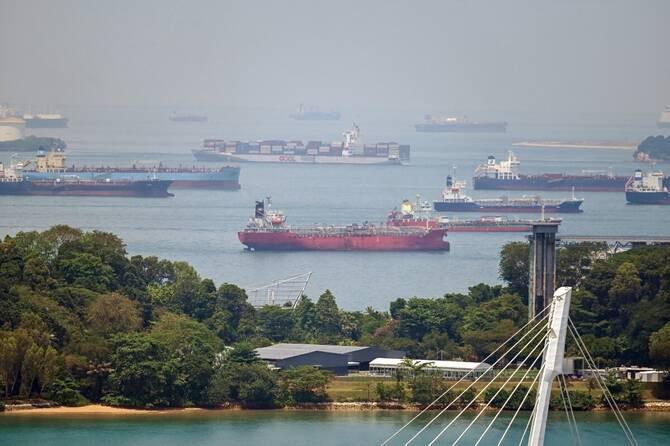 A container ship sails past oil tankers anchored on April 14 in the Singapore Strait, a key gateway to the Strait of Malacca. (AFP)
W
hen Iran shut the Strait of Hormuz during its conflict with the United States and Israel, the world took notice immediately. Global oil supply contracted by an estimated 20 percent, energy prices convulsed and the episode delivered a blunt reminder that chokepoints — those narrow passages through which disproportionate volumes of global commerce must flow — remain among the most potent instruments of strategic leverage in the modern age.
The ceasefire that took effect on April 18, has since been extended, but the lesson it produced endures. What remains underappreciated, however, is that Hormuz is not the most consequential strait on Earth. That distinction belongs to Malacca.
The Strait of Malacca carries an average of 23 million barrels of oil per day, making it the world's single busiest petroleum transit corridor. In 2025, more than 102,000 vessels of all types passed through its 900-kilometer length, carrying cargo that accounted for one-third of global merchandise trade.
China depends on Malacca for approximately 75 percent of its crude oil imports from the Middle East, Africa and Asia. Japan and South Korea rely on it for 90 percent of their oil supply. This dependency creates a dilemma, since the strait, which is not within their control, has become the center of gravity of the dependent economies. Hence, it would be a great concern for them in any case that impedes the free flow of goods in the strait.
Geography sharpens the strait’s strategic significance further. At the Phillips Channel near Singapore, its narrowest point measures just 2.7 km across. In several sections, the water depth falls to between 25 and 27 meters — too shallow for the largest tankers and container vessels, which must divert through Indonesia's Sunda or Lombok Straits, adding thousands of nautical miles and tens of thousands of dollars per voyage. Hormuz, by contrast, offers a wider passage, greater depth and a more limited range of dependent economies.
Malacca combines maximum commercial volume with minimum physical margin. It is, in every measurable sense, the more irreplaceable waterway.

History anticipated this reality. Economic historian William Bernstein observed that "convoluted coastal geography taught its merchants and navies the value of strategic straits and passages, the capture of which could bring starvation to a nation or to its enemies."