TheJakartaPost
Please Update your browser
Your browser is out of date, and may not be compatible with our website. A list of the most popular web browsers can be found below.
Just click on the icons to get to the download page.


Popular Reads
Top Results
No results found. Please check your search term and try again
Can't find what you're looking for?
View all search results
Popular Reads
Top Results
No results found. Please check your search term and try again
Can't find what you're looking for?
View all search resultsHow obscure interpretation of state losses fuels capital flight
When headline-grabbing "state loss" prosecutions replace rigorous evidence, Indonesia risks trading its top talent and foreign investment for a judicial spectacle where everyone loses.
Change text size
Gift Premium Articles
to Anyone
Share the best of The Jakarta Post with friends, family, or colleagues. As a subscriber, you can gift 3 to 5 articles each month that anyone can read—no subscription needed!
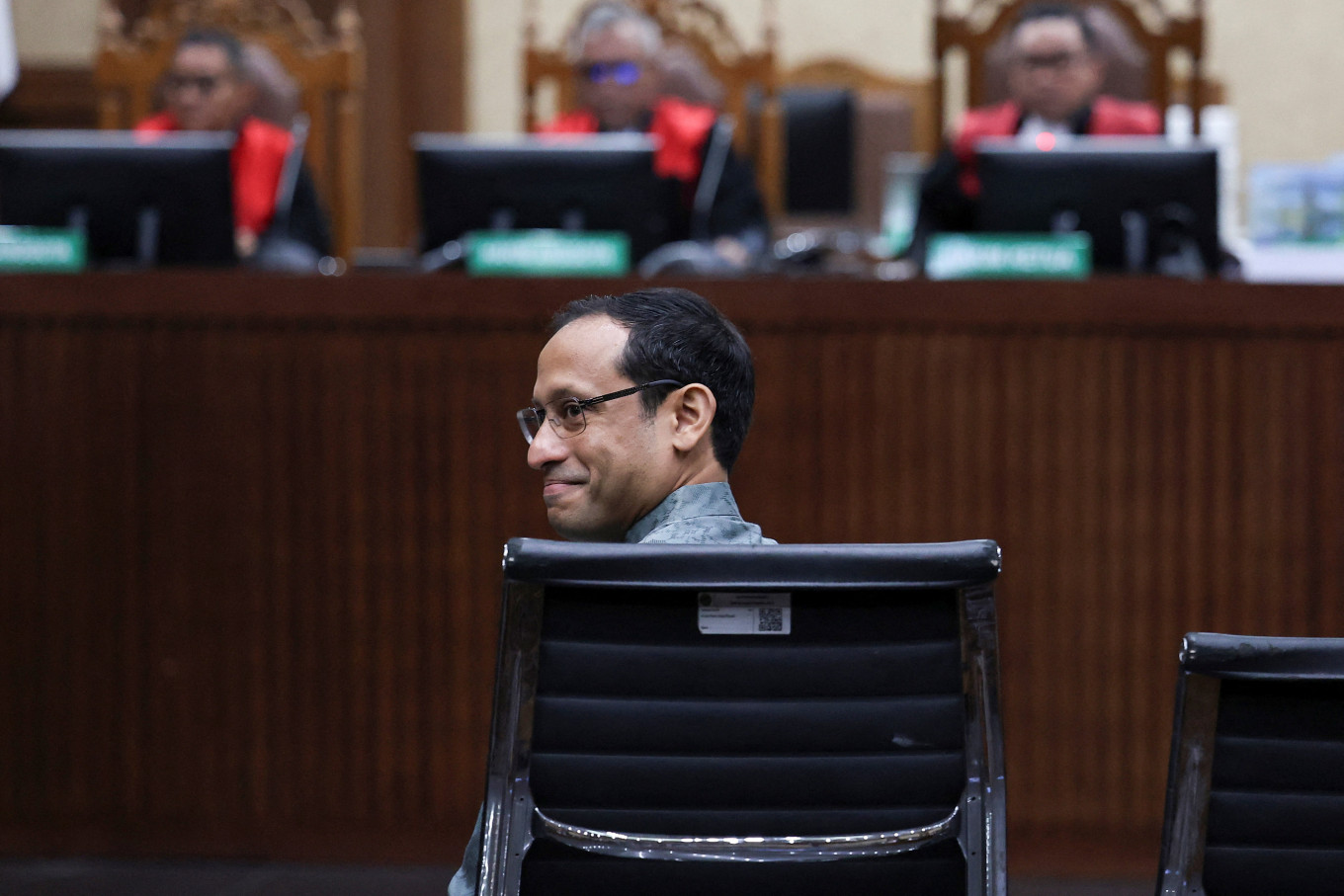 Former education minister Nadiem Makarim reacts prior to his trial in an alleged corruption case about his involvement in the procurement of Google Chromebook laptops for use at his ministry and by students, at the Jakarta Corruption Court on Jan. 5, 2026. (Reuters/Willy Kurniawan)
S
ince 2025, Bank Indonesia has reported significant capital outflows, exacerbated by MSCI’s warnings that triggered days of sequential market crashes. Simultaneously, Indonesia’s Corruption Perception Index has fallen to 109, placing the country on a par with Laos in its anti-corruption standing.
These may seem like two separate issues. However, evidence suggests that these phenomena stem, at least in part, from a misdirection in the country’s public law enforcement. Specifically, the system has shifted toward a specific and obscure financial crime of causing "state financial losses", a strategy that prioritizes news value over the accuracy and quality of convictions.
These viral-based prosecutions create unintended consequences, such as the deprioritization of complex financial market crimes, like insider trading or market manipulation, that erode market integrity and harm the public in the long run. Conversely, prosecutions based on spectacle and "state losses" generate significant noise and incentivize prosecutors to focus on exposing obscure violations.
This trend has been used repeatedly to scapegoat innocent professionals, from former trade minister Tom Lembong to Thomas van der Heyden, an American satellite industry professional who served as a consultant to the Defense Ministry.
To stop viral-based prosecutions in the short term, Indonesian regulators must apply stricter standards when formulating the three elements of a state-loss charge: first, the calculation of actual losses; second illicit enrichment; and third, mens rea (criminal intent).
This shift in focus, from "illicit enrichment" to "state losses", has brought concerning ramifications. To date, the broad interpretation of state losses disregards the principle of separation of assets and the business judgment rule. By improperly including opportunity losses, failing to distinguish between illicit and lawful enrichment, and failing to establish mens rea, the Indonesian criminal justice system has produced a "type-II error" in public enforcement.

According to Polinsky and Shavell, a type-II error refers to a false positive or wrongful conviction that undermines the deterrence objective of criminal law. Instead of deterring corrupt actors, this error reduces the difference between the cost of committing a crime and the cost of staying lawful. In other words, it discourages participation in legitimate activities because the legal risk remains the same regardless of conduct.