The Jakarta Post
Please Update your browser
Your browser is out of date, and may not be compatible with our website. A list of the most popular web browsers can be found below.
Just click on the icons to get to the download page.


Popular Reads
Top Results
No results found. Please check your search term and try again
Can't find what you're looking for?
View all search results
Popular Reads
Top Results
No results found. Please check your search term and try again
Can't find what you're looking for?
View all search resultsMisreading Iran: How strategy collapses into damage control
When "quick wins" collide with deep-rooted regional resilience, global powers face a sobering reality: in the age of drone warfare and strategic miscalculation, air sovereignty is no longer just a legal concept - it is the ultimate survival tool.
Change text size
Gift Premium Articles
to Anyone
Share the best of The Jakarta Post with friends, family, or colleagues. As a subscriber, you can gift 3 to 5 articles each month that anyone can read—no subscription needed!
 Set as preferred source
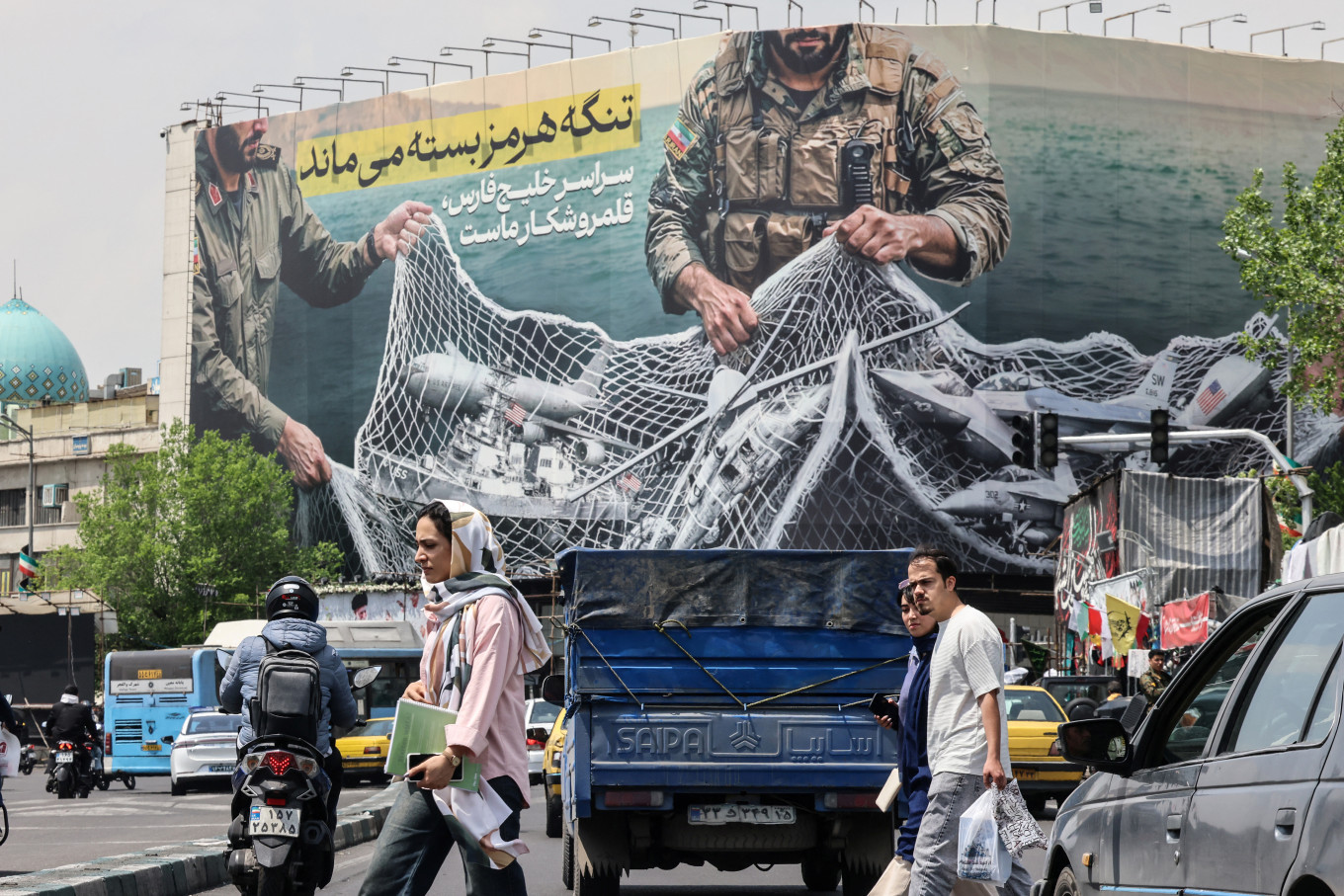 Under the spotlight: Iranians walks past a giant billboard on April 22 reading “The Strait of Hormuz remains closed” at the Revolution Square in Tehran, amid a ceasefire in the region. (AFP/Atta Kenare)
T
he evolution of the Middle East conflict over the past two months has entered an unexpected phase. The confidence of the United States under Donald Trump, which appeared to grow from what was perceived as a quick and relatively low-cost success in pressuring Venezuela, now looks increasingly like a strategic illusion.
That sense of success encouraged Washington, alongside Israel, to launch a military operation against Iran. Reality, however, has quickly demonstrated that Iran is not Venezuela.
The fundamental difference lies in geopolitical complexity. Venezuela sits within the traditional sphere of US influence, relatively isolated and lacking meaningful power projection capabilities. Iran, by contrast, functions as the center of the "axis of resistance", stretching from Tehran to Beirut and Sana’a. Any attack on Iran inevitably triggers a multi-actor response involving Hezbollah in Lebanon, Shia militias in Iraq and the Houthi movement in Yemen. In this context, striking Iran is not a limited operation but the opening of a broader regional confrontation.
Iran’s national resilience is also fundamentally different. While Venezuela collapsed under the weight of hyperinflation and systemic economic breakdown, Iran has spent decades building a "resistance economy" under sustained sanctions. It has developed alternative logistics networks, domestic military production and a deeply embedded culture of national endurance. Its ability to produce drones and ballistic missiles, combined with unconventional energy distribution networks, allows the state to function even under extreme external pressure.
Equally important is Iran’s political structure, which demonstrates a stable mechanism of succession. When Qassem Soleimani was killed in 2020, the transition of command within Iran’s Islamic Revolutionary Guard Corps (IRGC) occurred rapidly without a vacuum of authority. This stands in stark contrast to Venezuela’s dependence on personalized leadership; Iran reflects a state built on institutions and ideology rather than individual loyalty.
Strategic miscalculation is further exposed by internal dynamics within the US. Early signs of unpreparedness emerged when the Pentagon did not fully align behind the operation. Reports of senior military officials resisting what they viewed as a high-risk and poorly calculated plan highlight a serious warning sign. In professional military tradition, a sharp divide between political leadership and military command signals deep structural problems.

The turnover and pressure placed on military elites suggest a growing politicization of strategic decision-making. This has had direct consequences on operational execution, particularly in logistics and command coherence. Plans to blockade the Strait of Hormuz, a vital artery for global energy trade, proved ineffective. Without unified naval support and a reliable supply chain, such a move risks triggering wider economic disruption rather than achieving strategic gains.