The Jakarta Post
Please Update your browser
Your browser is out of date, and may not be compatible with our website. A list of the most popular web browsers can be found below.
Just click on the icons to get to the download page.


Popular Reads
Top Results
No results found. Please check your search term and try again
Can't find what you're looking for?
View all search results
Popular Reads
Top Results
No results found. Please check your search term and try again
Can't find what you're looking for?
View all search resultsIndonesia’s Latin American pivot strengthens South-South cooperation
Cooperation between Southeast Asia and Latin America matters, as both regions face similar pressures related to sustainable development, biodiversity protection and green industrialization.
Change text size
Gift Premium Articles
to Anyone
Share the best of The Jakarta Post with friends, family, or colleagues. As a subscriber, you can gift 3 to 5 articles each month that anyone can read—no subscription needed!
 Set as preferred source
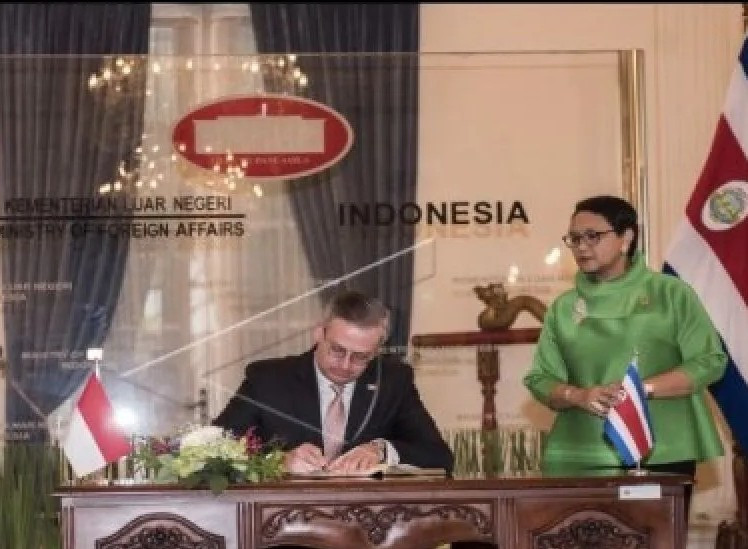 Costa Rican Foreign Minister Manuel Antonio Gonzales Sanz signs the guest book as his counterpart Retno Marsudi looks on at the Indonesian Foreign Ministry in Jakarta on Sept. 3, 2017. (Antara/Agung Rajasa)
I
ndonesia’s growing engagement with Latin America and the Caribbean reflects a broader transformation in global politics. As geopolitical tensions intensify and supply chains become increasingly fragmented, middle powers are searching for new partnerships beyond traditional alliances.
In this context, Indonesia is positioning itself not only as a Southeast Asian leader but also as a potential bridge connecting ASEAN, the Indo-Pacific and Latin America through pragmatic South-South cooperation.
This strategy is not based on ideology alone. Indonesia seeks to diversify its economic partnerships, reduce dependence on a limited number of major powers and expand its diplomatic influence across the Global South.
Latin America offers important opportunities in trade, energy transition, food security, critical minerals, agriculture and digital development. At the same time, many Latin American countries are also attempting to diversify their international partnerships beyond the United States and China. This creates a favorable environment for deeper interregional cooperation.
Indonesia’s role within ASEAN gives it a comparative advantage in this process. As the region’s largest economy and diplomatic anchor, Indonesia has consistently promoted dialogue, strategic autonomy and inclusive regionalism.
These principles can serve as the foundation for stronger engagement with Latin America and the Caribbean. Rather than approaching the region only through bilateral trade agreements, Indonesia could promote a broader ASEAN-Latin America connectivity framework focused on practical cooperation and long-term institution building.

A smarter strategy, however, requires moving beyond traditional export diplomacy. The current relationship remains limited by distance, logistics costs, weak institutional coordination and insufficient people-to-people connectivity. If Indonesia wants to become a true bridge between Southeast Asia and Latin America, it must adopt a more comprehensive and innovation-driven approach.