The Jakarta Post
Please Update your browser
Your browser is out of date, and may not be compatible with our website. A list of the most popular web browsers can be found below.
Just click on the icons to get to the download page.


Popular Reads
Top Results
No results found. Please check your search term and try again
Can't find what you're looking for?
View all search results
Popular Reads
Top Results
No results found. Please check your search term and try again
Can't find what you're looking for?
View all search resultsThe K-pattern and governance asymmetry, an uneven distribution of state capacity
While Indonesia’s macroeconomic indicators signal stability, a deepening governance asymmetry risks turning a temporary K-shaped recovery into a permanent structural divide.
Change text size
Gift Premium Articles
to Anyone
Share the best of The Jakarta Post with friends, family, or colleagues. As a subscriber, you can gift 3 to 5 articles each month that anyone can read—no subscription needed!
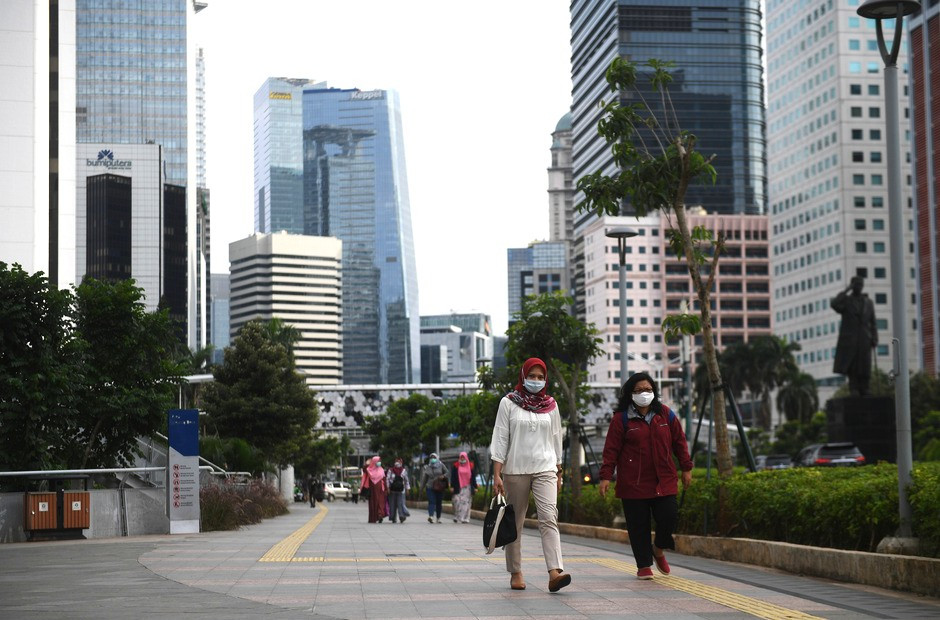 Office workers and other pedestrians stroll along a sidewalk on April 16, 2020, along Jl. Sudirman in downtown Jakarta. (Antara/Akbar Nugroho Gumay)
Economic data from 2019 through the first quarter of 2026 suggests that Indonesia is not currently in a macroeconomic crisis.
Several indicators remain stable. For instance, economic growth continues to hover around the 5 percent range and the fiscal deficit, which spiked during the pandemic, has been successfully reduced to near the 3 percent limit mandated by Law No. 17/2003. Since the public debt ratio also remains within a manageable corridor, aggregate indicators give the impression of a steady economy.
However, this surface-level stability should not be mistaken for a definitive benchmark of long-term resilience. A closer look at the economic structure reveals a middle class that has shrunk relative to its pre-pandemic size, while workforce informality remains stubbornly high at between 58 and 60 percent.
This phenomenon demonstrates that the economic pressures of the 2019-2026 period have not had a uniform impact. While some sectors and social groups have adapted and thrived, others remain trapped in structural vulnerability. This divergence is known as a K-shaped recovery.
In a K-shaped recovery, the economy does not collapse, but its resilience splits: one side ascends while the other stagnates or weakens. Though this trend may not appear dramatic in the short term, as aggregate data still suggests stability, it eventually degrades the quality of national development.
To understand this divergence, we must treat governance not merely as an administrative function but as a strategic resource. Following the resource-based view (RBV) theory, sustainability is defined by the ability to manage resources that are valuable, rare and difficult to replicate. At the state level, the most vital strategic resource is governance capacity.

The ability to exercise fiscal discipline, maintain monetary stability, respond to external shocks and coordinate cross-sectoral policies are primary forms of state capability. Indonesia’s response to COVID-19 proves that such an adaptive capacity exists.