TheJakartaPost
Please Update your browser
Your browser is out of date, and may not be compatible with our website. A list of the most popular web browsers can be found below.
Just click on the icons to get to the download page.


Popular Reads
Top Results
No results found. Please check your search term and try again
Can't find what you're looking for?
View all search results
Popular Reads
Top Results
No results found. Please check your search term and try again
Can't find what you're looking for?
View all search resultsWhy Indonesia’s emissions trading system needs revision
Indonesia has built a sophisticated carbon market on paper, but without a tighter cap and a real price floor, it remains a system for recording emissions rather than reducing them.
Change text size
Gift Premium Articles
to Anyone
Share the best of The Jakarta Post with friends, family, or colleagues. As a subscriber, you can gift 3 to 5 articles each month that anyone can read—no subscription needed!
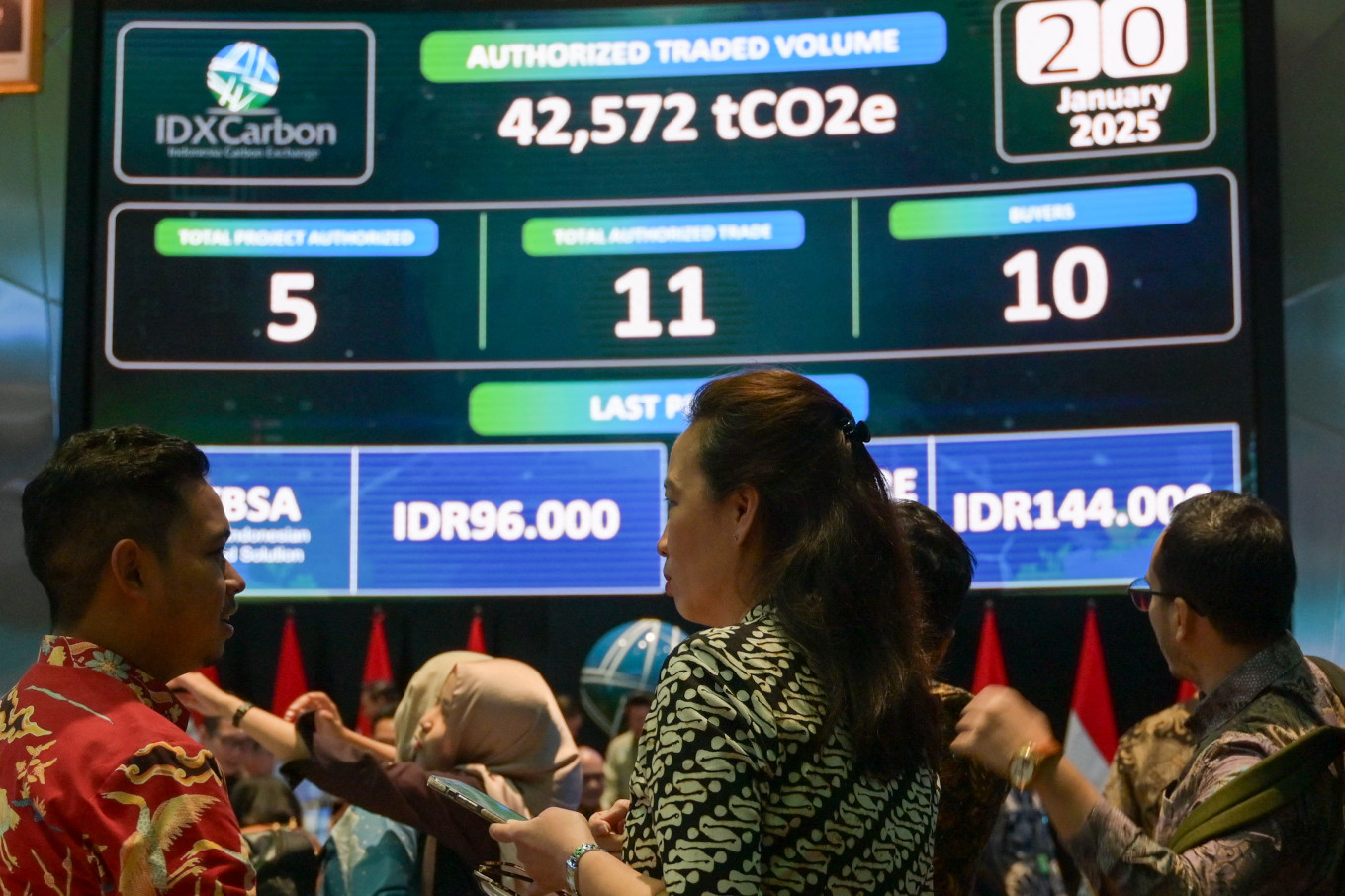 Traders crowd around an electronic information display showing watch carbon trading activity on Jan. 20, 2025, at the Indonesia Stock Exchange in Kebayoran Baru, South Jakarta. (AFP/Bay Ismoyo)
I
ndonesia’s emissions trading system (ETS) has been operational for three years, supported by a presidential regulation (Perpres), an implementing regulation, a national registry, a carbon exchange and a complete cycle of public trading data. However, it does not yet produce a functioning carbon price. The reason for this stagnation lies within the very design of the regulations.
A new Perpres issued in October 2025 has triggered a revision of the system’s operational rules, currently governed by Energy and Mineral Resources Ministerial Regulation No. 16/2022. As the government updates these frameworks, the critical question is: Which elements will be rewritten and which will remain unchanged to truly drive decarbonization?
The Indonesia Carbon Exchange (IDXCarbon) publishes monthly trading reports and has public archives spanning from June 2025 to March 2026. This period covers the 2025 compliance year and the surrender window that closed on April 20, 2026. It also marks the first cycle of Phase 2, where coverage expanded from 146 grid-connected coal plants to 563 installations, including captive coal and gas plants serving heavy industry.
The 2025 compliance year closed with a total trading volume of 903,915 tonnes of CO2 at a value of Rp 36.4 billion (US$2.3 million). Against the 225 million tonnes covered by the system in 2024, this represents less than half a percent of the regulated base.
Over 95 percent of that volume moved through the negotiated market, or bilateral deals registered through the exchange, rather than the regular market where open price discovery occurs. The regular market contributed a mere 3,672 tonnes in 2025, while the auction market has recorded zero volume since the exchange opened in 2023.
Trading activity concentrates heavily around compliance deadlines. December 2025 saw 190,264 tonnes traded, while March 2026 saw a recovery to 43,117 tonnes as the surrender deadline approached.

However, the number of retired units jumped significantly in March, while available units fell by a nearly identical amount. This suggests that entities are simply using existing holdings rather than engaging in new market activity. Following all surrenders, more than 3.14 million tonnes remained available on the exchange, creating a massive supply overhang.