The Jakarta Post
Please Update your browser
Your browser is out of date, and may not be compatible with our website. A list of the most popular web browsers can be found below.
Just click on the icons to get to the download page.


Popular Reads
Top Results
No results found. Please check your search term and try again
Can't find what you're looking for?
View all search results
Popular Reads
Top Results
No results found. Please check your search term and try again
Can't find what you're looking for?
View all search resultsDeconstructing conflict in Papua: A land beyond vacancy
As the government intensifies its food estate ambitions in Papua, a staggering 58-to-1 military-to-insurgent ratio reveals a development strategy that prioritizes industrial expansion over the basic human rights and ancestral lands of the indigenous population.
Change text size
Gift Premium Articles
to Anyone
Share the best of The Jakarta Post with friends, family, or colleagues. As a subscriber, you can gift 3 to 5 articles each month that anyone can read—no subscription needed!
 Set as preferred source
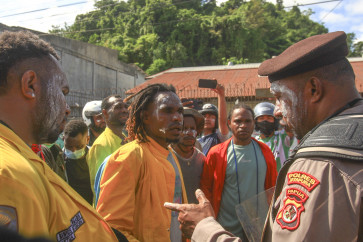
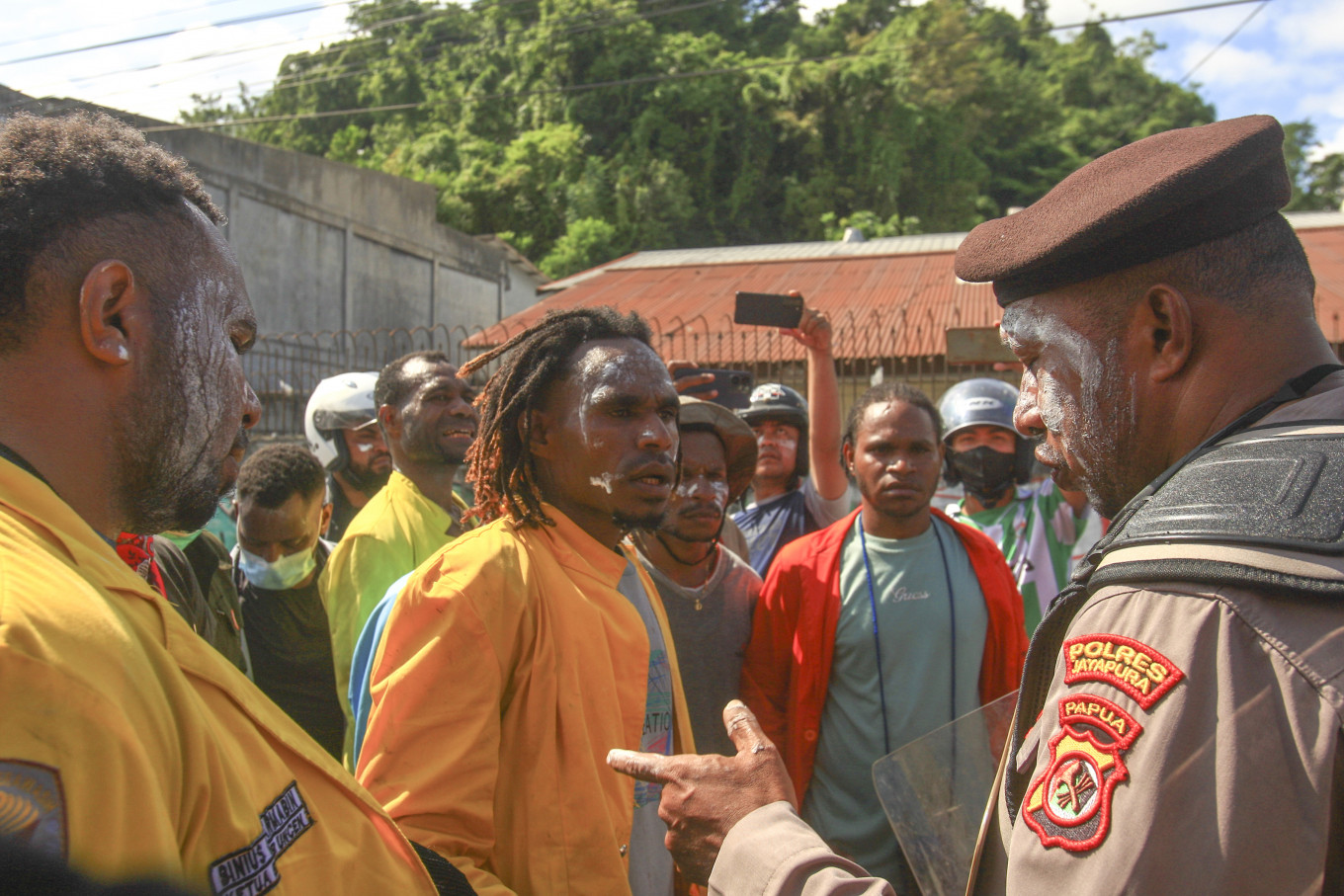 Police officers speak with protesters opposing violence in Papua on April 27 in Jayapura, Papua. Jayapura Police deployed 1,200 joint personnel from the police and military to secure the protest. (Antara/Gusti Tanati)
V
iolence in Papua has continued to escalate over the past four months. The latest incident occurred on April 14 in the districts of Kembru and Pogoma in Puncak Regency, Central Papua, leaving 15 civilians dead and seven others injured, including children
Reports from the Papuan Church Council and local pastors describe coordinated ground and air attacks involving firearms and grenades directed at honai (traditional mushroom-roofed houses). Gunfire was also reported at displacement sites in Kembru—an area previously designated as a civilian safe zone—which housed residents fleeing clashes between state security forces and the West Papua National Liberation Army (TPNPB), the armed wing of the Free Papua Organization (OPM).
In response to the violence, the Puncak government declared a 14-day emergency response status on April 17. This decision aimed to accelerate aid for hundreds of internally displaced persons (IDPs) and facilitate the evacuation of victims trapped within the conflict zone. Meanwhile, on April 27, Papuan Students Solidarity held coordinated protests in Jayapura, Nabire and Wamena to demand an end to excessive militarization. In Jayapura, the rally escalated into unrest, and police dispersed protesters with tear gas and water cannons.
Further calls for peace came from the National Committee for West Papua (KNPB) on May 1. Their demands included the removal of military posts, an end to indigenous land seizures and the closure of gold and copper producer PT Freeport Indonesia. The protest coincided with the 63rd anniversary of the administration of Papua being transferred from the United Nations Temporary Executive Authority (UNTEA) to Indonesia.
Opposition to this militarization is well-founded. As of December 2025, there are 56,517 organic Indonesian Military (TNI) personnel stationed in Papua out of a total 83,177 security personnel, according to independent data. Between 2024 and 2026, TNI numbers swelled further through the establishment of five Vulnerable Area Support (PDR) infantry battalions tasked with food security projects—predominantly in Merauke, South Papua.
This density creates a ratio of one soldier to every 103 residents and one police officer to every 219 residents, based on a 2025 population of 5.8 million. These figures are starkly disproportionate to national averages, where the ratio is approximately one soldier per 696 residents. While the state justifies this presence as necessary to confront separatist groups—estimated by police to number just 1,438 members with limited weaponry—the reality is that state forces outnumber insurgents at a staggering ratio of 58 to 1.

Despite this overwhelming force, the conflict persists. The instability is not merely a byproduct of separatism; it is rooted in economic disparity, the marginalization of Indigenous Papuans (OAP), and the systematic appropriation of ulayat (customary) lands. Although the Special Autonomy Law (Otsus) was intended to protect indigenous rights, its implementation has been contradicted by a surge in displacement. Indonesia Legal Aid Institute Foundation (YLBHI) data indicates that since 2018, the number of IDPs has reached 76,228 across seven regencies, severing their access to education and traditional livelihoods.