The Jakarta Post
Please Update your browser
Your browser is out of date, and may not be compatible with our website. A list of the most popular web browsers can be found below.
Just click on the icons to get to the download page.


Popular Reads
Top Results
No results found. Please check your search term and try again
Can't find what you're looking for?
View all search results
Popular Reads
Top Results
No results found. Please check your search term and try again
Can't find what you're looking for?
View all search resultsWhen democracy tires, movements fade and a generation holds back
When political systems neither collapse nor improve, they enter a state of fatigue that erodes the very possibility of reform. Indonesia has transitioned from the explosive ruptures of 1998 to a modern era of managed stagnation, leaving a generation to navigate a democracy that functions as a procedure but fails as a promise.
Change text size
Gift Premium Articles
to Anyone
Share the best of The Jakarta Post with friends, family, or colleagues. As a subscriber, you can gift 3 to 5 articles each month that anyone can read—no subscription needed!
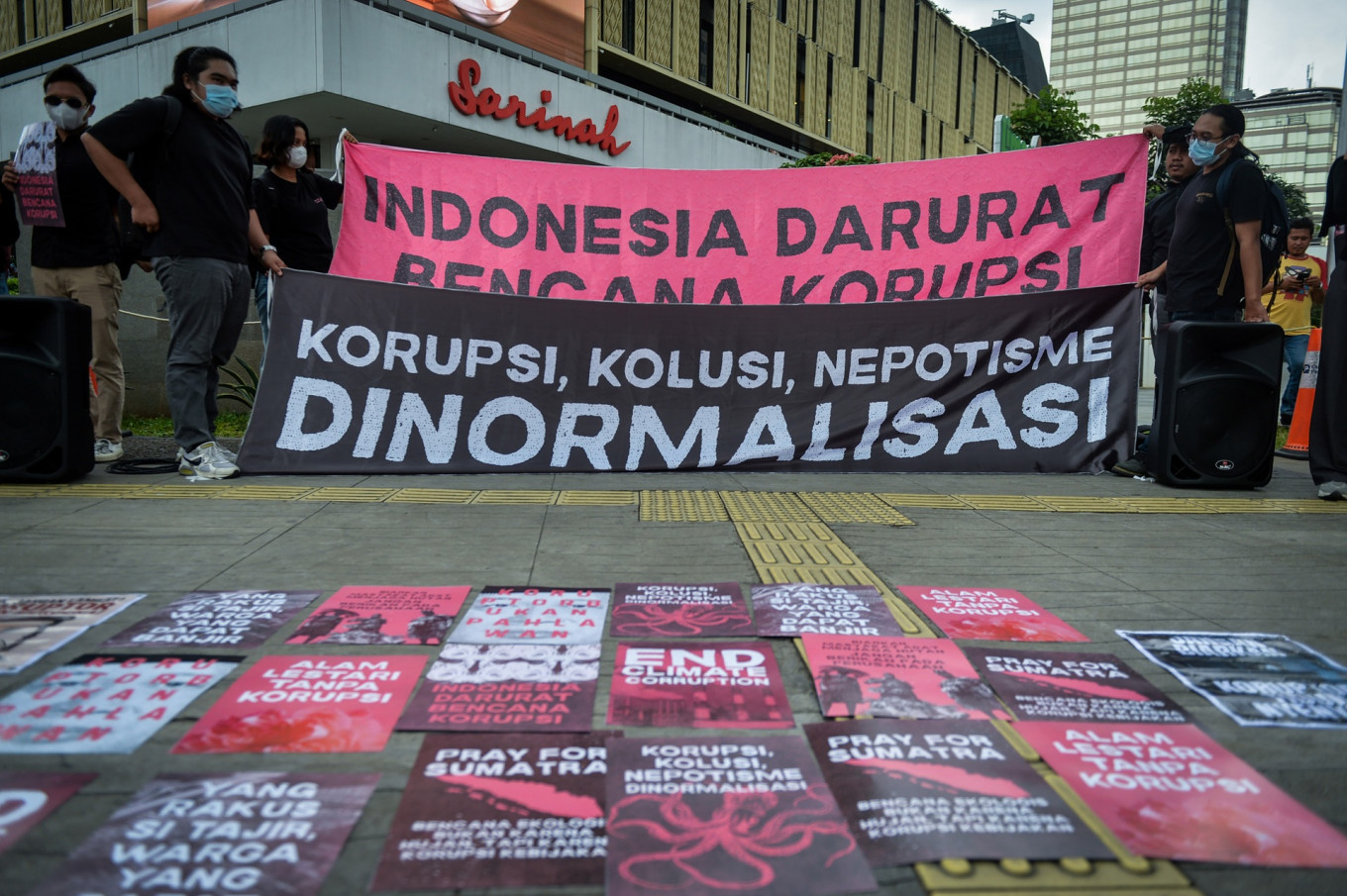 Protesters hold banners that read “Indonesia Darurat Bencana Korupsi“ (Indonesia in emergency disaster of corruption) (top) and “Korupsi, kolusi, nepotisme dinormalisasi“ (Corruption, collusion and nepotism normalized) (bottom) during a protest on Dec. 9, 2025, to commemorate the International Anti-Corruption Day in Jakarta. (Antara/Putra M. Akbar)
I
n political analysis, crisis is often understood as a sudden, punctuated event. The collapse of regimes, open conflict, or major economic shocks are commonly treated as the primary signals of a system in distress.
Yet, there is another form of crisis that is rarely recognized as such: the condition in which a system fails to improve but also refuses to collapse. We have long been accustomed to viewing crisis as an explosion; in many modern contexts, however, what unfolds is the opposite, a prolonged state of fatigue.
How do we explain a situation in which the state continues to function, institutions operate and society carries on, yet without a clear direction for change? Fatigue offers a way to understand crisis as a gradual, cumulative and often unnoticed process.
Within sociology and political science, various thinkers have examined the pressures within social systems that lead to such a state. Émile Durkheim explained how societies lose direction when norms weaken; Robert K. Merton described the tension between social goals and the means available to achieve them; and Jürgen Habermas analyzed the erosion of public trust when institutions fail to maintain legitimacy.
These traditional approaches, however, tend to conceptualize crisis as a specific, identifiable moment, a threshold where norms collapse or legitimacy sharply declines. But crisis does not always appear as an event; it often unfolds as a process that accumulates over time.
This argument advances three propositions. First, fatigue should be understood as a gradual and cumulative mode of crisis. Second, institutional and societal fatigue are interconnected in a circular, reciprocal relationship. Third, fatigue is not always a passive condition; in certain contexts, it is deliberately produced, managed, and sustained.

The distinction between crisis and fatigue lies in how systemic pressure operates. In a standard crisis, pressure reaches a threshold and triggers visible disruption. In a state of fatigue, pressure never reaches a breaking point, yet it never disappears. It persists and repeats, gradually eroding institutional capacity and social energy.