TheJakartaPost
Please Update your browser
Your browser is out of date, and may not be compatible with our website. A list of the most popular web browsers can be found below.
Just click on the icons to get to the download page.


Popular Reads
Top Results
No results found. Please check your search term and try again
Can't find what you're looking for?
View all search results
Popular Reads
Top Results
No results found. Please check your search term and try again
Can't find what you're looking for?
View all search resultsSystem, not symptom: Indonesia’s real higher education problem
Indonesia has no shortage of brilliant minds; what it lacks is a system capable of cultivating them
Change text size
Gift Premium Articles
to Anyone
Share the best of The Jakarta Post with friends, family, or colleagues. As a subscriber, you can gift 3 to 5 articles each month that anyone can read—no subscription needed!
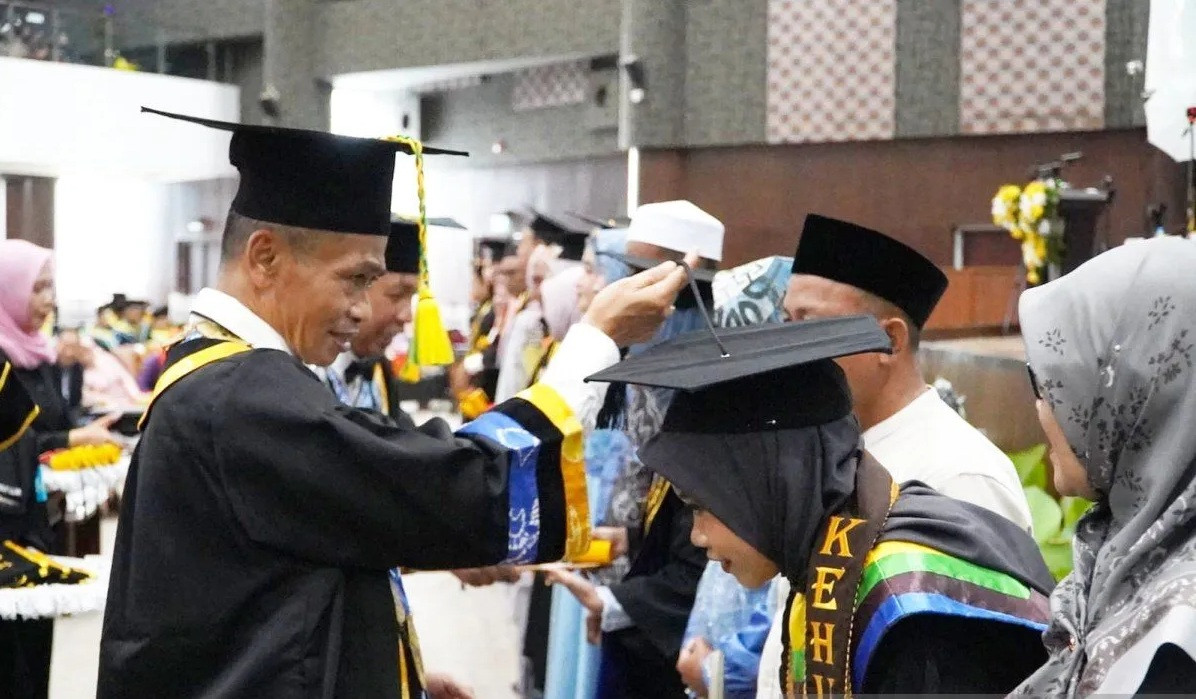 The rector of Lambung Mangkurat University, Prof. Ahmad Alim Bachri, turns the tassel for the top graduates at the faculty level at the ULM Auditorium, Banjarbaru, Banjarmasin, South Kalimantan, on July 3, 2024.
(Antara/Firman)
The rector of Lambung Mangkurat University, Prof. Ahmad Alim Bachri, turns the tassel for the top graduates at the faculty level at the ULM Auditorium, Banjarbaru, Banjarmasin, South Kalimantan, on July 3, 2024.
(Antara/Firman)
I
n his op-ed in The Jakarta Post on May 5, 2026, Toronata Tambun is right in one important way: We cannot evaluate the quality of education simply by closing a study program because its graduates struggle to find short-term employment.
What a university delivers is not limited to labor market outcomes. Indeed, the Higher Education Ministry’s plan to shut down programs based solely on immediate employment data turns the diagnosis on its head. For these reasons, Toronata’s op-ed is both correct and valuable.
However, the case he makes beyond these points is ultimately a defense of a system that is increasingly difficult to justify. By framing the closure debate as a purely philosophical issue, he avoids the more salient question: Why, even after getting off to a running start at independence, has Indonesia’s higher education system lagged so far behind those of its neighbors?
The proof of that gap is striking. The People’s Republic of China was proclaimed in 1949, four years after Indonesia's own independence. In a single lifetime, China has constructed an innovation economy that manufactures passenger jets, aircraft carriers and a world-class electric vehicle industry. Chinese universities graduate more than 40,000 science and engineering PhDs annually, creating research and development at a scale Indonesia currently cannot replicate.
Vietnam’s path is even more telling. Until the early 2000s, Vietnam was considered to have the weakest regional higher education system. Today, Vietnamese EVs are becoming commonplace on the streets of Jakarta and Surabaya, while Indonesian aspirations remain merely on the agenda.
Vietnamese students are steadily rising to prominence in Singapore's best secondary schools and global science competitions, the result of a national system that has prioritized STEM disciplines for over two decades. At the 2022 International Mathematical Olympiad (IMO), Vietnam placed a respectable fourth; Indonesia ranked 38th.

This disparity has nothing to do with innate talent. Indonesia has no shortage of brilliant minds; what it lacks is a system capable of cultivating them. The evidence lies in the outcomes. In PISA 2022, Indonesia scored 366 in mathematics, 359 in reading and 383 in science, falling into the bottom quartile of participating countries and significantly lagging behind Vietnam, which scored 469, 462 and 472 respectively.