The Jakarta Post
Please Update your browser
Your browser is out of date, and may not be compatible with our website. A list of the most popular web browsers can be found below.
Just click on the icons to get to the download page.


Popular Reads
Top Results
No results found. Please check your search term and try again
Can't find what you're looking for?
View all search results
Popular Reads
Top Results
No results found. Please check your search term and try again
Can't find what you're looking for?
View all search resultsThe Trump–Xi summit and the new rules of competition
The center stage now belongs to technologies and industrial systems that will define long-term competitiveness. And increasingly, these two countries will help define its direction.
Change text size
Gift Premium Articles
to Anyone
Share the best of The Jakarta Post with friends, family, or colleagues. As a subscriber, you can gift 3 to 5 articles each month that anyone can read—no subscription needed!
 Set as preferred source
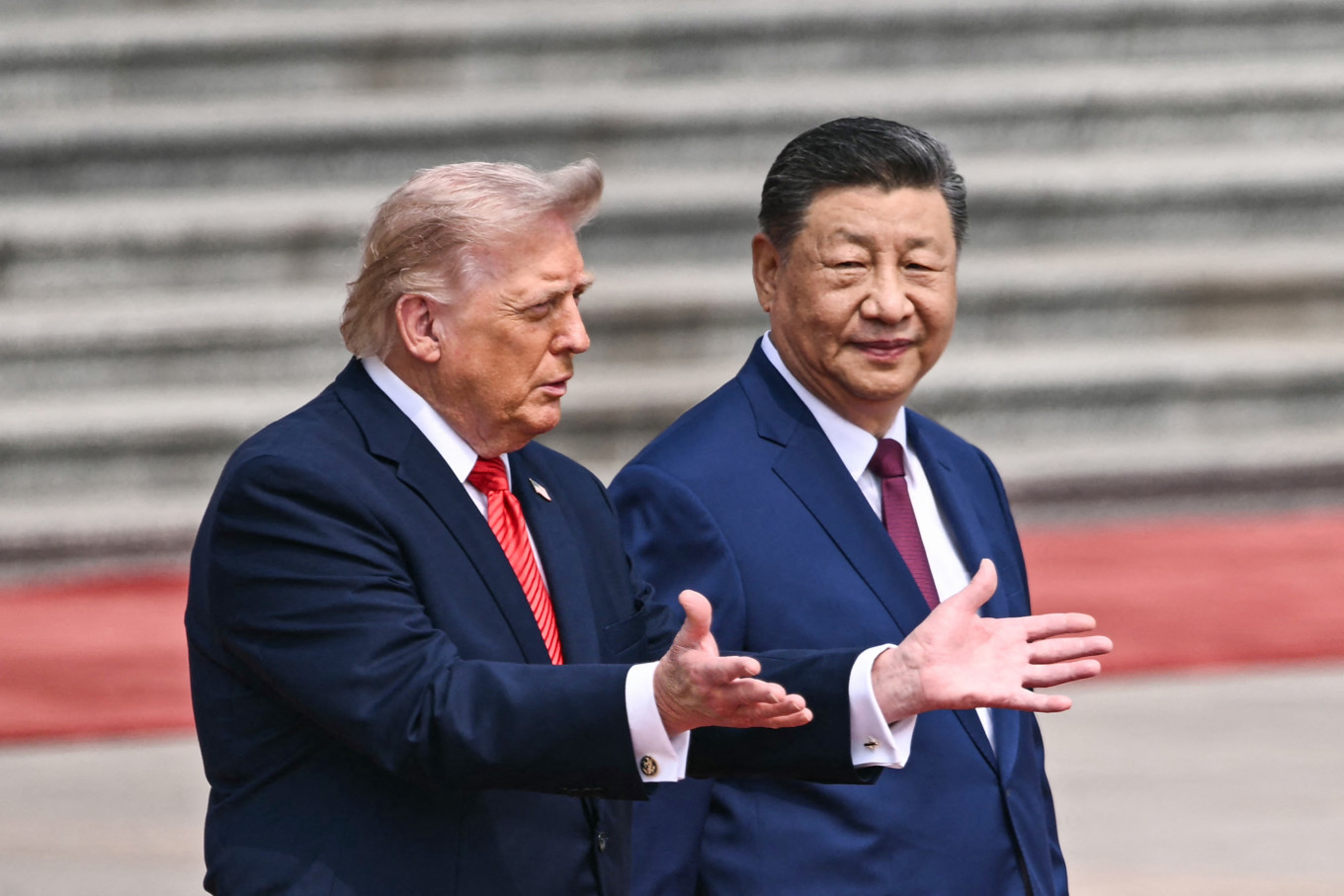 United States President Donald Trump (left) takes part in a welcome ceremony on May 14, 2026, with China's President Xi Jinping at the Great Hall of the People in Beijing. (AFP/Brendan Smialowski)
I
n Beijing, anticipation often reveals itself subtly. Roads become more regulated. Security grows more visible. Diplomatic calendars tighten. The city senses when an important moment is approaching. Ahead of the meeting between United States President Donald Trump and China President Xi Jinping, there is growing awareness of the weight this summit carries far beyond the borders of the two countries.
Much attention will naturally focus on issues such as trade, Taiwan, as well as the wars in Ukraine and the Middle East. But for me, the deeper issue surrounding the summit is no longer confined to geopolitical competition in its traditional sense.
The center stage now belongs to technologies and industrial systems that will define long-term competitiveness. And increasingly, these two countries will help define its direction.
In the weeks leading up to the Trump–Xi summit, significant developments have emerged in this field. Artificial intelligence is beginning to train itself using synthetic data. Military AI systems such as Project Maven are moving from experimentation into operational deployment. Quantum computing raises concerns that future breakthroughs could render current encryption systems obsolete within seconds. AI models are becoming smarter while requiring fewer cutting-edge chips and lower costs.
At the same time, blockchain technology and alternative payment systems are slowly challenging the dominance of traditional financial infrastructure. Power is increasingly defined by control over computers, energy systems, critical minerals, industrial ecosystems and technological standards.
But the reality is that no country can thrive entirely alone, including in advanced technological ecosystems. Supply chains have become too interconnected, industrial specialization too deep and technological competition too expensive. As Nvidia CEO Jensen Huang recently suggested, excessive fragmentation of global technology ecosystems may ultimately slow innovation itself.

This is perhaps why, from my observation, the approach emerging between Washington and Beijing during the summit is becoming less about complete decoupling and more about managed competition.