TheJakartaPost
Please Update your browser
Your browser is out of date, and may not be compatible with our website. A list of the most popular web browsers can be found below.
Just click on the icons to get to the download page.


Popular Reads
Top Results
No results found. Please check your search term and try again
Can't find what you're looking for?
View all search results
Popular Reads
Top Results
No results found. Please check your search term and try again
Can't find what you're looking for?
View all search resultsBuilding a prosperous, inclusive, peaceful and sustainable world
Humanity stands at a critical juncture where unprecedented technological growth collides with escalating inequality and ecological collapse. We need a radical shift toward an inclusive, blue economy and peaceful diplomacy as the only viable path to a sustainable future.
Change text size
Gift Premium Articles
to Anyone
Share the best of The Jakarta Post with friends, family, or colleagues. As a subscriber, you can gift 3 to 5 articles each month that anyone can read—no subscription needed!
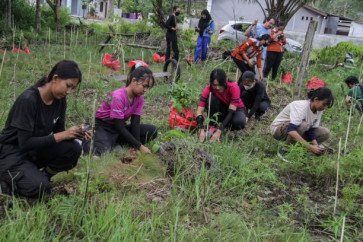
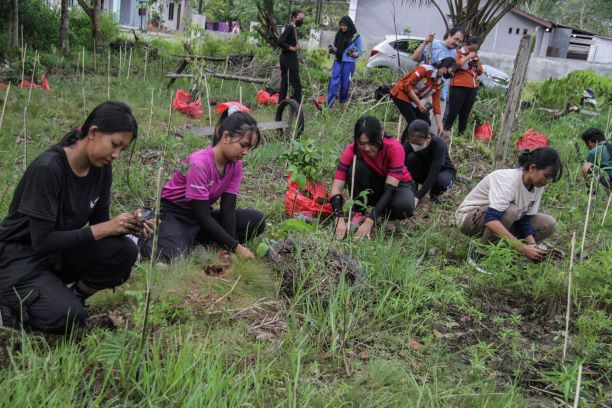 Students of Palangka Raya University participate in a tree-planting program in a peatland area in the Central Kalimantan provincial capital of Palangka Raya on April 15, 2023. Indonesian universities score high in their commitment to Sustainable Development Goals. (Antara/Makna Zaezar)
H
uman civilization today stands at a defining crossroads. While scientific advancement, technological innovation and global economic integration have created unprecedented opportunities for progress, the world simultaneously faces escalating crises. These include rising geopolitical tensions, armed conflicts, widening economic inequality, climate change, pollution, biodiversity loss, food insecurity, energy instability and social fragmentation.
These interconnected challenges serve as a reminder that economic growth alone is insufficient. The true measure of development lies in whether prosperity can be shared equitably, peace can be maintained collectively and natural ecosystems can be preserved sustainably for future generations.
According to the World Bank, using a poverty line of US$6.85 per day, the number of the world’s poor in 2025 reached approximately 3 billion people, some 36 percent of the total population. Roughly 1.5 billion people (18 percent) lived in extreme poverty, surviving on less than $3 per day.
Even more alarming is the scale of global economic inequality: the top 10 percent of the global population holds 76 percent of all global wealth and captures 52 percent of global income, while the bottom 50 percent owns just 2 percent of global wealth and earns 8.5 percent of global income. The richest 1 percent accumulated 41 percent of all new global wealth, signaling an accelerating concentration of resources.
This dire global economic outlook is mirrored within Indonesia. Based on the 2025 poverty line of Rp 609,160 ($34.76) per person per month, the number of Indonesians living in poverty was 23.36 million, or 8.25 percent of the total population. However, according to the World Bank’s poverty line of $6.85 per day (approximately Rp 3.5 million per month), the number of poor in Indonesia reached 171 million, 60.2 percent of the population.
Regarding economic inequality, Indonesia ranks as the third-worst country globally; the richest 1 percent owns wealth nearly equal to 50 percent of the nation’s total wealth. Moreover, the wealthiest 0.2 percent of the population owns approximately 70 percent of Indonesia’s total land area.

A prosperous world must ensure that economic development benefits all people, not merely a small fraction of society. Across many developing nations, more than 2 billion people still struggle with unemployment, malnutrition, inadequate health care and limited access to education. Economic systems that prioritize excessive consumption and short-term profit without social justice often deepen instability.