TheJakartaPost
Please Update your browser
Your browser is out of date, and may not be compatible with our website. A list of the most popular web browsers can be found below.
Just click on the icons to get to the download page.


Popular Reads
Top Results
No results found. Please check your search term and try again
Can't find what you're looking for?
View all search results
Popular Reads
Top Results
No results found. Please check your search term and try again
Can't find what you're looking for?
View all search resultsCounter-extremism strategy must anticipate, not just respond
For the second phase of Indonesia's counter-extremism policy to succeed, it must become a discipline of strategic thinking with the capacity to evolve alongside the complex security, social and developmental issues that are intertwined in violent extremism.
Change text size
Gift Premium Articles
to Anyone
Share the best of The Jakarta Post with friends, family, or colleagues. As a subscriber, you can gift 3 to 5 articles each month that anyone can read—no subscription needed!
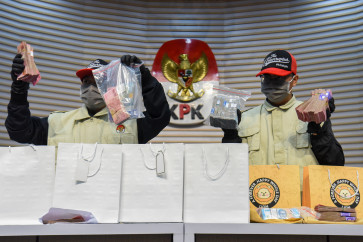
 The raid: Personnel from the National Police’s counterterrorism squad Densus 88 show seized firearms and other items following a raid on the house of an alleged sympathizer of the Islamic State movement in Bekasi, West Java, on Aug. 14, 2023. (AFP/Rezas)
I
ndonesia’s National Action Plan for Preventing and Countering Violent Extremism 2026-2029, also known as the RAN PE Phase II, showcases policy maturity on paper. Enacted in February as Presidential Regulation No. 8/2026, it signals continuity, institutional commitment and a widening understanding that violent extremism is not merely a security issue but also a social and developmental one.
Yet the real question is not whether Indonesia has a strategy; it is whether the strategy is strategic enough.
It is therefore useful to borrow from Michael D. Watkins’ framework in The Six Disciplines of Strategic Thinking (2024), which argues that effective strategy is not simply about planning. It is also about how leaders think across time, systems and consequences.
The RAN PE Phase II, if it is to succeed, must be more than a coordination mechanism. It must become a discipline of strategic thinking applied to one of the most complex policy challenges of our time.
Watkins begins with anticipation: the ability to see beyond immediate pressures and recognize emerging patterns.
Indonesia has become relatively successful at reducing large-scale violent extremist incidents. But the deeper challenge now is not visibility but transformation. Extremist ecosystems have become more fragmented, relational and adaptive.

From my field engagement with reintegration cases such as a young returnee in Yogyakarta, an individual who was a child in conflict zones and is now an adult navigating identity loss, it is clear that the most important dynamics are no longer occurring in formal organizations: They are occurring in the long afterlife of conflict.