TheJakartaPost
Please Update your browser
Your browser is out of date, and may not be compatible with our website. A list of the most popular web browsers can be found below.
Just click on the icons to get to the download page.


Popular Reads
Top Results
No results found. Please check your search term and try again
Can't find what you're looking for?
View all search results
Popular Reads
Top Results
No results found. Please check your search term and try again
Can't find what you're looking for?
View all search resultsTrump-Xi summit stabilizes US-China bilateral relations
As the world’s two largest economies meet in Beijing, the 2026 Summit marks a high-stakes pivot from "crisis management" to a fragile but essential strategic equilibrium.
Change text size
Gift Premium Articles
to Anyone
Share the best of The Jakarta Post with friends, family, or colleagues. As a subscriber, you can gift 3 to 5 articles each month that anyone can read—no subscription needed!
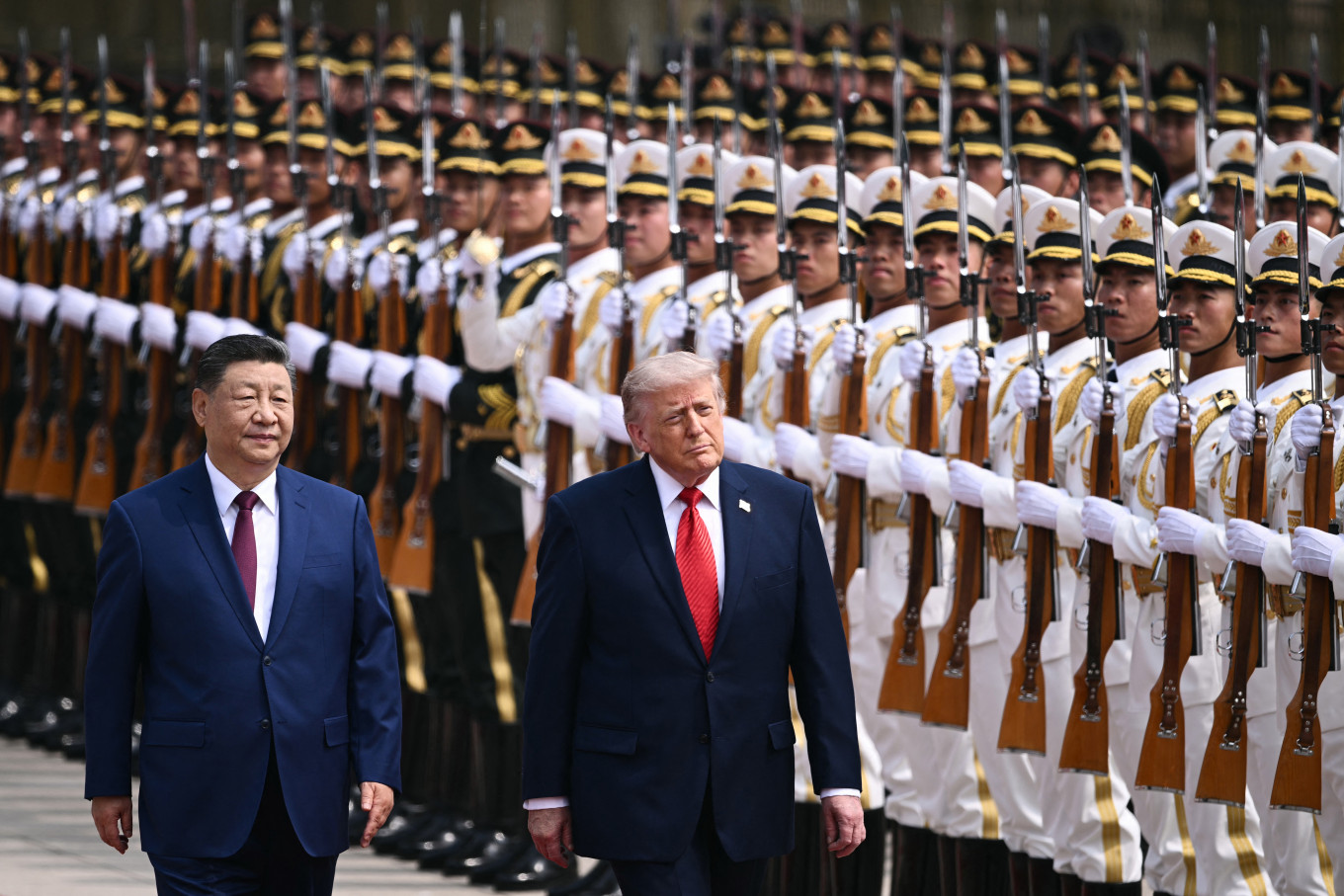 Friends or foes?: United States President Donald Trump (right) and China’s President Xi Jinping inspect a guard of honor on May 14, 2026, during a welcome ceremony at the Great Hall of the People, in Beijing. (AFP/Brendan Smialowski)
U
nited States President Donald Trump arrived in Beijing on Wednesday for a new round of face-to-face talks with Chinese President Xi Jinping. The May 14-15 visit came at a particularly delicate moment in global politics and the international economy.
It marked the first in-person meeting between the two leaders since the Busan agreement last October, where both sides agreed to suspend further escalation of the US–China trade war for one year. While a flare-up in the Middle East delayed this meeting by a month, the cooling of tensions with Iran has finally cleared the flight path for what many view as the most consequential diplomatic inflection point of 2026.
Amid a fragile global recovery and uncertainty in international markets, the Beijing meeting is being closely watched to see whether both powers can move from "crisis management" to a more sustainable form of strategic equilibrium, with profound implications for broader global economic stability.
At their first meeting on Thursday morning, President Xi congratulated the US on its 250th anniversary, while President Trump praised Xi as “a great leader”, setting a warm and friendly tone for the opening of the summit. President Xi noted that China and the US should be partners, not rivals, emphasizing that the relationship between the two countries would have implications not only for their peoples but also for the future of the world. President Trump remarked that this would be a historic summit, noting that a top-tier business delegation accompanied him.
A US official said the two sides are expected to continue discussions on establishing new mechanisms for trade and investment coordination, with cooperation in agriculture, aerospace and energy also likely to feature prominently. Analysts broadly agree that the summit reflects a shared near-term interest in stabilizing China–US relations, even as deeper strategic tensions remain unresolved.
Zhao Hai, director of the International Politics Program at the National Institute for Global Strategy, points out that the primary "product" of this summit needs to be predictability. For the private sector, a specific policy is often less damaging than the volatility of not knowing what the policy will be tomorrow.

This mirrors the “managed strategic competition” framework championed by former Australian prime minister Kevin Rudd: the goal is not necessarily to bridge a decade-long trust deficit in three days, but to prevent accidental escalation.