TheJakartaPost
Please Update your browser
Your browser is out of date, and may not be compatible with our website. A list of the most popular web browsers can be found below.
Just click on the icons to get to the download page.


Popular Reads
Top Results
No results found. Please check your search term and try again
Can't find what you're looking for?
View all search results
Popular Reads
Top Results
No results found. Please check your search term and try again
Can't find what you're looking for?
View all search resultsWhy Eurasia cannot wait: A charter for our time
As global hegemonic structures falter, the Eurasian Charter offers a bold, indigenous blueprint for a continent-wide security architecture built on the principle of indivisible security. This is a final call for Eurasian nations to claim their seat at the table and define a future free from external diktat.
Change text size
Gift Premium Articles
to Anyone
Share the best of The Jakarta Post with friends, family, or colleagues. As a subscriber, you can gift 3 to 5 articles each month that anyone can read—no subscription needed!
 Set as preferred source
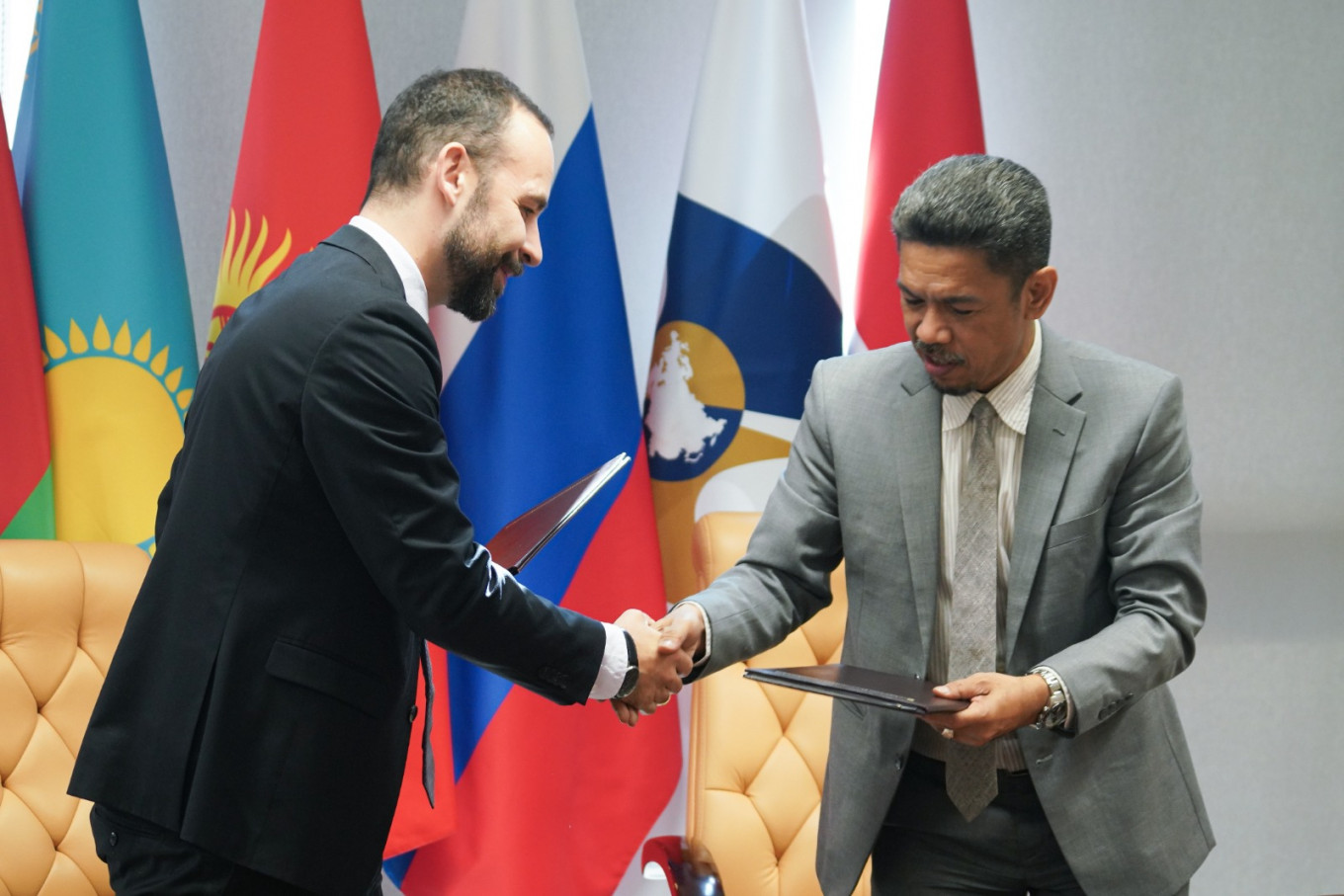 The Indonesian Negotiating Group chairman, director of bilateral negotiations of the Indonesian Trade Ministry Johni Martha shakes hands with the EAEU Negotiating Group chairman, head of division for special issues in trade regulation for trade policy department Anton Tsetsinovskiy after the second round of Indonesia-Eurasian Economic Union free trade agreement negotiations in Moscow, July 28, 2023. (Trade Ministry/-)
L
ast year, in an extensive piece on the Eurasian Charter of Diversity and Multipolarity in the XXI Century, published by Russia in Global Affairs, I argued that external interference in the affairs of Eurasian countries has consistently prevented their successful and independent development.
I traced this pattern from the Conference for Security and Cooperation in Europe (CSCE) to the Organization for Security and Cooperation in Europe (OSCE), and finally to the post-Cold War United States strategies of “enlargement” and geostrategic domination articulated by former US National Security Advisers Anthony Lake and Zbigniew Brzezinski.
The current conflict in the Middle East has tragically and irrefutably confirmed this observation. This conflict is not merely another regional tragedy; it is the latest violent proof that external actors cannot manage Eurasian security. Once again, we have witnessed a familiar pattern: unilateral intervention in violation of international law, disregard for local realities, attempts to pit neighbors against each other, and the pursuit of strategic interests that have nothing to do with the well-being of the nations caught in the crossfire. The result, as always, is more death, more displacement and a deeper erosion of hope for regional stability.
Regrettably, the architects of these policies have not learned the lessons of the Balkans, Iraq, Afghanistan or Ukraine. They continue to believe that military force, unilateral sanctions and political manipulation can reshape Eurasia according to their own blueprints. They fail every time, but only after causing immense suffering to the people of our continent.
For Eurasian countries, the message could not be clearer: we cannot rely on external guardians to provide our security. We cannot wait for a “benign international liberal order” to return, because such an order never truly existed in practice, it was not liberal, but hegemonic. We certainly cannot afford to remain passive while others attempt to determine the future of our continent. What we need, urgently, is our own solution, forged by us and for us. We need Eurasian solutions to Eurasian problems.
The core lesson of the current Middle East conflict, and of every other failed external intervention in Eurasia over the past three decades, is this: only an indigenous, inclusive and consensus-based security architecture can work. The CSCE succeeded during the Cold War precisely because it was a genuine forum for dialogue between two camps that respected each other’s existence. The OSCE failed when it became an instrument for one group of participating states to impose its will on others. The so-called US-led “liberal order” failed because it was never liberal; it was hegemonic.

What Eurasia needs instead is a new approach, grounded in a principle invoked since the 1975 Helsinki Final Act but never truly implemented: the indivisibility of security. No country in Eurasia should seek its own security at the expense of others. No external power should be allowed to play one Eurasian state against another. No regional conflict should be treated as an opportunity for geopolitical gain.