TheJakartaPost
Please Update your browser
Your browser is out of date, and may not be compatible with our website. A list of the most popular web browsers can be found below.
Just click on the icons to get to the download page.


Popular Reads
Top Results
No results found. Please check your search term and try again
Can't find what you're looking for?
View all search results
Popular Reads
Top Results
No results found. Please check your search term and try again
Can't find what you're looking for?
View all search resultsJakarta meets the deep state
The institutional reflexes that govern Jakarta were not built for a New York index provider that can erode a fifth of Indonesia's sovereign investor mandate overnight.
Change text size
Gift Premium Articles
to Anyone
Share the best of The Jakarta Post with friends, family, or colleagues. As a subscriber, you can gift 3 to 5 articles each month that anyone can read—no subscription needed!
 Set as preferred source
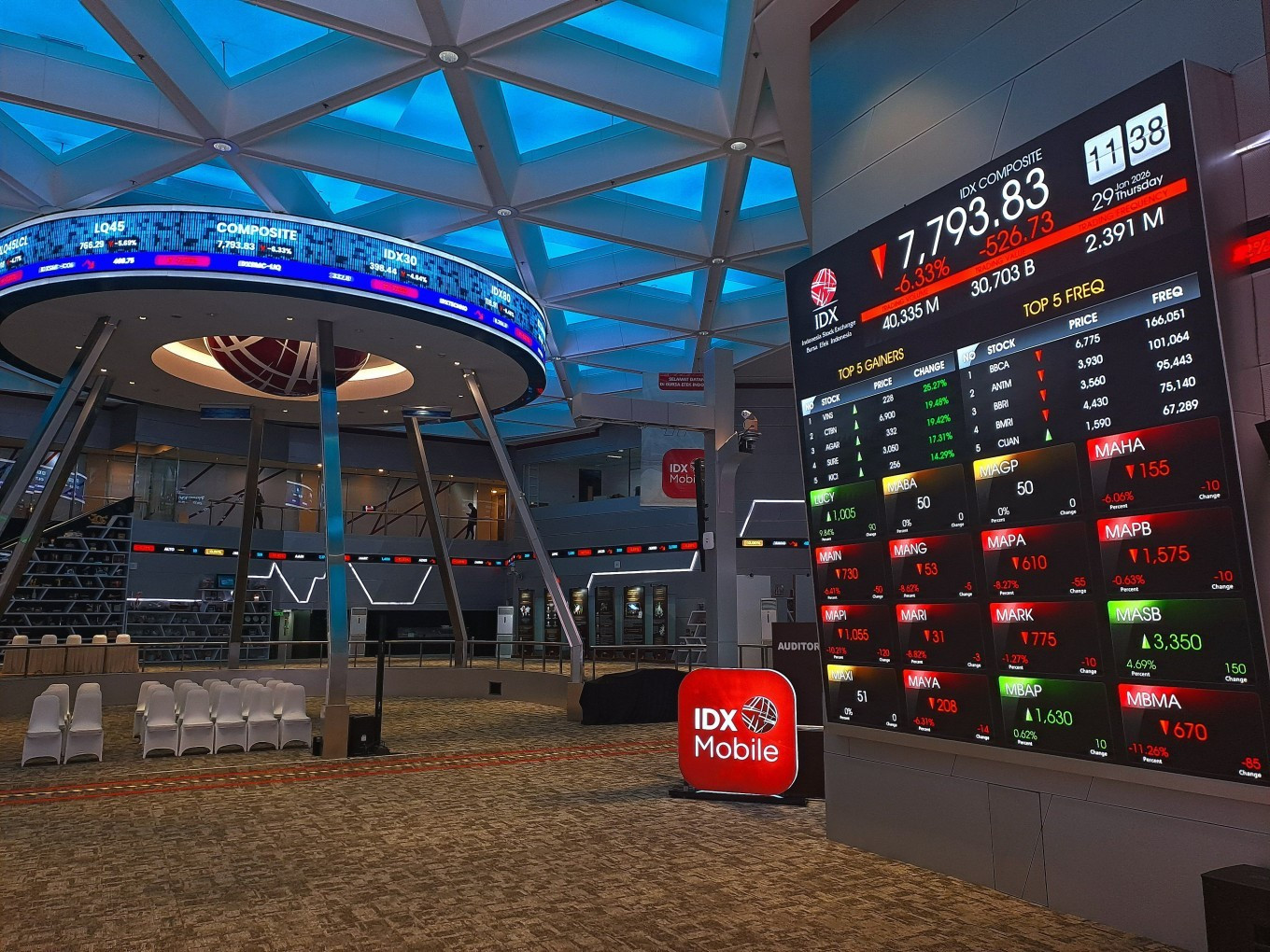 An electronic display board shows an overall downward movement across most stocks during the lunch break on Jan. 29, inside the main hall of the Indonesia Stock Exchange (IDX) in South Jakarta. (TJP/Deni Ghifari)
O
n May 12, MSCI delivered a verdict on Indonesia. Nineteen companies were removed from its global benchmark indices, six of them large caps, including Amman Mineral, Barito Renewables and Chandra Asri. The decision was made in New York, the United States. The Indonesia Stock Exchange (IDX) Composite (IHSG) opened 1.33 percent lower the next morning. Passive global funds began forced selling with no discretion to do otherwise. Expected outflows ran as high as US$2.2 billion. The IHSG has now fallen roughly 23 percent from its January peak.
The verdict was issued by a four-firm cartel. MSCI draws the maps. BlackRock, Vanguard and State Street manage the capital that follows them. Together these four New York firms exercise more authority over the world's capital markets than most governments.
MSCI is the world's largest equity-index provider. BlackRock is the world's largest Exchange-Traded Fund (ETF) issuer. By contract, BlackRock's iShares funds license MSCI indices and must track them. Roughly $1.5 trillion of BlackRock assets are benchmarked to MSCI indices, making BlackRock MSCI's largest client.
BlackRock, Vanguard and State Street are also MSCI's largest shareholders. They pay MSCI to draw the maps. They also own the map-maker. Their funds are required to follow the maps. The same three asset managers — overseeing $25 trillion — are also the dominant shareholders of every major US defense company. The network that just devalued the Jakarta Stock Exchange is the same network that owns the military-industrial complex.
The vocabulary is older than the architecture. On Jan. 17, 1961, US president Dwight Eisenhower gave a farewell address remembered for three words: military-industrial complex (MIC). The phrase was the first warning of what would later be called a deep state. Eisenhower understood that once a defense establishment crossed a certain scale and permanence, arms procurement would shape strategy rather than the reverse. He warned of "unwarranted influence, whether sought or unsought." The architecture he described has not gone away. It has gone global, and it has gone financial.
The MIC of 2026 is no longer just an arms-production network. The same passive-fund architecture that mechanically holds Lockheed Martin and RTX also mechanically holds Apple and Microsoft, Saudi Aramco and TSMC, Bank Mandiri and Reliance. State Street holds 14.9 percent of Lockheed Martin and comparable concentrations across other sectors and geographies. The MIC supplied the architecture. The architecture then propagated across every industry. Defense remains the political-economy core, because the Pentagon's recurring sovereign cash flow anchors the equity rents accumulated by the holders.

This is the market that is not a market. From the outside it looks like price discovery — buyers, sellers, prices, transactions. From the inside it is administrative allocation.