TheJakartaPost
Please Update your browser
Your browser is out of date, and may not be compatible with our website. A list of the most popular web browsers can be found below.
Just click on the icons to get to the download page.


Popular Reads
Top Results
No results found. Please check your search term and try again
Can't find what you're looking for?
View all search results
Popular Reads
Top Results
No results found. Please check your search term and try again
Can't find what you're looking for?
View all search resultsThe rules-based order: Between power and post-normality
As the long-standing rules-based order fragments under global uncertainties due to geopolitics, economics and technology, the world urgently needs a coherent, credible and collective framework for stability.
Change text size
Gift Premium Articles
to Anyone
Share the best of The Jakarta Post with friends, family, or colleagues. As a subscriber, you can gift 3 to 5 articles each month that anyone can read—no subscription needed!
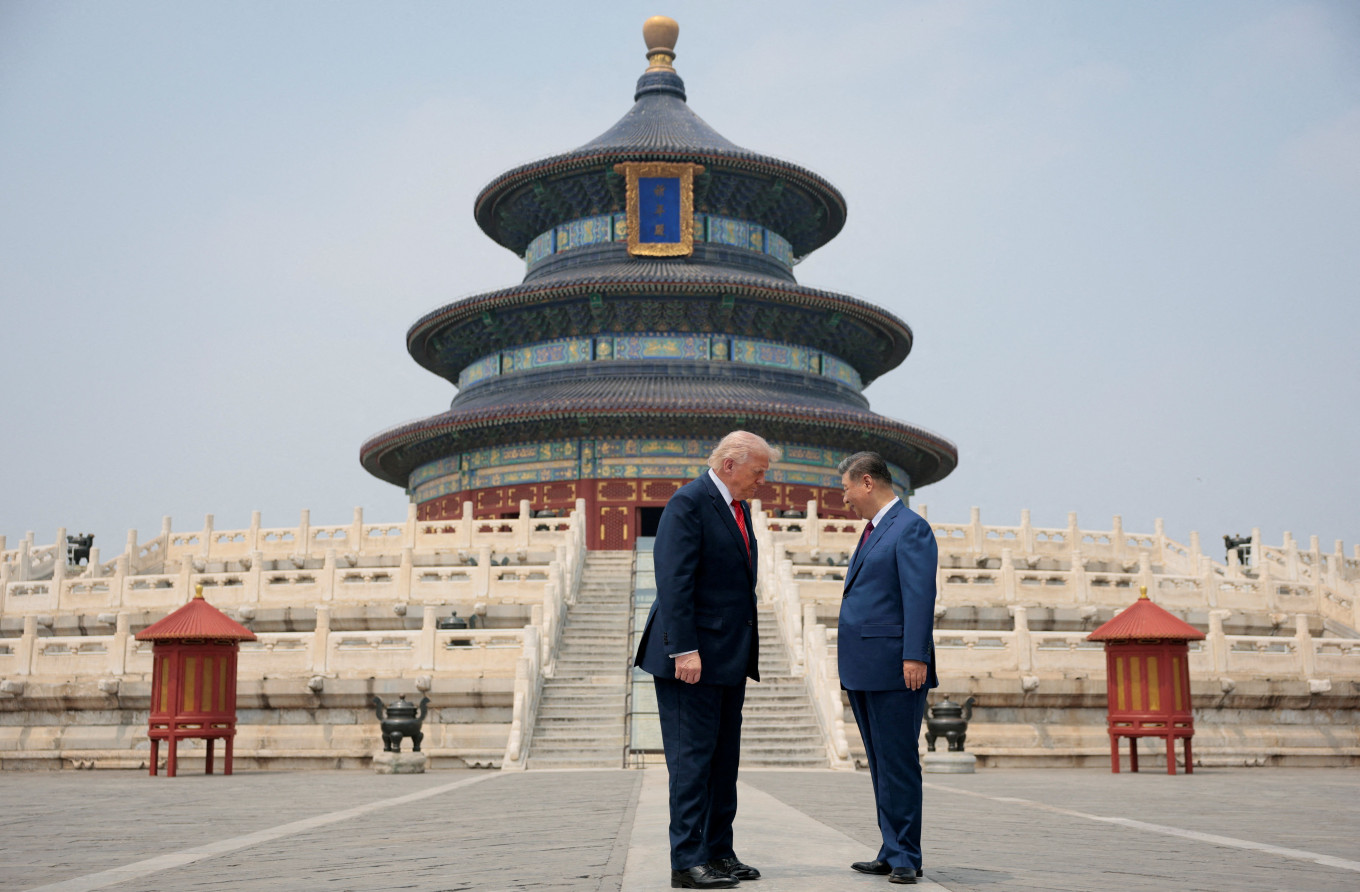 Chinese President Xi Jinping (right) and United States President Donald Trump stand facing each other on May 14, 2026, during a tour of the Temple of Heaven in Beijing. (Reuters/Evan Vucci)
T
he phrase “rules-based international order” has become one of the most frequently invoked yet least interrogated concepts in global affairs. It is repeated in summit communiqués, echoed in speeches by world leaders and embedded in the strategic lexicon of great powers. Yet beneath its apparent clarity lies a profound contestation over who writes the rules, who enforces them and who ultimately benefits from them.
At its most idealistic, the rules-based order reflects the liberal aspiration that international relations can be governed not merely by brute force, but by law, institutions and shared norms.
Thinkers such as G. John Ikenberry and Robert Keohane have long argued that institutions, from the United Nations to the World Trade Organization, serve as stabilizers of global order. They reduce uncertainty, facilitate cooperation and mitigate the anarchic tendencies of the international system. In this telling, rules are not instruments of domination but safeguards against chaos.
Yet this liberal vision has always coexisted uneasily with the realist critique. Scholars such as John Mearsheimer and Kenneth Waltz remind us that rules do not emerge in a vacuum. They are products of power.
The post-1945 order, often celebrated as rules-based, was in fact underwritten by overwhelming American preponderance. It was Franklin D. Roosevelt and Harry S. Truman who laid the institutional foundations of this order, but it was American economic and military dominance that ensured its durability.
Indeed, when George H.W. Bush spoke of a “new world order” in the aftermath of the Gulf War, he was not merely invoking a system of rules. He was signaling the consolidation of a unipolar moment in which the United States could define, interpret and enforce those rules.

The distinction between a rules-based order and a power-based order thus becomes blurred. Rules, in this sense, are often the language through which power legitimizes itself.