The Jakarta Post
Please Update your browser
Your browser is out of date, and may not be compatible with our website. A list of the most popular web browsers can be found below.
Just click on the icons to get to the download page.


Popular Reads
Top Results
No results found. Please check your search term and try again
Can't find what you're looking for?
View all search results
Popular Reads
Top Results
No results found. Please check your search term and try again
Can't find what you're looking for?
View all search resultsThe rupiah’s long decline and Indonesia’s structural imbalances
The rupiah's persistent depreciation is a structural consequence of over-reliance on volatile capital inflows to finance a chronic current account deficit, persistent saving–investment imbalances, lasting fiscal deficit and a narrow, commodity-dependent export base.
Change text size
Gift Premium Articles
to Anyone
Share the best of The Jakarta Post with friends, family, or colleagues. As a subscriber, you can gift 3 to 5 articles each month that anyone can read—no subscription needed!
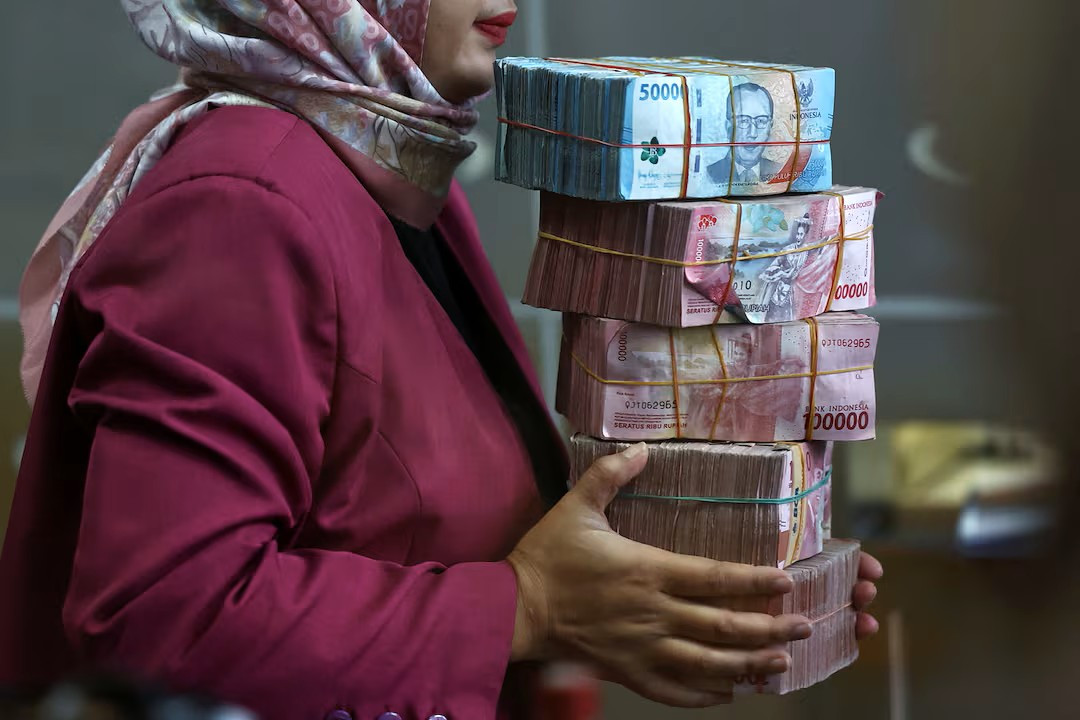 A teller holds rupiah bank notes on April 9, 2025, at a money changer in Jakarta. (Reuters/Willy Kurniawan)
O
n May 12, the rupiah closed at Rp 17,512 per United States dollar, the weakest level in Indonesia's recorded history. Bank Indonesia intervened, and policymakers emphasized that the currency was “undervalued” relative to fundamentals. Perhaps it was. But a record low is still a record low. More telling is how unsurprised the market seemed. What should be an anomaly is beginning to look routine.
The rupiah's persistent depreciation is not primarily a failure of monetary policy or short-term market pressures, but a structural consequence of over-reliance on volatile capital inflows to finance a chronic current account deficit, persistent saving–investment imbalances, lasting fiscal deficit and a narrow, commodity-dependent export base.
Without deeper economic transformation, currency depreciation will remain a recurring and normalized outcome.
Year to date, the rupiah has depreciated by 5 percent. Since President Prabowo Subianto took office in October 2024, the cumulative slide exceeds 11 percent. Against the 2026 state budget assumption of Rp 16,500 per dollar, the Finance Ministry’s own sensitivity calculations suggest that every 100-rupiah deviation widens the fiscal deficit by around Rp 800 billion. At current levels, the implied fiscal pressure is already in the trillions of rupiah.
The proximate causes are not hard to identify. Geopolitical turbulence has sent investors toward dollar-denominated safe havens. The US labor market has held up, reducing pressure on the Federal Reserve to cut rates, keeping US yields high and the dollar strong. Between mid-March and mid-April alone, Indonesia recorded net portfolio outflows of US$1.47 billion, concentrated in equities. These are largely external forces, beyond the control of policymakers in Jakarta.
But external factors alone do not explain why the rupiah tends to weaken more deeply than regional peers such as the Thai baht or Philippine peso. The rupiah’s vulnerability is structural, rooted in Indonesia’s balance of payments and decades in the making.

Indonesia’s current account has run persistent deficits for most of the past three decades, interrupted only by the COVID-era import collapse of 2020–21 and the commodity boom of 2022. The country’s external position remains fragile because its growth model still depends on foreign capital.