TheJakartaPost
Please Update your browser
Your browser is out of date, and may not be compatible with our website. A list of the most popular web browsers can be found below.
Just click on the icons to get to the download page.


Popular Reads
Top Results
No results found. Please check your search term and try again
Can't find what you're looking for?
View all search results
Popular Reads
Top Results
No results found. Please check your search term and try again
Can't find what you're looking for?
View all search resultsValues-based realism: Countering US hegemonic foreign policy
As US foreign policy shifts into a cutthroat, transactional game under Trump, Europe is fighting back by forging its own strategic autonomy rooted in value-based realism.
Change text size
Gift Premium Articles
to Anyone
Share the best of The Jakarta Post with friends, family, or colleagues. As a subscriber, you can gift 3 to 5 articles each month that anyone can read—no subscription needed!
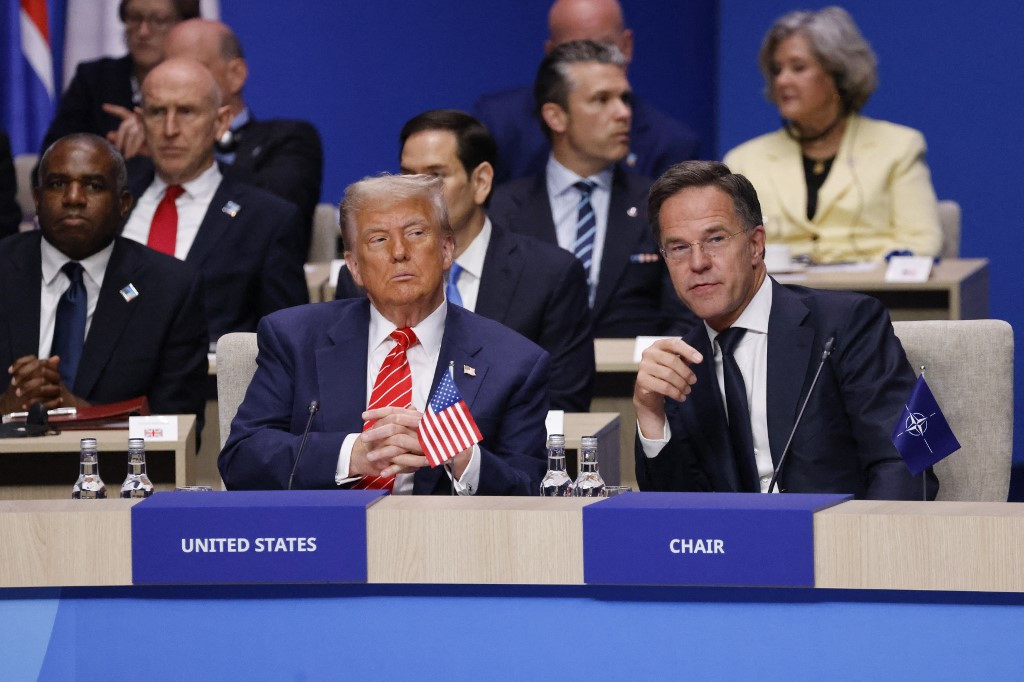 The United Kingdom's Foreign Secretary David Lammy, United States President Donald Trump and NATO Secretary General Mark Rutte (from left to right) attend the start of a NATO leaders summit on June 25, 2025, in The Hague, the Netherlands. (AFP/Ludovic Marin)
I
t has been widely discussed that under the Trump administration United States foreign policy is shifting toward transactional and hegemonic practices. Recent developments show how the US has been capitalizing on war, employing coercive diplomacy and pressuring Iran with a naval blockade in the Strait of Hormuz.
Theoretically speaking, current US foreign policy aligns with offensive realism, a framework in which states are viewed as power maximizers seeking hegemony for their survival. As John Mearsheimer argued in his book The Tragedy of Great Power Politics (2001), great powers consider conflict to be endemic; consequently, states must maximize their power to survive, even if doing so creates a hostile environment. To secure its position, a state must ultimately become a hegemon.
Ironically, the US has misplaced this offensive realism. By viewing international relations strictly as a zero-sum game, it has exhibited erratic behavior and a distinct lack of ethical values, treating both allies and other nations as competitors. This is evident in President Donald Trump’s audacious rhetoric toward European leaders, including France’s President Emmanuel Macron, Italy’s Prime Minister Giorgia Meloni, Spain’s Prime Minister Pedro Sánchez, United Kingdom Prime Minister Keir Starmer and recently, German Chancellor Friedrich Merz.
For these European leaders, the US-Israel attacks on Iran are illegal, violating both international law and moral standing. Consequently, Italy, Spain and the UK rejected the use of their airbases for US strikes against Iran.
Trump condemned these leaders, occasionally launching personal attacks, and strongly criticized NATO for its lack of support. This tension culminated in Trump's decision to withdraw 5,000 US troops from Germany, spurred by his anger over Merz’s statement that “the US is being humiliated by Iran’s leadership”.
The deepening cracks between Trump and European leaders are worsened by evidence that the European public increasingly views the US as a threat. A new survey conducted by the European Pulse Poll and published by Politico magazine last April showed that only 12 percent of people in Poland, Spain, Belgium, France, Germany and Italy view America as a close ally. Meanwhile, 36 percent see America as a threat.

Citizens in Spain held the most negative perception of the US (51 percent), followed by Italy (46 percent), Belgium (42 percent), France (37 percent) and Germany (30 percent).