TheJakartaPost
Please Update your browser
Your browser is out of date, and may not be compatible with our website. A list of the most popular web browsers can be found below.
Just click on the icons to get to the download page.


Popular Reads
Top Results
No results found. Please check your search term and try again
Can't find what you're looking for?
View all search results
Popular Reads
Top Results
No results found. Please check your search term and try again
Can't find what you're looking for?
View all search resultsAnalysis: Reforming the National Police beyond the status quo
Change text size
Gift Premium Articles
to Anyone
Share the best of The Jakarta Post with friends, family, or colleagues. As a subscriber, you can gift 3 to 5 articles each month that anyone can read—no subscription needed!
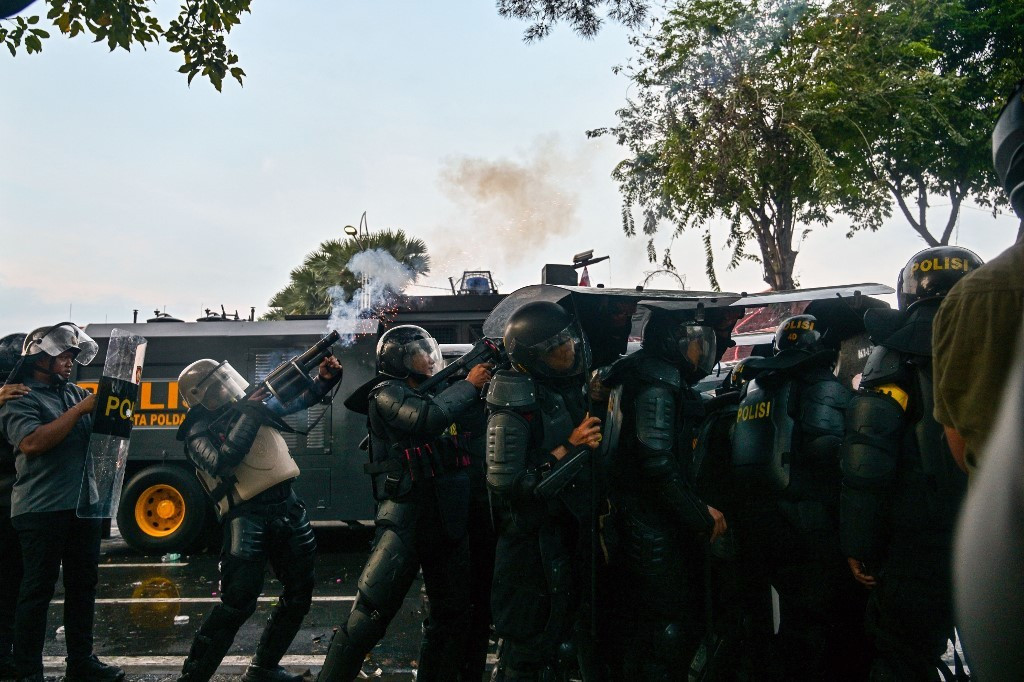 Police fire tear gas to disperse demonstrators during a protest against the Police Mobile Brigade (Brimob) in front of the East Java gubernatorial residence in Surabaya, East Java on Aug. 29, 2025, following the death of 21-year-old motorcycle transportation driver Affan Kurniawan, who was killed after being struck by a police tactical vehicle amid a protest against lavish allowances for lawmakers in Jakarta on Aug. 28. (AFP/Juni Kriswanto)
T
here is renewed hope for police reform following President Prabowo Subianto’s approval of the police reform committee’s recommendations. Although several points merely preserve the status quo, the recommendations also call for more substantive action, particularly a revision of the 2002 National Police Law.
On May 5, the President approved the six-point reform recommendations proposed by the police reform committee. This marks an important milestone following his long-awaited pledge to reform the National Police, coming shortly after the committee completed its work in early March.
Of the six recommendations, two largely maintain existing arrangements. First, the National Police will remain an institution directly under the president rather than being moved under a ministry. Second, the appointment of the National Police chief will continue through the confirmation hearing mechanism in the House of Representatives.
The third recommendation is more consequential. It seeks to strengthen the National Police Commission (Kompolnas), the government-sanctioned oversight body, by granting it broader authority to hold officers accountable and by removing ex officio seats for government officials. Kompolnas needs to be institutionally strengthened so that it possesses investigative authority and the capacity to issue binding recommendations. At present, the body can only provide non-binding advice to the president, which limits its effectiveness as an accountability mechanism.
Committee chair Jimly Asshiddiqie argued that the National Police’s direct accountability to the president must be balanced by strengthening Kompolnas as an independent institution. This reflects a fundamental governance principle: concentrated executive authority requires equally robust oversight to prevent the abuse of power and ensure democratic accountability.
The fourth recommendation is equally essential because it directly affects the public: the demilitarization of the National Police’s work culture. Demilitarization involves more than just reducing the excessive use of force; it requires transforming organizational culture, command structures and public engagement strategies. The goal is to ensure policing becomes more civilian-oriented and rights-based.

The fifth recommendation concerns tighter regulations governing the placement of police officers in civilian posts, such as ministries and state agencies. This issue has long been debated because the expansion of police influence into civilian institutions risks blurring the boundaries between security functions and civilian governance. Stronger limitations are necessary to preserve democratic checks and balances.