The Jakarta Post
Please Update your browser
Your browser is out of date, and may not be compatible with our website. A list of the most popular web browsers can be found below.
Just click on the icons to get to the download page.


Popular Reads
Top Results
No results found. Please check your search term and try again
Can't find what you're looking for?
View all search results
Popular Reads
Top Results
No results found. Please check your search term and try again
Can't find what you're looking for?
View all search resultsReforming the National Police or preserving the status quo?
The Police Reform Acceleration Committee’s 3,000-page report exposes deep systemic ailments within the National Police, yet by keeping the force directly under presidential control, it risks preserving the political status quo under the guise of reform.
Change text size
Gift Premium Articles
to Anyone
Share the best of The Jakarta Post with friends, family, or colleagues. As a subscriber, you can gift 3 to 5 articles each month that anyone can read—no subscription needed!
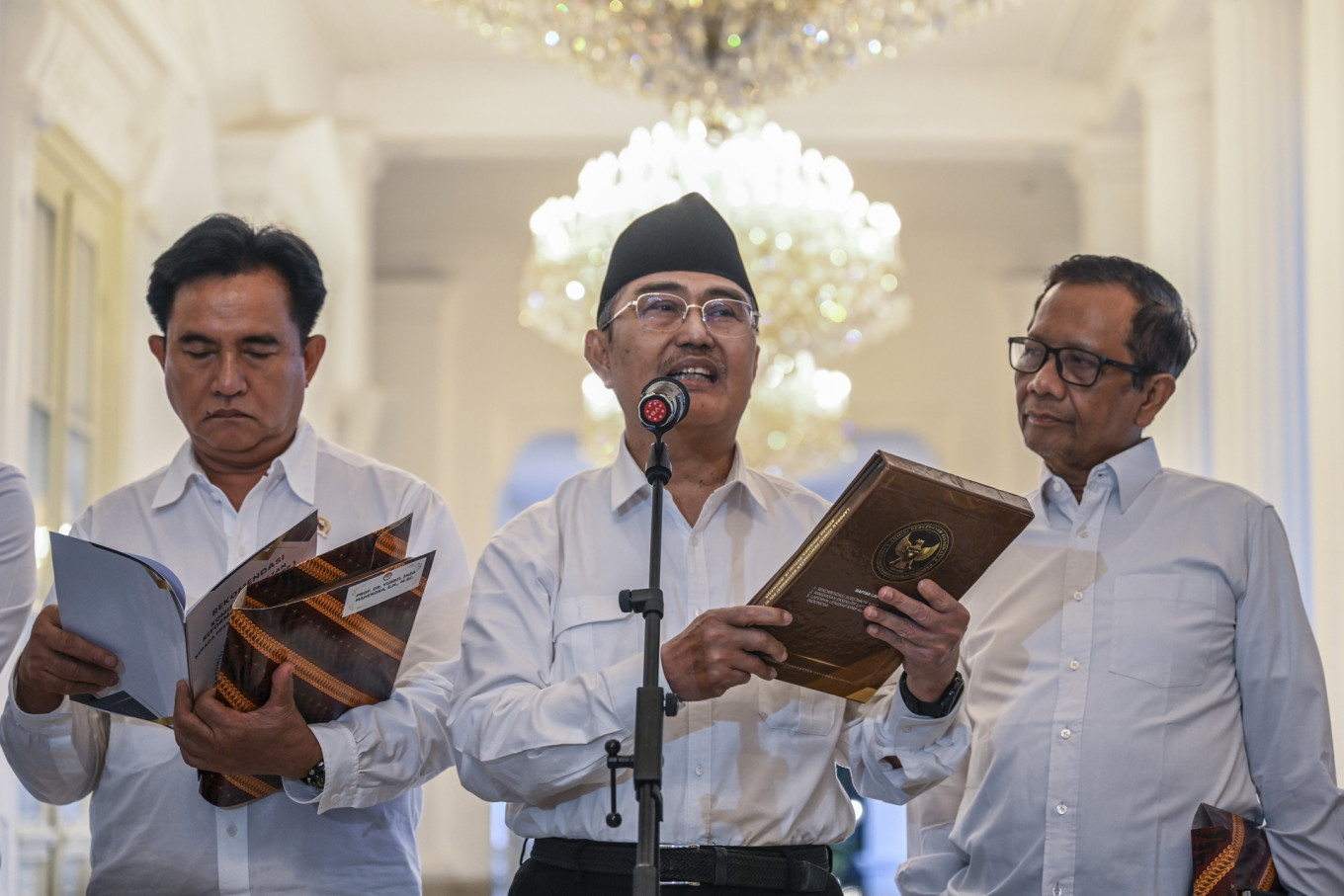 Police Reform Acceleration Committee chair Jimly Asshiddiqie (center) as well as members Yusril Ihza Mahendra (left) and Mahfud MD (right) speak to journalists during a press briefing at the Presidential Palace complex in Jakarta on May 5, 2026. The committee members met with President Prabowo Subianto to submit their six-point proposal to reform the National Police. (Antara/Galih Pradipta)
T
he submission of a 3,000-page report by the Police Reform Acceleration Committee to President Prabowo Subianto on May 5 marks a significant attempt to diagnose systemic pathologies within the National Police. However, despite this exhaustive effort, the report faces valid criticism for failing to decouple the force from direct executive control.
By maintaining the force’s direct subordination to the President and explicitly rejecting the creation of a security ministry, or any comparable civilian state entity, the ad hoc committee risks concentrating power rather than shielding the institution from political interests. This decision leaves a central pillar of genuine reform, institutional independence, unaddressed, potentially preserving the status quo under the guise of "preventing overpoliticization".
The preservation of the status quo is also evident in the appointment of the police chief, where President Prabowo chose to retain the existing legislative checks and balances through the House of Representatives. The chairman of the committee, Jimly Asshidiqqie, acknowledged a split within the committee on this issue: one camp favored exclusive presidential selection without legislative involvement to improve responsiveness, while the other preferred retaining the confirmation role of the House.
To prevent political bargaining, the executive continues to deploy a single-candidate nomination strategy. Under this model, lawmakers do not conduct a traditional confirmation hearing; instead, they simply provide approval.
More progressively, however, the committee has introduced meritocratic thresholds for police leadership, requiring a strict career pathway from the police precinct (Polsek) to provincial (Polda) levels to ensure future commanders possess deep operational experience.
These design choices raise a fundamental question: Does this policy genuinely diminish politicization, or does it merely consolidate political control within the presidency? More broadly, the report mirrors a historical trajectory dating back to antiquity, where policing consistently functioned as an apparatus of state power rather than a purely civic service.

Even as modernity introduced the public-service ideal, most notably through the 19th-century reforms initiated in the United Kingdom by Robert Peel, the founder of modern policing, police institutions remain tied to the state’s requirement for order. Consequently, despite the contemporary evolution toward community-oriented models, history confirms that police forces are primarily established to enforce social control and preserve the political status quo.