TheJakartaPost
Please Update your browser
Your browser is out of date, and may not be compatible with our website. A list of the most popular web browsers can be found below.
Just click on the icons to get to the download page.


Popular Reads
Top Results
No results found. Please check your search term and try again
Can't find what you're looking for?
View all search results
Popular Reads
Top Results
No results found. Please check your search term and try again
Can't find what you're looking for?
View all search resultsWhy Indonesian workers remain in the safety paradox
Indonesia’s workplace safety system is highly certified on paper, but a skyrocketing accident rate reveals a tragic reality: we are regulating compliance while completely failing to control real-time risks.
Change text size
Gift Premium Articles
to Anyone
Share the best of The Jakarta Post with friends, family, or colleagues. As a subscriber, you can gift 3 to 5 articles each month that anyone can read—no subscription needed!
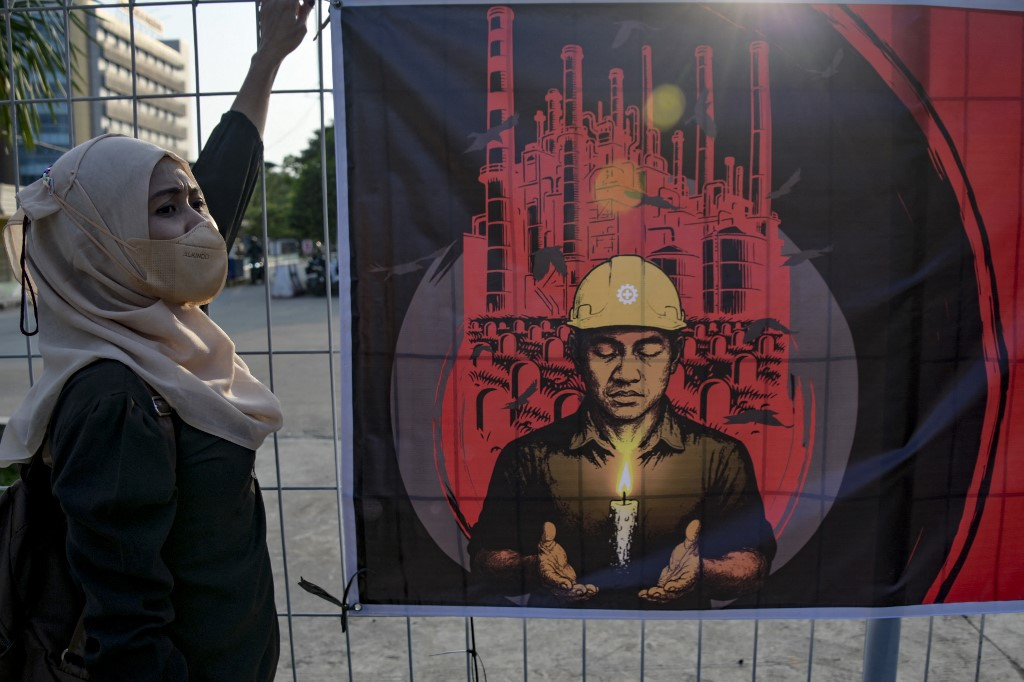 A worker takes part in an International Workers' Memorial Day vigil on April 28, 2025, to honor colleagues who have died from workplace accidents and occupational diseases, after finishing their shifts in an industrial area in Jakarta. (AFP/Bay Ismoyo)
M
illions of Indonesian workers put on their helmets every day, undergo health and safety procedures and participate in mandatory training, believing these efforts will ensure they return home safely.
Indeed, Indonesia’s Sistem Manajemen Keselamatan dan Kesehatan Kerja (SMK3), or Occupational Health and Safety Management system, appears to provide a robust formal foundation for workplace safety. However, the ground beneath this foundation is cracking.
The statistics speak for themselves. According to data published by the social security provider BPJS Ketenagakerjaan and the Manpower Ministry, there were 461,554 reported workplace accidents in Indonesia in 2024. Even more alarming, accident claims have steadily increased over the last decade.
More rules, it seems, result in more accidents - not the other way around. This is not merely a paradox; it is a tragedy.
What, then, is the problem? It is not the absence of a legal framework. The government has regulated this area since 1970 through Law No. 1/1970 on Occupational Safety and Health, and later via Government Regulation No. 50/2012 on SMK3. Yet, the systemic issues remain. Why? Because we have built a system that is governed but not coordinated. Compliance has been achieved, but actual risk control has not.
Recent preventable accidents prove this point. On April 27, a collision between a long-distance train and a commuter train in Bekasi, West Java resulted in the deaths of several commuting workers. While not a factory accident, the train wreck is considered work-related under Presidential Regulation No. 82/2018. Therefore, transportation risks must be integrated into the occupational safety governance sphere.

This lack of coordination extends to heavy industry as well. In December 2023, a furnace explosion at a nickel smelter in the Morowali Industrial Park, Central Sulawesi claimed at least 21 workers' lives and injured dozens more. While these smelters form a key pillar of Indonesia’s industrial downstreaming strategy, high-energy activities, the improper management of contractors and a lack of emergency preparedness routinely turn them into death traps.