The Jakarta Post
Please Update your browser
Your browser is out of date, and may not be compatible with our website. A list of the most popular web browsers can be found below.
Just click on the icons to get to the download page.


Popular Reads
Top Results
No results found. Please check your search term and try again
Can't find what you're looking for?
View all search results
Popular Reads
Top Results
No results found. Please check your search term and try again
Can't find what you're looking for?
View all search resultsService delivery holds the key to social protection returns
Indonesia's Rp 508 trillion social protection budget can only achieve its true value when the government stops focusing on how much it spends and starts fixing the fragmented digital architecture that is holding it back.
Change text size
Gift Premium Articles
to Anyone
Share the best of The Jakarta Post with friends, family, or colleagues. As a subscriber, you can gift 3 to 5 articles each month that anyone can read—no subscription needed!
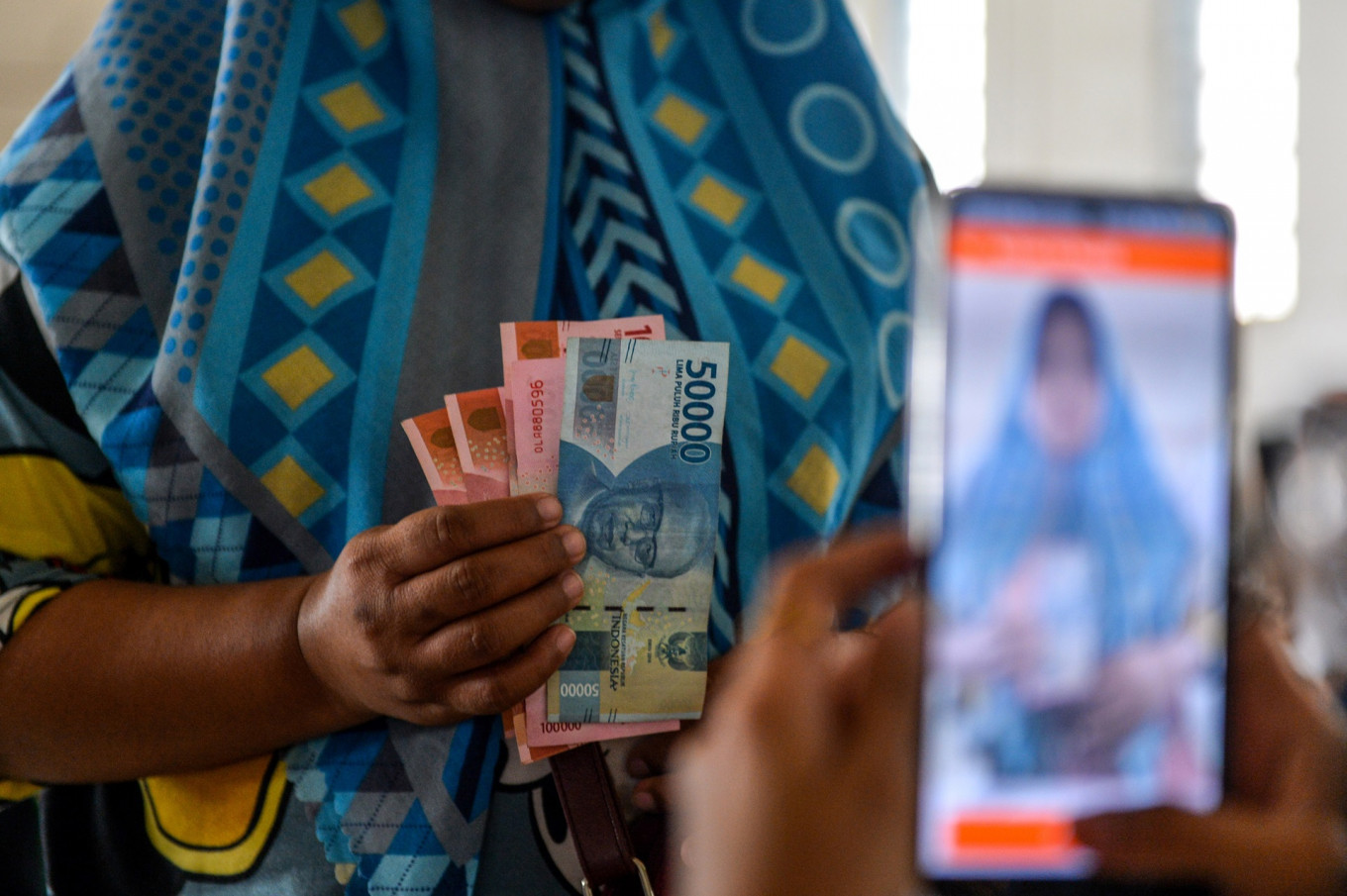 A social aid beneficiary holds up money she received though the Family Hope Program (PKH) on May 10, 2024, while posing for a photograph at the Bandung Central Post Office in West Java. (Antara/Raisan Al Farisi)
I
nequality and vulnerability remain persistent challenges in Indonesia. While the country has made notable progress in reducing poverty and improving human development outcomes, achieving truly inclusive development remains a work in progress.
Social protection plays a central role in this agenda, with Rp 508.2 trillion (US$29 billion) allocated in 2026 to support initiatives such as the Family Hope Program (PKH), Noncash Food Assistance (BPNT), National Health Insurance Premium Assistance Beneficiaries (PBI-JKN) and energy subsidies targeting the poorest 40 percent, according to Finance Ministry data.
Yet despite its massive scale, delivery remains plagued by structural inefficiencies. Recent findings highlight significant mistargeting with around 1.9 million ineligible families receiving benefits, resulting in potential fiscal losses of up to Rp 17.9 trillion annually. The core issue, therefore, is not the level of spending but the effectiveness of system design and delivery.
The World Bank’s digital public infrastructure (DPI) framework starts from the premise that effective service delivery relies on strong foundational systems: digital identity, interoperable data exchange and digital payments. When implemented in social protection, DPI serves as the backbone where digital identity enables accurate beneficiary verification, interoperable data exchange allows cross-agency eligibility validation in real time and digital payments ensure that benefits are delivered faster, more transparently and with greater traceability.
This transforms social protection from manual, fragmented processes into an end-to-end system where citizens can register once, are verified digitally and receive benefits with minimal administrative friction.
However, gaps in data quality, fragmented governance, limited interoperability and uneven local capacity continue to constrain performance. The ultimate impact of DPI depends not only on system adoption but also on how effectively these components work together to improve targeting, efficiency and outcomes at scale.

Evidence from Banyuwangi, East Java, makes this challenge tangible. Through the Social Protection Portal developed by the Digital Transformation Acceleration Committee (KPTD), efforts to strengthen DPI are already reducing fragmentation and improving delivery.