The Jakarta Post
Please Update your browser
Your browser is out of date, and may not be compatible with our website. A list of the most popular web browsers can be found below.
Just click on the icons to get to the download page.


Popular Reads
Top Results
No results found. Please check your search term and try again
Can't find what you're looking for?
View all search results
Popular Reads
Top Results
No results found. Please check your search term and try again
Can't find what you're looking for?
View all search resultsDeterring talent
Young Indonesian diaspora now question whether returning home to serve in public institutions is worth the risk if ambitious reforms can later be reframed as criminal acts.
Change text size
Gift Premium Articles
to Anyone
Share the best of The Jakarta Post with friends, family, or colleagues. As a subscriber, you can gift 3 to 5 articles each month that anyone can read—no subscription needed!
 Set as preferred source
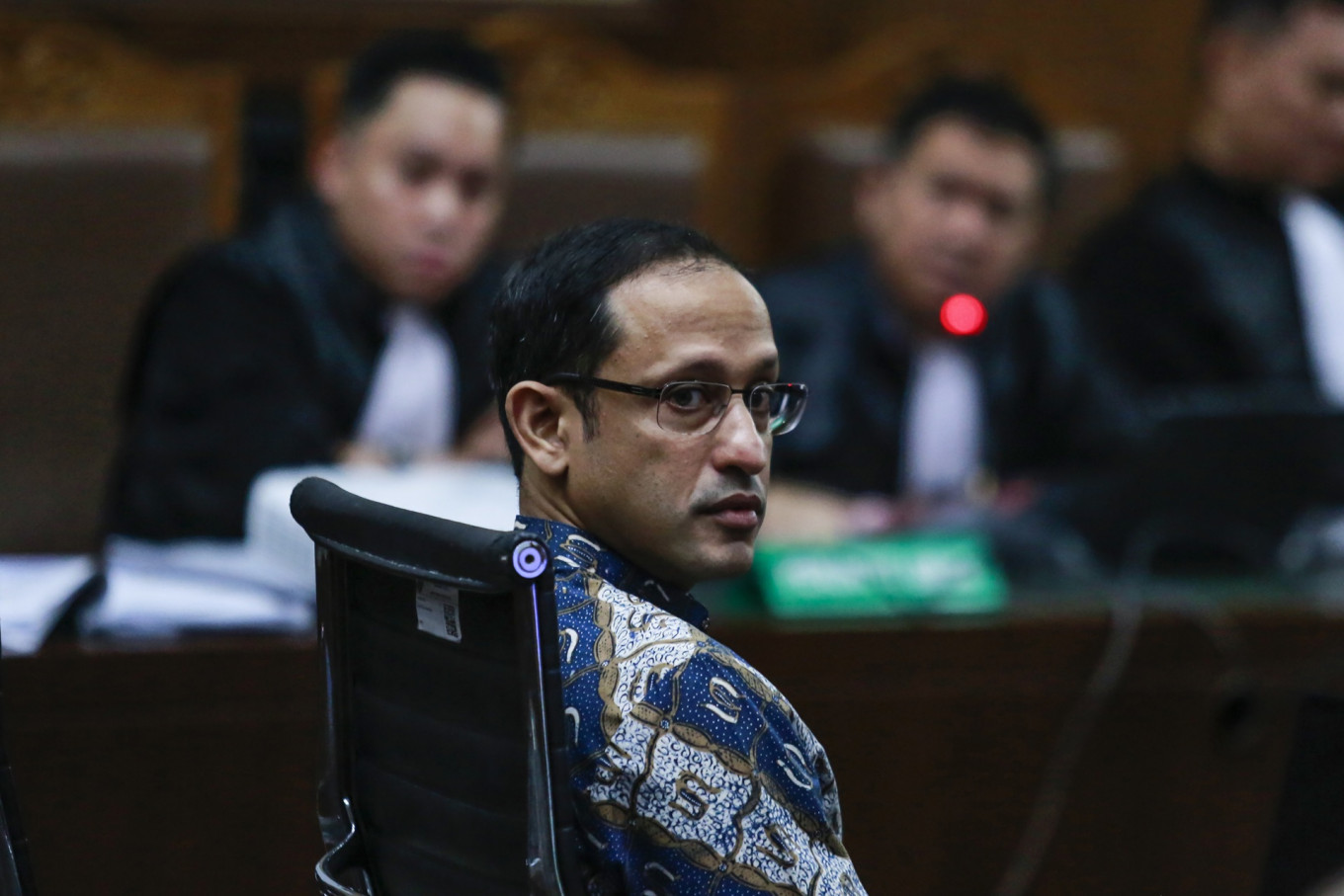 Former education minister and graft defendant Nadiem Makarim looks at the camera during a hearing on May 11 at the Jakarta Corruption Court. (Antara/Asprilla Dwi Adha)
I
ndonesia has long grappled with the brain drain phenomenon, as growing numbers of bright young Indonesians pursue education and careers abroad, taking with them the talent needed to drive the country’s progress.
Yet rather than strengthening incentives for them to return, Indonesia has been sending the opposite messages, with the latest one being the seemingly forced prosecution of former education minister Nadiem Makarim, as many observers have suggested.
Once hailed as a symbol of Indonesia’s technological ambition, the criminalization of Nadiem Makarim over policies aimed at advancing education in underserved regions through digitalization has deepened fears among Indonesians overseas that returning home to serve in government or drive innovation could come with significant personal and legal risks
Nadiem, 41, was not a career politician. He founded Gojek, one of the country’s most successful homegrown technology companies, which transformed urban mobility while creating economic opportunities for millions through ride-hailing, food delivery and logistics services.
After being appointed in 2019 by then-president Joko “Jokowi” Widodo as education minister, the Harvard Business School graduate introduced the Merdeka Belajar (Freedom to Learn) curriculum, which many educators viewed as a breakthrough for promoting more flexible learning, focusing on essential competencies and encouraging character development instead of rote memorization.
His ministry also scrapped the long-criticized national exams (UN), which imposed uniform standardized testing despite stark educational disparities across the archipelago, and replaced them with the National Assessment (AN), which measures literacy and numeracy competencies through sampling rather than high-stakes testing.

The ministry further accelerated school digitalization through the Merdeka Mengajar platform, allowing teachers to independently access training materials and share innovative teaching practices. Another initiative involved procuring Chromebook laptops for schools in remote and underdeveloped regions to support digital learning, a policy that has now become the basis of the criminal case against him.