TheJakartaPost
Please Update your browser
Your browser is out of date, and may not be compatible with our website. A list of the most popular web browsers can be found below.
Just click on the icons to get to the download page.


Popular Reads
Top Results
No results found. Please check your search term and try again
Can't find what you're looking for?
View all search results
Popular Reads
Top Results
No results found. Please check your search term and try again
Can't find what you're looking for?
View all search resultsWhy presidential banter fuels public anxiety
The humor, sarcasm and barbed language utilized on stage represent a deliberate cultural attempt to construct a new form of state-approved common sense.
Change text size
Gift Premium Articles
to Anyone
Share the best of The Jakarta Post with friends, family, or colleagues. As a subscriber, you can gift 3 to 5 articles each month that anyone can read—no subscription needed!
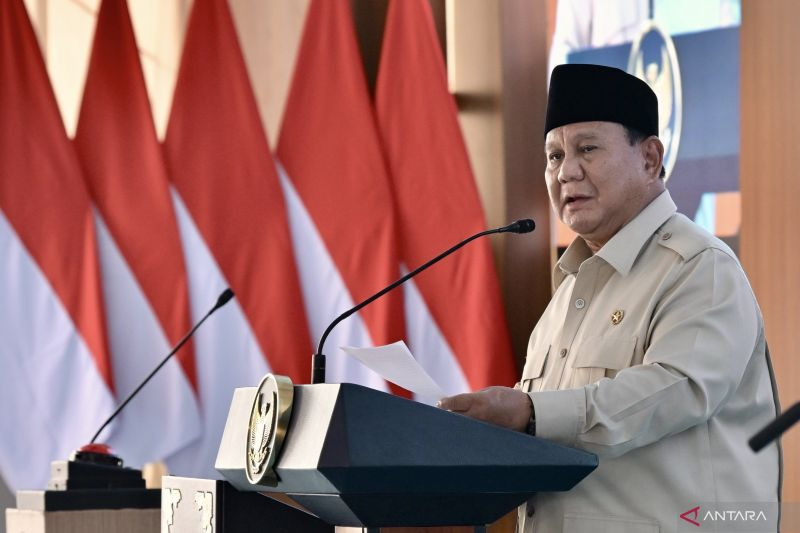 President Prabowo Subianto delivers a speech to mark the launch of a rural cooperative under the Red and White Cooperatives program in Nganjuk regency, East Java, on May 16, 2026. (Antara/Presidential Secretariat)
F
rom a casual dismissal of the United States dollar to sharp remarks regarding Yemen, political commentators and alleged foreign lackeys, the linguistic choices of President Prabowo Subianto have increasingly captured the absolute center of public attention. His specific lexicon has unleashed a torrential downpour of relentless, wide-ranging and unyielding criticism across the national landscape.
Crucially, when one carefully deconstructs the structural anatomy of these speeches, it becomes evident that these polarizing remarks do not represent the foundational substance of the administration's policy goals. Instead, they operate merely as stylistic flourishes: tangential footnotes, marginal digressions or humorous banter interspersed throughout rigid state addresses.
Evaluated strictly through the lens of political entertainment, these jokes can hardly be classified as failures. The immediate environments in which they are delivered, usually formal assembly halls, frequently erupt into genuine laughter from the live audience. Within that localized space, such laughter functions as a mechanism of social validation, signaling an immediate, albeit temporary, acceptance of his rhetoric.
However, the theater of politics is never confined to the safety of an auditorium stage. Beyond those walls, socio-economic reality speaks a much more severe and uncompromising language.
The President's lighthearted claim that "rural villagers have no practical use for US dollars" immediately provoked fierce opposition. The citizenry swiftly dismantled this narrative using cold, structural economic principles. They argued that while an Indonesian farmer may never physically carry US currency, the macroeconomy ensures that any upward spike in the US dollar exchange rate immediately inflates the cost of imported chemical fertilizers, vital agricultural machinery parts, fuel and daily household staples.
This public pushback was rapidly translated into striking, highly shareable digital infographics across social media platforms, serving as clear empirical evidence that the public viewed the executive rhetoric as deeply flawed.

A nearly identical pattern of immediate public pushback occurred when other controversial statements were made. The moment a casual jab about Yemen was delivered, the collective public consciousness refused to remain passive. The Indonesian digital sphere was instantaneously saturated with historical texts re-establishing Yemen as a profoundly revered and blessed territory. Netizens aggressively reminded the nation of its historical debt to Yemeni scholars, whose ancient migrations brought a peaceful, enduring wave of Islamization to the archipelago.